Get Full Government Meeting Transcripts, Videos, & Alerts Forever!
Get email alerts on the Enterprise Development topic
No spam. Unsubscribe anytime.
Miami-Dade school board reviews data-driven 'educational enterprise' framework to prioritize district land and facilities
Summary
Board members heard staff and consultants outline a new enterprise asset-development framework and a 16-page dashboard and scoring model meant to evaluate 28 district-owned projects; members pressed for more transparency, a full list of projects and clarity on how the ABC (attendance boundary) process and safety factors interact with redevelopment plans.
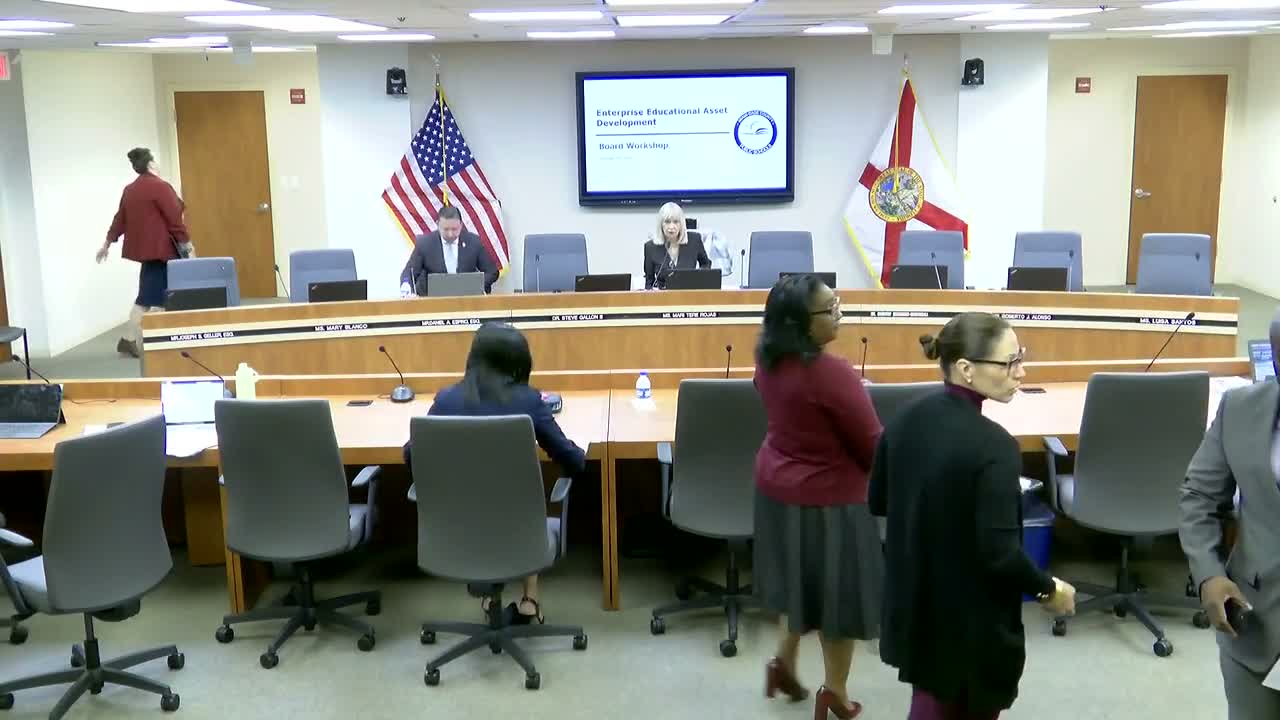
Miami-Dade County Public Schools staff and outside consultants presented an "educational enterprise" asset-development framework at a board workshop on Oct. 28, 2025, describing a data-driven dashboard and scoring model intended to guide decisions about district-owned real estate, program placement and potential redevelopment.
The workshop featured a multi-department steering team and outside advisers, who explained how internal data (academics, seat utilization, finance, facility condition) and external market factors (market value, rezoning feasibility, developer interest and neighborhood economic benefit) are combined into a scoring process. Tiffany Pauline and Dr. Verena Cabrera walked the board through a 16-page dashboard and an eight-variable score formula, with four equally weighted buckets (academics, utilization, finance and facilities) to normalize and rank schools for potential re-envisioning.
"These core principles define how we manage and plan for every district-owned asset," Tiffany Pauline said, describing the framework's goals of preserving educational benefit, ensuring policy and legal compliance, and promoting transparency and long-term financial stability.
Consultants from the district's external team (identified in the presentation as Ursa Young; a presenter addressed as Mr. Edwards) described an external redevelopment scoring overlay that places the greatest weight on market value while also quantifying rezoning feasibility, execution risk and neighborhood benefit. The consultants ran two anonymized case studies: one scored as moderate potential (development score 77) and another as high potential, with comparables above $5,000,000 called out as a short-term market threshold.
Raul Perez, representing facilities, told the board the steering team has identified 28 projects across Miami-Dade County and highlighted 10 for summary review, naming sites that include Chatelain Elementary, Biscayne Gardens Elementary, a former transportation plant (potential land exchange with Miami-Dade County), Arthur & Polly Mays Conservatory of the Arts, Hialeah Senior High and a transit-oriented redevelopment at the J.R.E. Lee Educational Center. Perez said solicitations (invitations to negotiate) are being prepared or are under negotiation and that final negotiated agreements would be brought to the board for approval.
Board members used the Q&A to press staff on process and safeguards. Board member Dan Espino and others warned that the enterprise work must not inadvertently short-circuit the ABC (attendance boundary committee) process or exclude programmatic considerations. Several members requested a full list of the 28 projects, earlier promised written responses to a September request, and more detail on how indices such as school-climate surveys and achievement are converted into the scoring formula.
"We could set the cutoff at 0.8 or 0.5; the 0.7 sample was a way to run the model," Dr. Verena Cabrera said, noting the 0.7 threshold shown was illustrative and not a binding pass/fail rule.
Several members raised equity and procedural concerns: whether municipalities with Community Redevelopment Agencies (CRAs) would receive implicit scoring preference (staff said no preferential treatment is baked into the model), how partial uses or co-location with private providers would be evaluated, and how dependency on outside subsidy pools (federal, state or county funds) would affect developer scoring and project viability.
Board members also flagged fiscal context. Facilities office staff cited a deferred-maintenance backlog figure of about $3 billion and board members referenced a longer-term 10-year trend that could raise needs to roughly $8 billion; members asked staff to quantify how revenue from redevelopment projects might help close those gaps.
The board also handled one procedural vote during the workshop. The chair moved to allow a board member identified in the transcript as seeking to participate virtually (doctor Bendross/Mendengall, as described on the record). The board voted orally in favor; staff agreed to follow up to arrange phone or video participation and to brief the member on options.
Superintendent Jose Aldotris and staff emphasized that the enterprise framework is intended to support educational priorities rather than supplant them and pledged individual briefings for board members to review sites and metrics in detail before any naming or formal actions. Staff said additional data points and the full list of 28 projects would be provided to the board.
What happens next: staff will continue one-on-one briefings with board members, complete the promised written responses to the board’s earlier requests, finalize solicitations (ITNs) for specific sites where appropriate and return negotiated agreements to the full board for formal approval. The steering team also said it will provide monthly written updates to the board beyond the quarterly requirement to support transparency and oversight.