Get Full Government Meeting Transcripts, Videos, & Alerts Forever!
Get email alerts on the School Nutrition topic
No spam. Unsubscribe anytime.
Miami‑Dade outlines 'Food for the Future' framework, unveils composting and scratch‑cooking pilots
Summary
District leaders presented the 'Food for the Future' framework at an Oct. 29 workshop, detailing daily meal volumes, a $157,000 dishwasher pilot at Palmetto Middle School, a USDA‑funded composting trial at seven schools and commitments to cleaner, scratch‑cooked menu items and local sourcing.
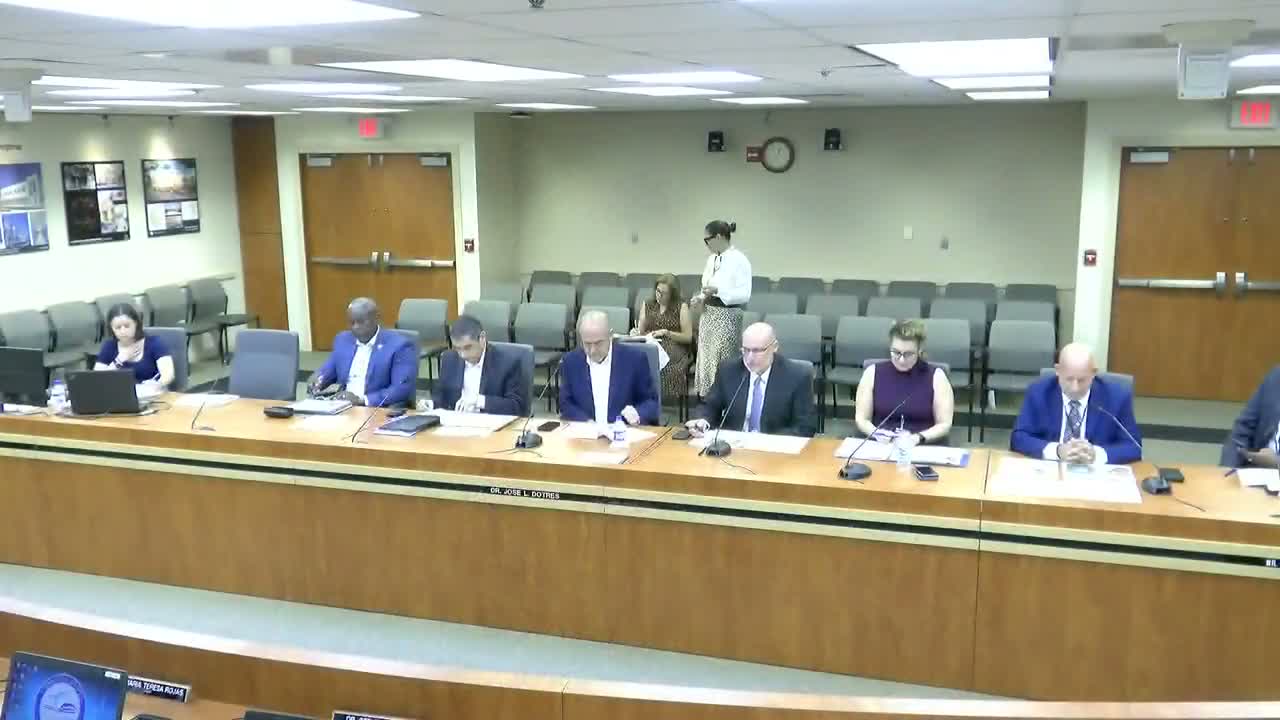
At an Oct. 29 school board workshop, Miami‑Dade County Public Schools staff presented a new Food for the Future policy framework that aims to expand scratch cooking, increase local sourcing and cut meal‑related waste across the district.
Luis Diaz, who staff introduced as leading the presentation, said the district serves a mass scale of meals: “152,000 meals, student lunches on a daily basis are provided by Miami Dade County Public Schools,” and noted the district’s annual nutrition budget is roughly $230,000,000 and is largely supported by federally reimbursable meals.
Why it matters: the district is one of the region’s largest meal programs; changes to menus, procurement and waste handling could affect tens of thousands of students, food‑service jobs and local farmers.
Staff described several pilots and operational changes. Assistant Superintendent Alexis Martinez outlined a USDA‑funded composting and diversion pilot that selected seven schools from roughly 70 applicants and will run for 180 days. Martinez said the vendor estimates the seven sites will generate about 186,597 pounds of organic material and return approximately 20 cubic yards of compost for teaching gardens and food forests.
Angie Casalakis, the district’s food and nutrition officer, reviewed nutritional standards and the district’s voluntary “clean‑label” commitments. “We have removed artificial food dyes from all of our products in our school meals,” Casalakis said, and staff described efforts to phase out high‑fructose corn syrup, avoid partially hydrogenated oils and expand whole‑grain and plant‑based options.
The district also discussed a targeted equipment pilot. Staff described a feasibility study to add a dishwasher at Palmetto Middle School during a planned kitchen renovation, estimating the site‑specific dishwasher cost at about $157,000. Officials said feasibility depends on space, electrical and drainage infrastructure and the presence of a hood suppression system.
Other waste‑reduction measures include expanding the district’s share‑table program (now at 104 schools), an offer‑versus‑serve approach in an after‑school meal pilot (34 schools), menu forecasting and first‑in, first‑out inventory practices to cut spoilage. Staff said professional development for cafeteria managers supports forecasting and participation tracking.
The presentation highlighted farm‑to‑school work and local sourcing. Elena Pernas, an executive director in the food and nutrition department, noted a partnership with R.C. Haddon Farms to provide seasonal corn and green beans, while staff said vendors responding to an upcoming solicitation will report daily on locally grown produce delivered.
Staff also proposed a student‑centered feedback loop: a Student Nutrition Ambassadors program and an annual district food show. The first large food show drew more than 500 student participants who taste‑tested more than 50 potential menu items; staff said the show will be expanded next year.
To track performance, the district plans a dashboard reporting student health metrics, meal counts, participation trends and share‑table impact. Staff set a provisional initial push to assemble baseline data in January 2026, with adjustments expected after stakeholder review.
Board members praised the initiatives and pressed staff for details: questions included the current federal reimbursable lunch rate (staff cited $4.62 per reimbursable lunch), how many schools have salad bars (no exact count provided; typically at senior high level), and whether bulk milk or water dispensers might further reduce packaging waste. Staff said they are researching proportioned bulk dispensers and evaluating suppliers.
What’s next: staff will continue the pilots, finalize solicitation reporting requirements, post nonprofit contracting information for share‑table donations and bring updated dashboard data and CEP eligibility recommendations back to the board after the ongoing technical and policy reviews. There were no motions or votes on the item at the workshop.
Sources: presentation and Q&A at the Oct. 29, 2025 Miami‑Dade County Public Schools board workshop.