Get Full Government Meeting Transcripts, Videos, & Alerts Forever!
Get email alerts on the Deep Sea Mining topic
No spam. Unsubscribe anytime.
Sponsor Mosse and community witnesses urge passage of Bill 253‑38 to ban deep‑sea mining in Guam waters
Summary
At a General Government Operations and Appropriations hearing, sponsor Mosse and multiple witnesses, including a University of Guam student group, urged support for Bill 253‑38 to prohibit seabed mining in Guam waters, citing insufficient baseline science, a lack of transparency about impacts, and concerns about erosion of NEPA protections. No formal vote was recorded.
At a hearing of the General Government Operations and Appropriations committee, sponsor Mosse and supporters urged passage of Bill 253‑38 to prohibit seabed (deep‑sea) mining in Guam waters, saying existing scientific data are insufficient to assess long‑term ecological harm and that federal review processes are moving too quickly.
The bill’s sponsor, Mosse, closed the hearing by recalling a prior, unanimous local resolution opposing proposed activities in the MIT (training/testing) area and saying community concern has grown because the threat now feels proximate rather than distant. "To it's amazing to see… a tenfold increase in what they are proposing to do in the area," Mosse said, framing the scale of proposed activities as central to the risk calculus.
Why it matters: Witnesses argued that decisions to permit seabed extraction or expanded military training have consequences for fisheries, marine mammals and local livelihoods, and that Guam’s principal avenues for federal engagement—public comment periods under the National Environmental Policy Act (NEPA)—are particularly important for the territory because residents lack a voting member in Congress. "If that process is under attack, we are in serious jeopardy," a community witness said, urging committee support.
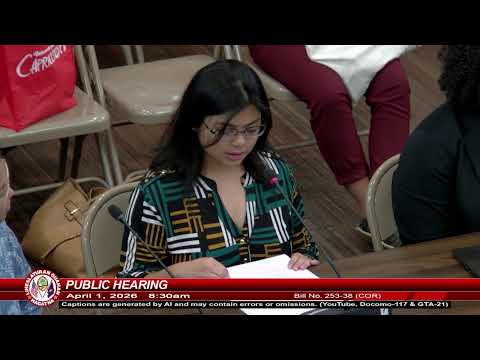
University of Guam student Bryn Leon Guerrero, representing the Social Work Student Alliance, testified in support of Bill 253‑38 and described what she called a lack of meaningful public input and insufficient long‑term studies on environmental, ecological and economic impacts. "Deep sea mining has the potential to cause irreversible damage to the oceanic environment through pollution, disturbance of marine organisms, and a lack of safety protocols and guidelines," Guerrero said, adding that island nations with prior mining experience have suffered large debts and long‑term harms.
Panels and agency officials discussed the available science. An agency official said NOAA’s Pacific Islands regional office (National Marine Fisheries Service) completed a draft biological opinion for the CNMI EEZ for BOEM in an unusually short timeframe and that the draft is not yet releasable; committee members expressed concern about how a rapid biological opinion will be integrated into an environmental impact statement. Several speakers noted NOAA reports and urged consultation with local biologists, including Brent Tibbetts, for baseline data on marine mammals.
Community speakers also raised specific operational concerns. Cesar Smasi warned of what he described as a tenfold increase in air activities, explosions and sonar in the MIT area and said available reporting does not make clear the number of animals likely to be harmed or displaced (commonly characterized as "take"). He said a lack of baseline data for deep‑sea species makes it impossible to fully assess environmental impacts.
The committee did not record a formal vote during the hearing. Testimony concluded with supporters urging the committee to preserve NEPA comment processes, gather fuller baseline science and advance the protective measure. The bill remains at the committee stage with additional information requested by lawmakers and staff.
What to watch next: Committee staff signaled intentions to collect referenced NOAA reports and to seek more detailed baseline information; no procedural vote or scheduling decision was announced at the hearing’s close.