Get Full Government Meeting Transcripts, Videos, & Alerts Forever!
Get email alerts on the Enrollment And Asset Management topic
No spam. Unsubscribe anytime.
Miami‑Dade officials outline plan to cut surplus seats, focus funding on school quality
Summary
District staff presented diagnostic findings showing declining school‑age population and surplus seat capacity, and proposed a guiding policy to 'break the cycle' by reducing and re‑envisioning underused facilities while prioritizing initiatives that improve school quality and systems efficiency.
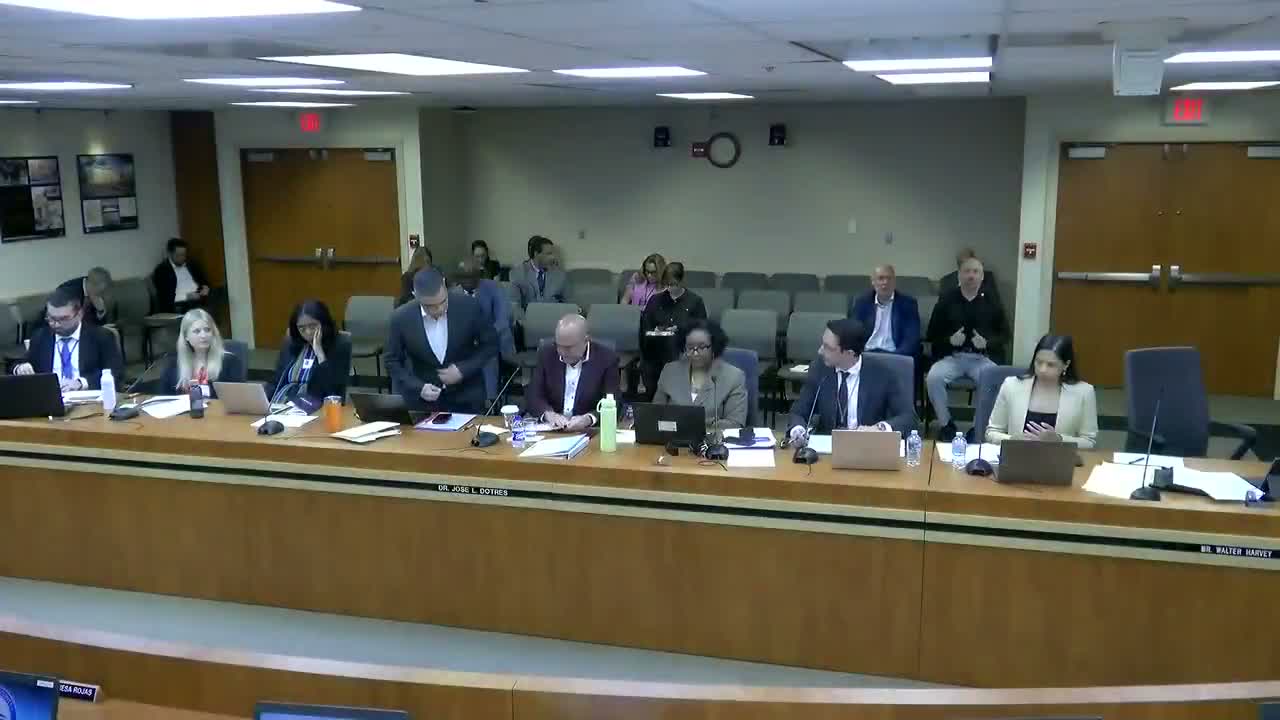
Miami‑Dade County Public Schools staff told the board on Feb. 17, 2026, that demographic trends and market dynamics are creating surplus seat capacity and rising per‑student fixed costs. Alex Ramirez of the Office of Strategic Planning said the diagnostic drew on stakeholder surveys and forecasting models showing a continuing decline in school‑age population and that the district must respond with both asset management and quality improvements.
Ramirez framed the problem as twofold: a structural decline in school‑age children driven by lower birth rates and migration, and a loss of families to competitor providers (charter, private or other options). He summarized the proposed managerial response: reduce or re‑envision surplus space, concentrate students and programs into a right‑sized set of high‑demand schools, and use savings to protect and grow classroom investment.
Ramirez asked two filter questions for future initiatives: will the proposal reduce surplus seat capacity, and will it improve school quality or systems optimization? If the answer to both is yes, the initiative would be a primary strategic priority; if only one, it would be secondary; if neither, it would not be a strategic priority.
The board’s discussion emphasized speed, policy alignment and relationships. Several members urged faster execution and changes to board procedures (the ABC process) and recommended strengthening school‑level community relationships as a competitive advantage. Dr. Gallon and others highlighted the importance of “professionalism, performance and relationships” at the school front line — including the principal’s role and the first impression families receive at a school office.
Board members also raised practical facility concerns (curb appeal, deferred maintenance) and succession planning for long‑serving principals in communities where relationships with leaders drive enrollment. Staff said the district will develop an enterprise asset strategy and operational reforms and return with more concrete measures and options for board consideration.
No formal motions or votes were taken at the workshop. Staff said the next steps are to translate these guiding priorities into measurable objectives and to present a comprehensive strategic plan for board review in late spring.