Get Full Government Meeting Transcripts, Videos, & Alerts Forever!
Get email alerts on the Schools Of Hope topic
No spam. Unsubscribe anytime.
Community voices oppose Schools of Hope colocation and urge board to defend local control
Summary
Parents, teachers and advocacy groups at the Miami-Dade school board meeting urged the board to resist Florida's Schools of Hope co-location notices, saying the policy risks displacing programs, stretching district resources and weakening locally elected authority. Speakers requested public statements, town halls and formal board action.
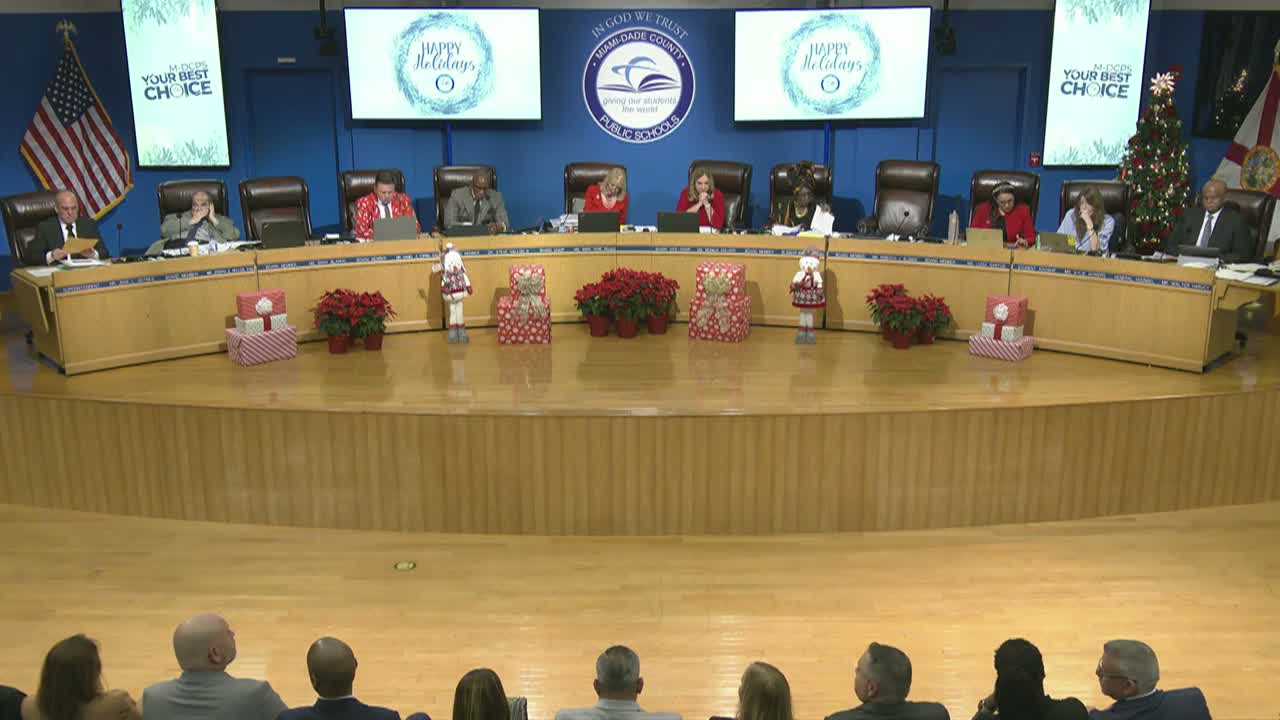
At a packed public hearing during the Miami-Dade County School Board's Dec. 17 meeting, dozens of parents, students, teachers and union leaders urged the board to push back against Florida's Schools of Hope colocation provisions and to defend local control over school facilities.
The morning and afternoon sessions opened with the board's procedural items; the substantive public debate about Schools of Hope began when speakers addressed item H4 and continued through the public hearing. Antonio White, president of United Teachers of Dade, said state-driven colocations "threaten pre-K, workforce programs and pile unfunded costs of custodial work, maintenance and food service onto this district." White added that colocations "fracture campuses, dilute services, and weaken this board's ability to protect public assets for the public good." (Antonio White)
Danielle Boyer, first vice president of United Teachers of Dade, told the board that "our classrooms are not businesses" and said districts should focus on strengthening the public programs and choices already offered by Miami-Dade County Public Schools rather than diverting resources. She and several other speakers pressed the board to use its platform in Tallahassee and the community to seek legislative changes and additional protections.
Speakers raised operational and safety concerns. Mindy Grimes Festige, secretary-treasurer of United Teachers of Dade, said colocations "blur" responsibility for campus access and emergency procedures and raised questions about background checks, supervision and traffic flow if two separate operators share a campus.
Students and community organizers described the possible local effects. A student from Miami Jackson said co-location would further strain already limited space and resources at neighborhood schools; other speakers said colocation notices had arrived for multiple Miami-Dade campuses in recent days and asked for town halls and clear communications to affected families.
Several speakers also raised governance and potential conflicts of interest after recent news that Miami-Dade College will act as an authorizer for some charter schools. Community members asked the board to clarify what authority remains with locally elected board members and to press for transparency where trustees serve on multiple governing bodies.
Board members responded in part: several said the changes being discussed originated in state statute enacted in prior years and that the board retains statutory oversight of charter agreements, but multiple trustees acknowledged community concern and supported presenting a legislative platform and seeking amendments to protect district assets and operations.
The public requested immediate actions: publicly affirming local authority, hosting town halls in affected neighborhoods, preparing financial and operational analyses, and pursuing legislative amendments or litigation as needed. The board did not take a final, binding vote on school land policy at the meeting; the public hearing closed after a regularly scheduled 90-minute period and additional speakers were allowed by motion.
Next steps identified in testimony and board comments included drafting a resolution or legislative request for the board's legislative platform, committing to community outreach and publishing clearer district data on which schools and programs would be affected by colocation notices. The board said it would continue to examine the legal and policy options available to it.