Get Full Government Meeting Transcripts, Videos, & Alerts Forever!
Get email alerts on the School Finance topic
No spam. Unsubscribe anytime.
Jim Hamilton: state funding shifts and voucher growth have squeezed Santa Rosa’s discretionary school dollars
Summary
Independent consultant Jim Hamilton told the Santa Rosa County School Board that recent changes to the Florida Education Finance Program and rising scholarship (voucher) enrollment have rolled previously categorical funds into the base, reducing the district’s discretionary revenue and leaving little room for new recurring expenses.
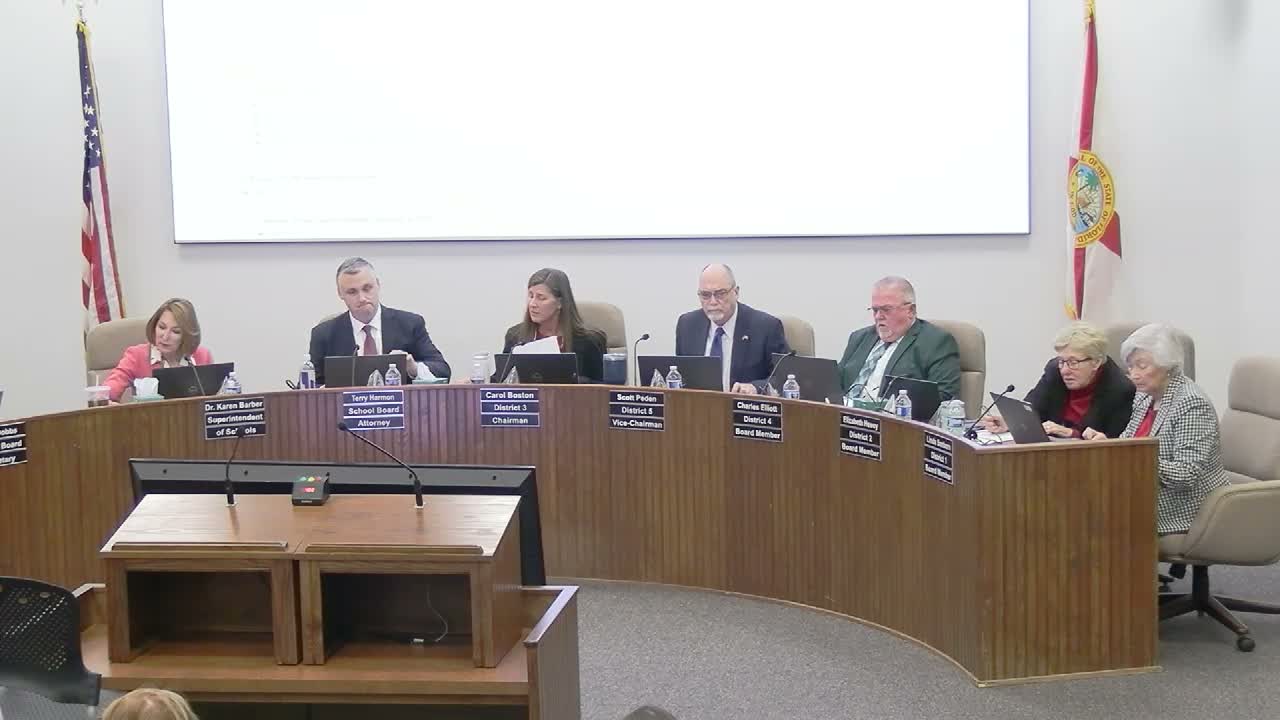
Jim Hamilton, a consultant who has worked in Florida school finance for decades, told the Santa Rosa County School Board on Feb. 3 that recent state funding changes and faster growth in scholarship (voucher) enrollments have sharply reduced the district’s discretionary operating dollars.
Hamilton said roughly 92% of operating revenue for districts like Santa Rosa flows through the Florida Education Finance Program (FEFP), and that three state-level changes over recent years have eroded locally available funds: several categorical line items were rolled into the FEFP base; a state-funded discretionary supplement was added to offset local differences; and some weighted/add-on FTE calculations were modified. He told the board those moves made the district appear to have larger increases in public releases and press materials even when much of the added funding merely flowed through in different accounting categories.
That restructuring, combined with an increase in scholarship (voucher) payments, has meant Santa Rosa received substantial nominal increases in its FEFP allocation but was required to spend large portions of that increase on specific purposes or to offset scholarship outflows. Hamilton cited district figures showing that, after accounting for scholarship growth, categorical mandates and required salary allocations, the district’s net unencumbered revenue fell to nearly zero in the latest (third) FEFP calculation. "At the end of the calculation, you were net negative," he said, summarizing the math provided in the report.
Hamilton showed the board tables for 2023–24 through the current year and said that, in 2023–24, Santa Rosa received a large base increase that was primarily money previously appropriated as categorical funding. He added that the scholarship program’s rapid enrollment growth required the district to pay out state scholarship dollars that otherwise would have remained in the local allocation. Hamilton warned the board that many of the funding increases are restricted to specific uses (for example, funds tied to AP/IB weighted FTE, transportation, ESE) and cannot be repurposed to cover districtwide inflationary costs such as insurance or utilities.
Board members and Superintendent Karen Barber discussed local enrollment trends (the district is down about 0.7% this year), the district’s decision to maintain a 5% financial condition ratio, and strategies to retain teachers (the superintendent noted a 92% teacher retention rate year-to-year). Hamilton advised treating a 5% reserve as a floor and recommended the board defend that policy to protect the district against state intervention that can follow low reserves.
Hamilton also reviewed scenario work tied to the governor’s recommended budget and cautioned that longer-term projections show fiscal pressure to 2027–28. He recommended the board continue close monitoring of FEFP calculations and work with district finance staff to understand enrollment and scholarship trends.
The board did not take formal action on Hamilton’s recommendations during the meeting; the presentation concluded with a period for questions and follow-up from district finance staff.