Lifetime Citizen Portal Access — AI Briefings, Alerts & Unlimited Follows
Miami‑Dade board opens feasibility study on tying principal pay to enrollment amid strong concerns
Loading...
Summary
The Fiscal Accountability & Government Relations Committee asked the superintendent to study whether a school‑based leadership incentive tied to student recruitment and retention is possible. Several board members warned that linking pay to enrollment could unfairly penalize principals for factors beyond their control and risk widening inequities.
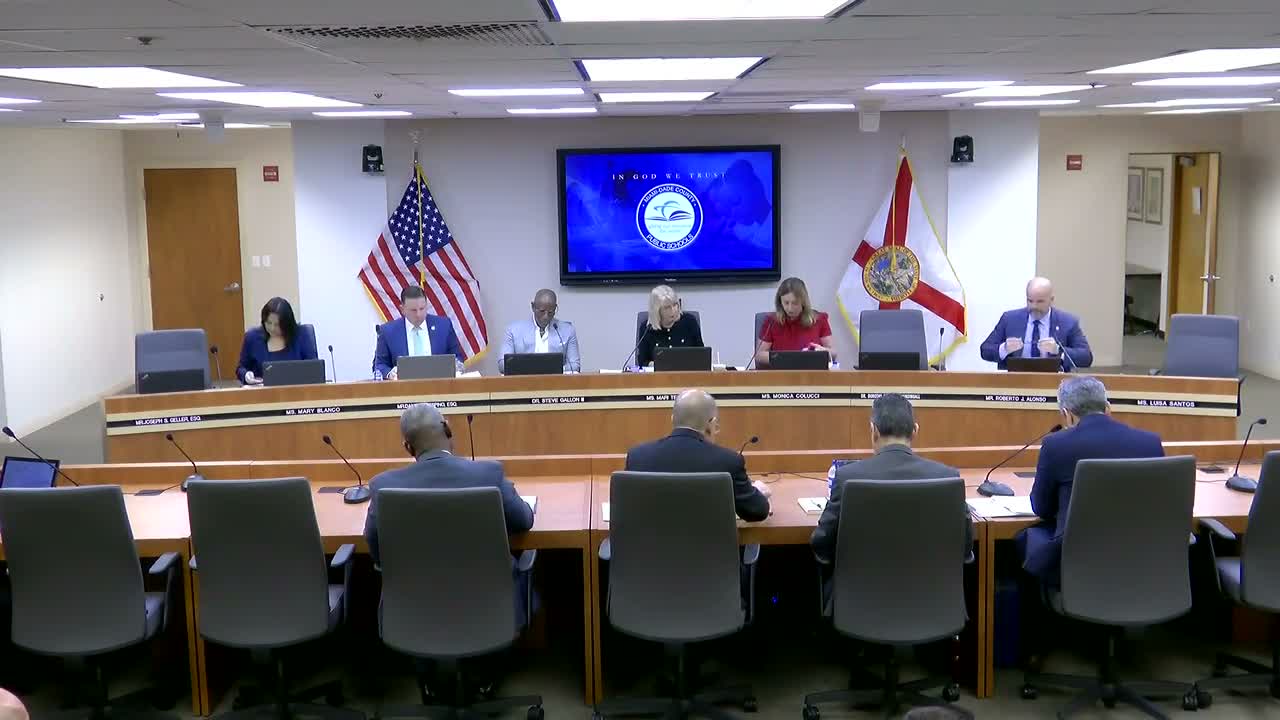
The Fiscal Accountability and Government Relations Committee asked the superintendent to produce a feasibility study on whether a school‑based leadership incentive tied to student recruitment and retention could be developed and what its fiscal implications would be. Committee Chair Roberto Alonzo presented the measure as an exploratory request, saying the analysis would help the board “understand what options may exist, what measurable indicators could be considered, and what the potential fiscal implications might be.”
Why it matters: Enrollment drives funding under the Florida Education Finance Program, and the district has seen shifting demographics and school‑choice pressures that affect staffing and facility planning. The study could shape future compensation decisions and influence how the district supports principals in recruitment and retention work.
Board members praised the intent but raised repeated cautions. Board member Danny Espino said he “welcome[s] any conversation that drives…recruitment and retention,” but warned that principals often lack the autonomy and resources to change underlying demographic trends. “Putting added pressure on principals…might give them an impossible task to perform,” Espino said, arguing that incentives could inadvertently force staff to act outside policies to meet enrollment goals.
Several former principals on the board made similar points. Doctor Steve Gallon asked whether denying increased compensation to some principals “through no fault of my own … would in essence be a penalty,” and urged the board to guard against creating unintended disparities. Vice Chair Colucci and other members recommended removing or substantially revising provisions that would tie direct pay supplements to school enrollment, noting principals’ role is statutorily instructional leadership and that many operational factors lie beyond a principal’s control.
Administration response: The superintendent and staff said they already include enrollment targets in goal‑setting for principal evaluations in some cases and emphasized the item as strictly a feasibility study. Staff described prior uses of stipends, demonstrated interest in non‑punitive incentives, and said electronic signature routing and other administrative changes could accelerate procurement and program rollout if the board proceeded.
Outcome and next steps: Chair Alonzo responded to board concerns by agreeing to strike the more controversial funding items (items 4 and 5 in the original draft) and to revise language to clarify the proposal is an exploratory feasibility analysis, not a compensation decision. The committee voted to transmit the amended item to the March 11 board meeting for further consideration. The superintendent was asked to include clear, measurable options and to flag potential equity impacts and legal constraints in the study.
What to watch for: The board will review the written feasibility study, including any proposed metrics and recommended guardrails to avoid penalizing principals for demographic or policy‑driven enrollment shifts. If the board chooses to consider direct pay adjustments later, it will need specific protections to avoid creating inequities across schools.
Ending note: For now, the board framed the request as a fact‑finding exercise. As Roberto Alonzo put it, the study is “simply a feasibility study” designed to help the board learn more before any policy change.