Get Full Government Meeting Transcripts, Videos, & Alerts Forever!
Get email alerts on the Student Meals topic
No spam. Unsubscribe anytime.
Broward board orders student payment obligations, asks staff to seek community funding to curb rising meal debt
Summary
After Food & Nutrition reported student meal debt rising above $300,000 and a projected $688,000 shortfall to sustain a no‑tray policy for the year, the board directed staff to implement obligations, accelerate outreach to enroll eligible families in meal benefits, and pursue community and municipal partners rather than asking the general fund to cover the full amount.
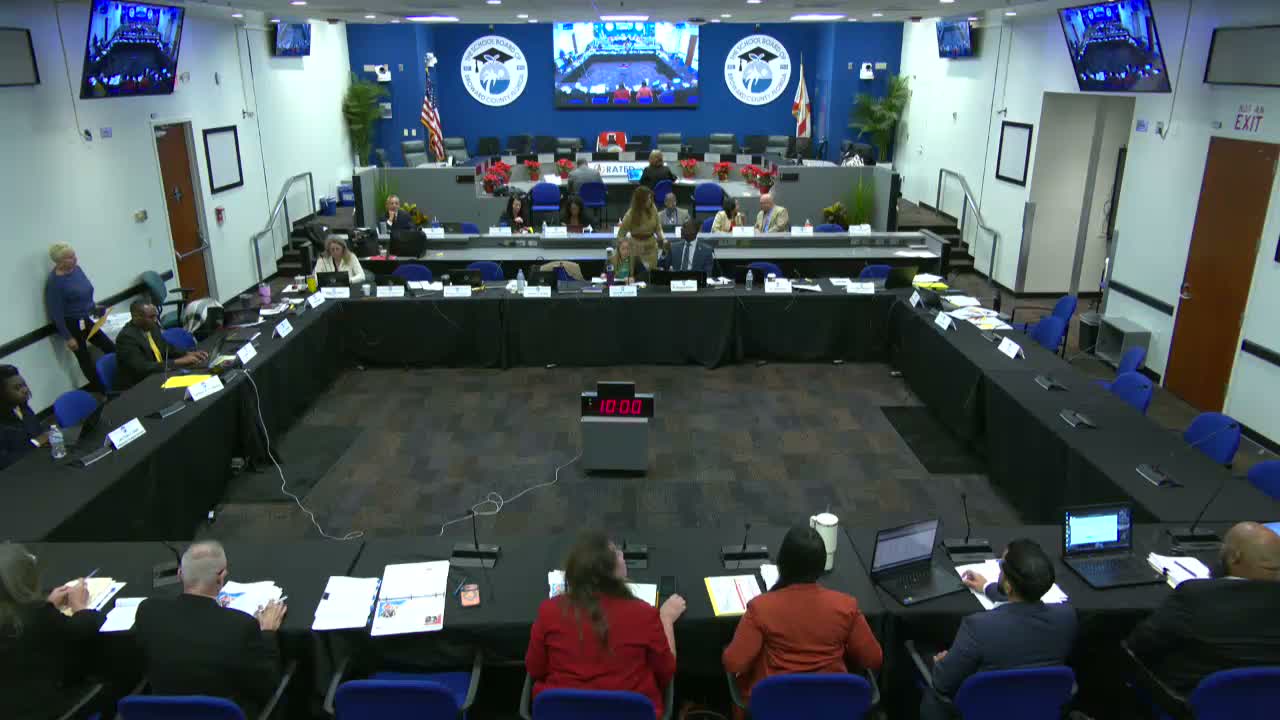
Facing a surge in unpaid cafeteria charges after pandemic‑era universal programs ended, Broward County School Board members on Dec. 10 directed staff to reintroduce student meal obligations and to pursue community and municipal funding to reduce outstanding student meal debt.
Food & Nutrition Services director Mary Mulder told the board that routine outreach and principal follow‑up have not stemmed a rapid increase in unpaid charges: staff reported the district’s outstanding meal debt rose during the meeting from roughly $252,000 to about $303,000 and that, under a conservative model projecting continued charge patterns, covering a no‑tray approach for the remainder of the year could cost roughly $688,000.
Mulder urged a combination of continued outreach for meal‑benefit applications, targeted fundraising and operational fixes. “We have principals reaching out with guidance counselors and social workers, but at times they are turned into collection agents,” Mulder said, describing principal concerns about collection responsibilities.
Parents and community members urged elimination of the debt and called for renewed universal programs or robust public/private partnerships. “This debt should not exist to begin with,” said Mariah Rabideau, a West Miramar parent and volunteer, during public comment, explaining that many eligible families had not completed applications and that the district should make eligibility identification automatic where possible.
After discussion, the board gave three clear directions: (1) restore or clarify student obligations going forward (effective immediately) so accounts are not allowed to continue unchecked; (2) ask the superintendent and staff to aggressively pursue municipal and philanthropic sources and strategic partnerships to offset outstanding balances rather than shifting the projected $688,000 entirely to the general fund; and (3) direct staff to return monthly with progress reports on collections, fundraising and enrollment in meal benefits. Board members also asked staff to explore operational measures — for example, limits on a la carte purchases or improved point‑of‑sale messaging — and to convene a short working group of principals, parents and cafeteria managers to test site‑level fixes.
Board members split on whether to replace hot‑meal courtesy policies with a lower‑cost substitute; some members favored returning to a pre‑COVID approach with clearly enforced obligations and limited points of credit, while others asked for a humane, operational approach that minimizes stigma for students.
Next steps: staff will implement obligations effective immediately (notifications and reporting to begin at the point of the first business day after the meeting), expand effort to enroll eligible families in meal benefits, convene a work group with principals and parents to test operational fixes, and report monthly to the board on the outstanding balance and fundraising progress.