Get Full Government Meeting Transcripts, Videos, & Alerts Forever!
Get email alerts on the Assessments topic
No spam. Unsubscribe anytime.
Parents, teachers and students tell Broward board assessments are too frequent; staff plans focus groups and clearer guidance
Summary
At a Feb. 17 workshop staff presented assessment calendars and survey results; teachers, students and parents told the board optional district benchmarks and computer‑based testing are overburdening K–5 students. District said it will run teacher focus groups, K–2 calibration work and a communication push to clarify required vs. optional assessments.
Broward County school officials and classroom teachers squared off over testing and instructional time at a Feb. 17 workshop that mixed staff analysis with dozens of public comments from parents, teachers and students.
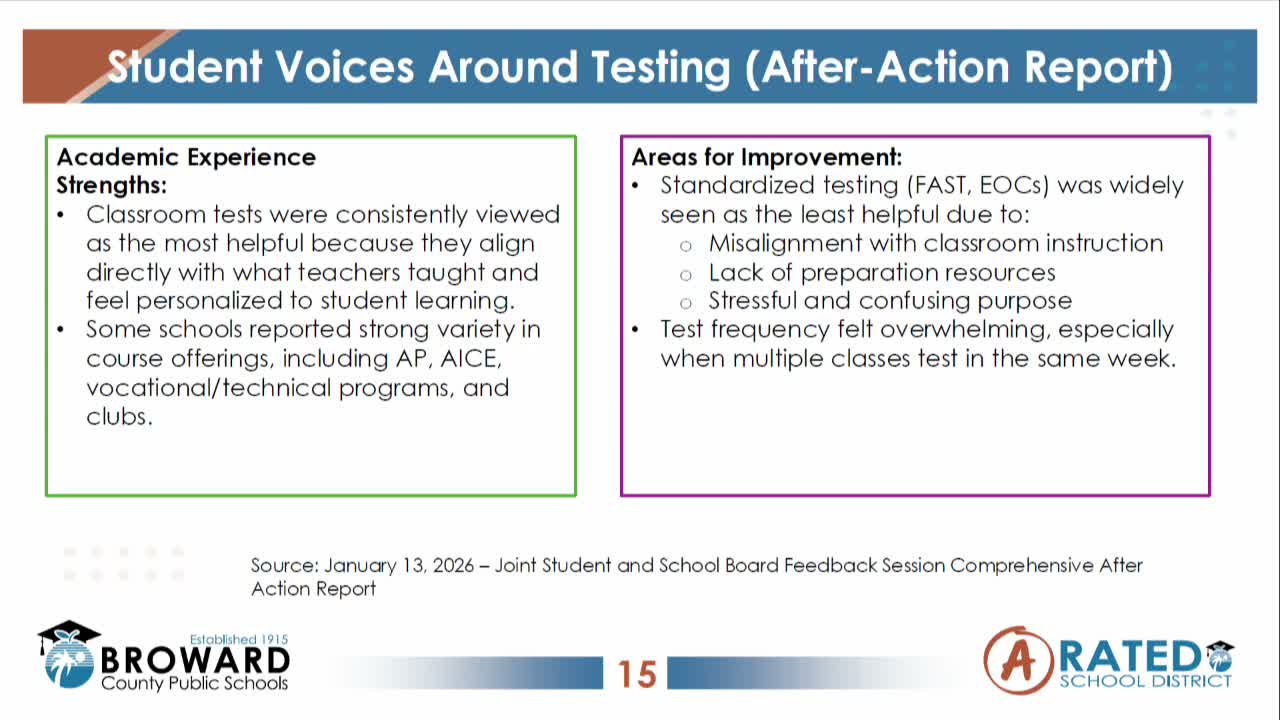
District academic staff outlined the difference between state‑required tests, district‑required measures, school‑discretion items and teacher‑discretion checks. Staff presented survey results from more than 1,600 teachers and over 100 principals showing many elementary teachers say students are overtested; principals most commonly asked for clearer guidance and training. Students and dozens of parents in public comment described heavy testing windows, multi‑day computer‑based diagnostics, platform glitches (notably Performance Matters and iReady reports), and stress and lost instructional time in K–5 classrooms.
Teachers and principals offered examples where computer‑based diagnostics can take days to finish and where platform usability and timing make assessments feel like a year‑round burden. Staff acknowledged the concerns and pointed to planned next steps: convene larger teacher focus groups, assemble a K–2 practitioner panel on computer‑based assessment practices, produce clearer communications to schools and families that distinguish state‑mandated vs. optional district tools, and work with the vendor to correct Performance Matters issues.
Board members asked staff to return with sharper, actionable options — for example, targeted reductions of optional district assessments in elementary grades, and scenario proposals documenting the pedagogical and measurement tradeoffs — rather than solely surveys and clarifications. Several board members requested quicker timelines and direct recommendations for tests that could be suspended or eliminated with minimal impact on accountability.
Next steps: district to hold deeper teacher focus groups, K–2 calibration sessions, and outreach to parents (parent university and targeted communications); staff will report back with concrete options and evidence on whether and how particular district assessments could be reduced without jeopardizing state reporting or early‑warning systems.