Get Full Government Meeting Transcripts, Videos, & Alerts Forever!
Get email alerts on the Pardon Power topic
No spam. Unsubscribe anytime.
Panel of judges, scholars debate judicial independence, pardons and public engagement
Summary
A panel of former judges and legal scholars at the University of Washington debated how to defend judicial independence, whether preemptive pardons should be constrained, and how the legal profession and media can better inform the public.
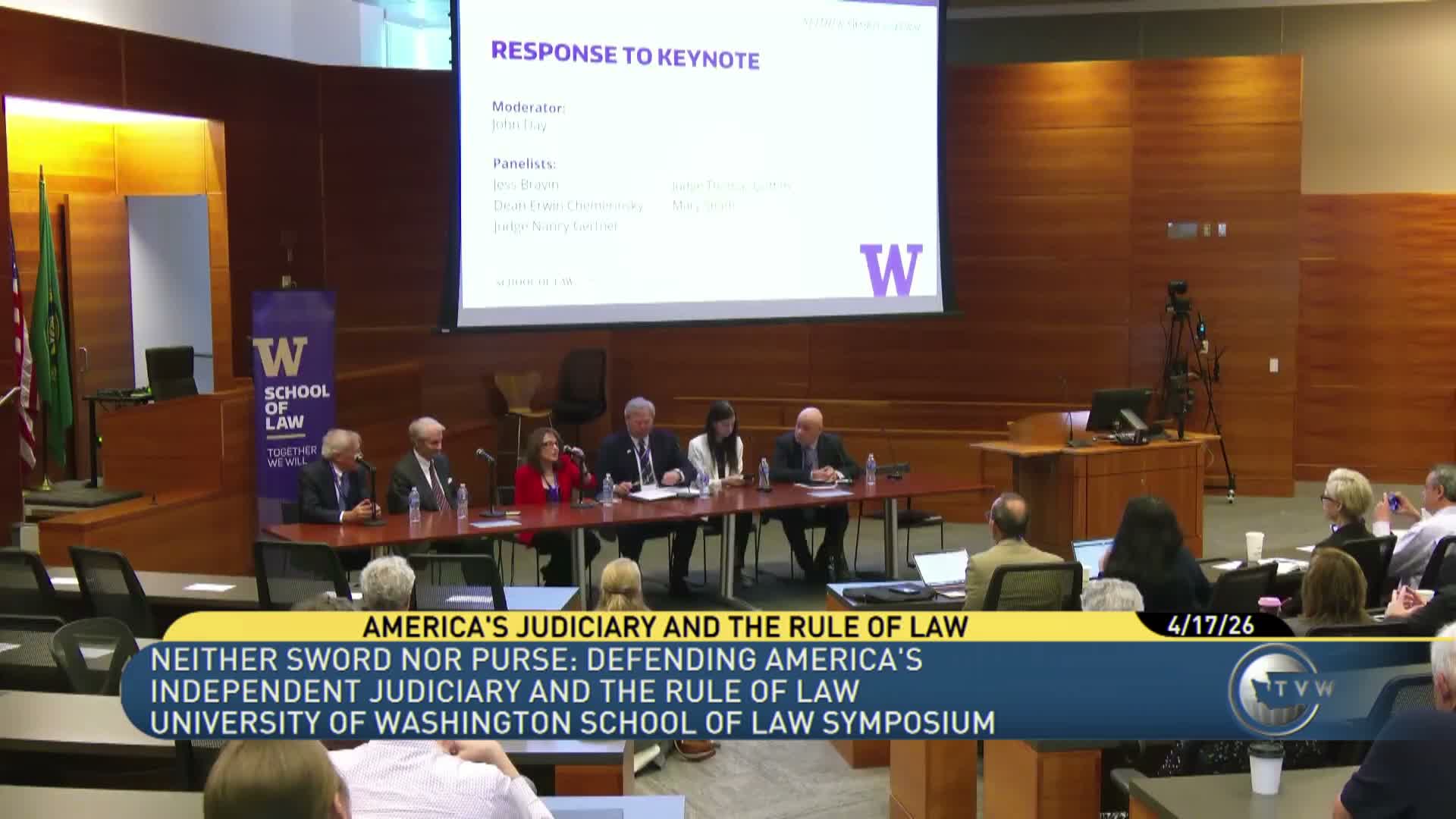
A panel following Judge J. Michael Luttig’s keynote at the University of Washington symposium brought together former judges, law deans and commentators to discuss the state of the federal judiciary, public perception and the pardon power.
Judge Nancy Gertner said Luttig’s urgent tone "met the moment," and cautioned that some silence is passive while other silence is fear-driven; she told the audience that "750 district court judges have dealt with Trump cases, and over, I believe the number is 77%, have ruled against the government," arguing that the public does not always see how courts have checked executive actions.
Judge Tom Griffith, while agreeing the nation faces perilous circumstances, said he had more confidence in the courts and cautioned that public contempt and polarization, rather than legal doctrine alone, pose acute risks to civic life.
Erwin Chemerinsky, dean at the law school, offered concrete examples he said illustrate the stakes: he cited the Alien Enemies Act and Posse Comitatus references, court interventions that checked executive moves, and recent Supreme Court decisions (including a June ruling limiting nationwide injunctions) that, in his view, make it harder to constrain some presidential actions.
Moderator John Day then asked the panel whether preemptive pardons should be permitted. Mary Smith — who discussed experience with the pardon process in the White House Counsel’s office — said the traditional pardon-review role of the Department of Justice has been "excised" in recent practice and cautioned that while the pardon power as envisioned is absolute, changes in process have widened its use.
Panelists debated tradeoffs. One panelist recommended exploring state-level options and concurrent jurisdiction as a counterweight; Judge Griffith said he favored curbing some pardon power in principle but worried about removing a critical remedy that has saved wrongfully convicted people. Dean Chemerinsky called certain pardon rhetoric a distortion of the rule of law.
Panelists also discussed media coverage and public engagement: a journalist on the panel said that large portions of the public hear these debates as abstract and that the media must balance scrutiny with the reality of significant popular support for some officials. Several panelists urged lawyers, bar associations and corporate leaders to do more civic education about how courts and laws operate.
The panel concluded with brief, timed remarks from each participant urging action, education and cross-sector engagement to support judicial independence and public understanding of the rule of law.