Get Full Government Meeting Transcripts, Videos, & Alerts Forever!
Get email alerts on the Public Safety Communications topic
No spam. Unsubscribe anytime.
Sheriff tells Goochland board eastern radio coverage failed during outage; staff propose new tower and trunking upgrade (~$4.25M)
Summary
Goochland’s sheriff briefed supervisors on a northeastern coverage gap and a July outage that cut communications in the eastern county; staff proposed a new tower/transmitter and a move toward trunking systems to restore redundancy and interoperability, with an FY28 cost estimate of about $4.245 million.
The sheriff told the Board of Supervisors on Dec. 19 that a recent outage of the Creekmore tower left the eastern portion of Goochland unable to communicate over handheld radios and that the county must shore up coverage quickly as growth concentrates in that corridor.
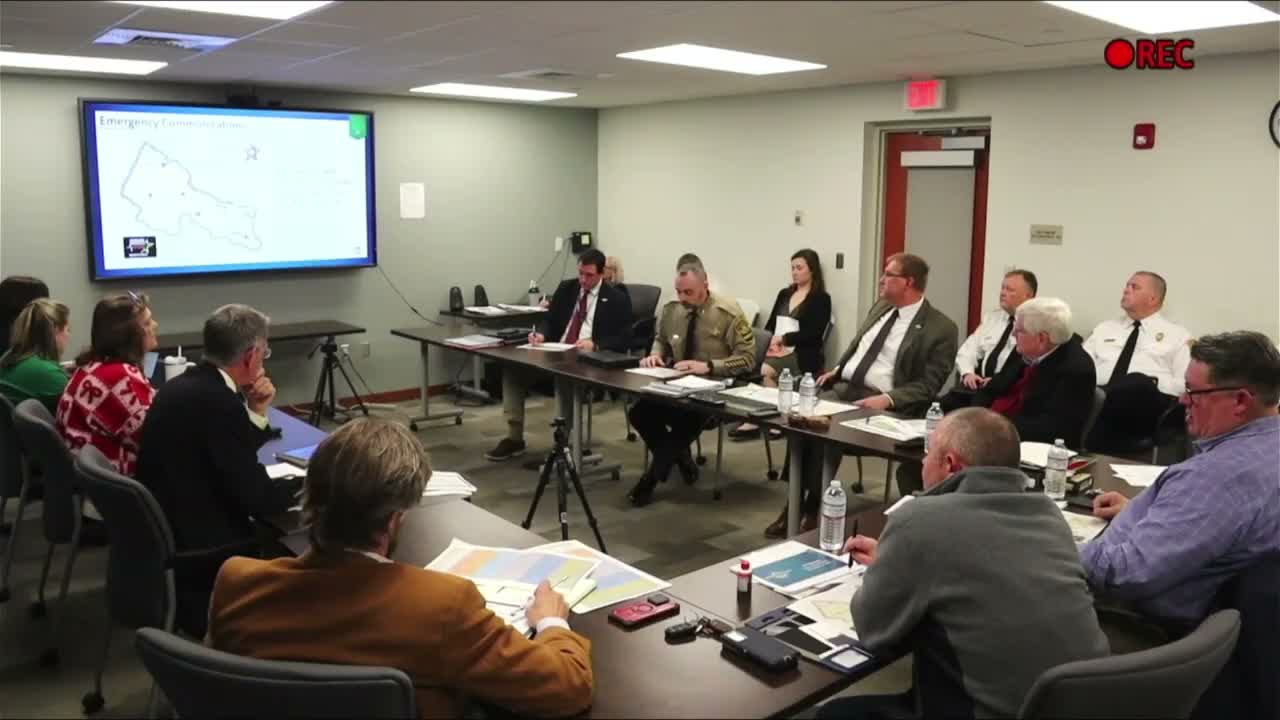
Explaining the technical issue, the sheriff said handheld radios typically reach about 6–10 air miles depending on terrain and building density and walked the board through maps showing a northeastern area where distances between the eastern site and alternate towers exceed that range. He recounted the July outage at the Creekmore site that involved generator and battery failures: “We lost all communication in the eastern part of the county,” he said, stressing the public‑safety consequence of a simultaneous tower and power failure.
County staff recommended adding a new tower/transmitter site in the northeastern sector and beginning steps to migrate to a trunking radio system to improve interoperability with neighboring jurisdictions. The high‑level estimate provided to the board for the tower, land and equipment was about $4,245,000 in FY28. Staff noted land acquisition, site selection and a radio communications study would be required before final design.
Board members pressed whether existing county property (water towers, park areas, park‑and‑ride lots) could host equipment to reduce land costs; staff said water towers often lack the vertical separation required for center/receive antennas and that some cell or private towers might provide opportunities but may not be suitable as sole long‑term public‑safety infrastructure.
What’s next: staff said they will scope a formal radio communications study, refine cost estimates and bring options to the board for timing and potential use of fund balance or grants. Board members urged that reliability and public‑safety redundancy be prioritized and discussed pulling forward funding if needed.