Lifetime Citizen Portal Access — AI Briefings, Alerts & Unlimited Follows
Economic Justice Alliance updates 10‑year plan, seeks regional partnerships and ROI analysis to guide priorities
Loading...
Summary
The Economic Justice Alliance reported a midpoint refresh of its 10‑year plan, won recognition from the Well‑being Economy Alliance, and described plans for regional hubs, focus groups, and public–private partnerships; advisory council recommended five aligned initiatives and asked task force members to help prioritize and connect to resources.
Laurie Finkst, executive director for the Economic Justice Alliance team at DSHS, briefed the task force on progress toward the Alliance’s 10‑year poverty‑reduction plan and next steps for a mid‑course refresh.
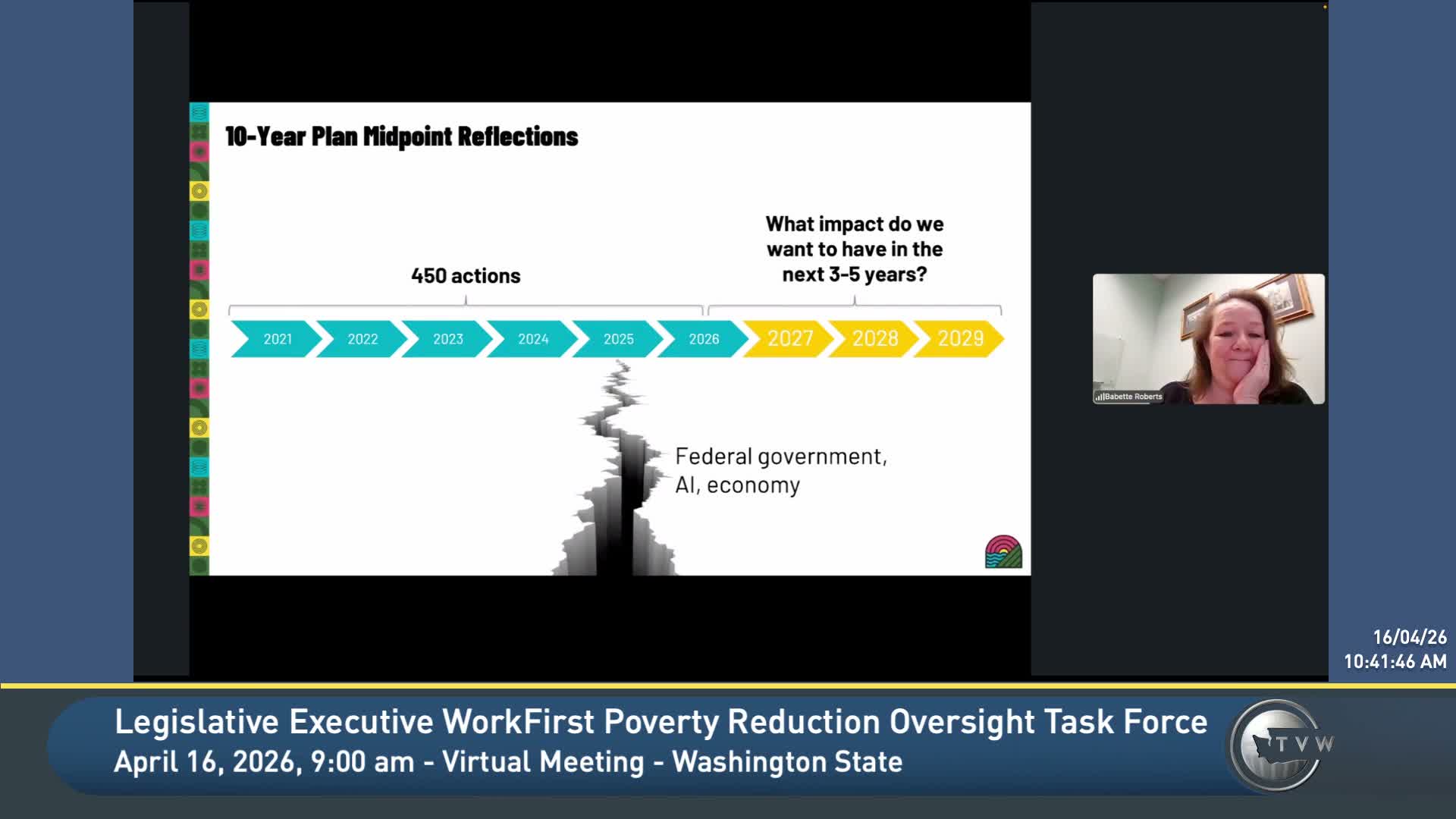
Laurie said the Alliance has logged roughly 450 actions since the plan’s 2021 release and is now centering work on the next three‑to‑five‑year impacts. The Alliance was recently recognized as an international best practice by the Well‑being Economy Alliance, Laurie said, and staff are using public–private partnership models to scale regional work. She described a framework of nine regional hubs, plans to run focus groups and ethnographic research, and pending grant awards that will help accelerate regional civic‑health planning.
Libby Beja (assistant director for aligned initiatives and operations) and advisory council co‑chairs presented five prioritized “aligned initiatives” for LUPRO consideration: direct cash pilots; reducing benefit cliffs; workforce‑program connections; creating shared/modernized agency application and technology solutions; and basic‑needs pilot services. Task force members emphasized constrained budgets and urged a prioritized menu of options tied to ROI analysis. Several members urged staff to first consider restoring effective programs that had been cut before asking for new funding, and to use WSIPP’s ROI modeling for comparative analysis across initiatives.
Staff asked task force members to help by surfacing existing ROI work, connecting to philanthropic partners, hosting local focus groups, and identifying where state agency systems can be aligned. Laurie and Libby said the Alliance will return with documented evaluation designs, ROI calculations for priority initiatives, and summaries of programs cut in recent budget cycles to inform prioritization.