Get Full Government Meeting Transcripts, Videos, & Alerts Forever!
Get email alerts on the Rules And Remote Participation topic
No spam. Unsubscribe anytime.
Highlands workshop debates 'rules' vs 'guidelines' and legal gray area over remote voting
Summary
At the April 16 workshop town attorney Nick told commissioners that pandemic-era orders that allowed remote participation lapsed and that courts have left remote voting and quorum questions ambiguous; the board agreed to have the attorney revise procedures and return them for formal adoption.
During the Highlands Board of Commissioners workshop on April 16, members spent substantial time on a draft rules-of-procedure document and on whether to call the document 'rules' or 'guidelines.'
Member concerns centered on whether a document labeled 'rules' could be used to challenge board actions if technical requirements were later contested. One commissioner urged calling the document 'guidelines' to avoid strict legal exposure; the town attorney, Nick, said the substance of the document matters more than its label, and courts often treat procedure-looking provisions as rules regardless of the chosen title.
Nick also addressed remote participation and quorum questions that have grown out of pandemic-era practice. He explained that emergency orders allowing remote open meetings ended with the emergency declarations and that recent appellate decisions have left unresolved whether a remotely participating member may be counted for quorum or may vote when most members are present in person. He advised caution: until state law or controlling case law clarifies the issue, consider treating remote participants as unable to count toward a quorum or cast binding votes.
The mayor illustrated the practical concern: if a commissioner appears on-screen and faces the public, why should that member be barred from voting? Nick said that while the argument is reasonable, current case law leaves the question open and the conservative approach protects the board from legal challenge. The attorney suggested adding explicit language for contingencies (for example, that remote participants may participate but not be counted for quorum) and said he would update the draft and bring it to a future meeting for formal action.
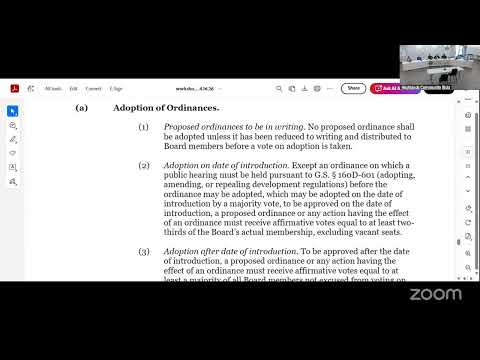
Commissioners also discussed statutory requirements for ordinances (including a cited provision that an ordinance generally may not be finally adopted on the date introduced except by a two-thirds affirmative vote of the board's full membership), closed-session participant invitations, and notice delivery for special or emergency meetings (email and telephone were treated as acceptable notice methods). The board did not adopt the rules at the workshop; members asked staff to incorporate clarifying changes and return the document for formal adoption at a later meeting.