Get email alerts on the Cdbg topic
No spam. Unsubscribe anytime.
Travis County outlines CDBG programs and tools, urges local input on needs survey
Summary
Travis County CDBG staff presented program basics to Bee Cave Council, highlighted project examples (inclusive playgrounds, sidewalks), described the home rehab program (grants up to $24,999) and an interactive map and survey to help applicants and inform county priorities; presenters asked council to help boost local survey participation.
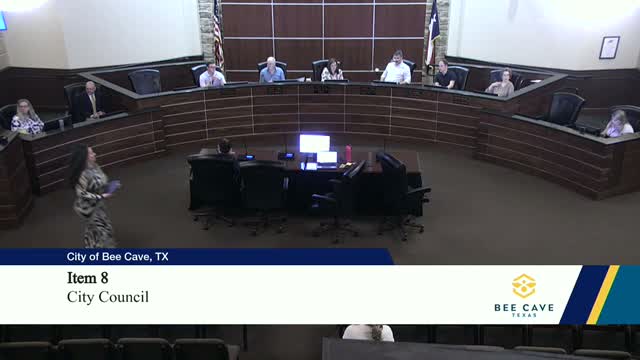
Travis County Community Development Block Grant (CDBG) planners briefed the Bee Cave City Council on March 10 about funding opportunities and tools for local projects designed to serve low- and moderate-income (LMI) families and neighborhoods.
Michaela Manion, a planner with Travis County CDBG, said the program receives an annual federal award administered by the county and supports projects in infrastructure and housing. She highlighted recent local projects funded by the program, including an inclusive playground and sidewalk improvements, and described a home-rehab program that can provide up to $24,999 per household to address needs such as septic systems, roofing, weatherization and ADA accessibility improvements.
Presenters emphasized eligibility rules (projects must primarily benefit LMI populations or meet federal objectives), the county's interactive map tool and a short community needs survey the county uses to set priorities. Manion said the county's grant "averages about $1.7" annually (the presenter did not specify units in the transcript). She encouraged local residents and neighborhood groups to complete the survey and suggested targeted income surveys for specific project areas where ZIP-code-level LMI rates are low.
Council members asked about deadlines and local data. Presenters said applications are accepted for the coming action-plan cycle, that last year's data remain available and that staff can share Bee Cave's survey results to tailor local requests. Several council members stressed the difficulty of securing CDBG funds and urged staff to consider targeted approaches (area-benefit projects and income surveys) to improve eligibility in parts of the city with low overall LMI rates.
County staff provided contact information and said they would be available after the meeting for follow-up.
AI generated
The text on this page is AI generated. Summaries, highlights, analysis, and video transcripts are all produced from the original source material.
AI can make mistakes, so if you spot one, and we will fix it for everyone.
Note: the source content is unaltered by us. Any content source we link to, be it a video, an audio recording, or a document, is presented exactly as its publisher released it. That publisher is usually a government body, sometimes an individual official or another organisation.