Lifetime Citizen Portal Access — AI Briefings, Alerts & Unlimited Follows
Heritage Center outlines 'Swords into Plowshares' public-art proposal using melted Lee statue bronze
Loading...
Summary
At an April 8 Charlottesville council work session, Andrea Douglas of the Jefferson School African American Heritage Center presented the Swords into Plowshares project: three finalist design teams would reuse bronze from the melted Robert E. Lee statue to create community-selected public artworks, with finalists to be announced July 10 and final adoption by council required before city ownership.
Andrea Douglas, executive director of the Jefferson School African American Heritage Center, told the Charlottesville City Council on April 8 that the Swords into Plowshares project aims to convert bronze from the melted Robert E. Lee statue into new public artworks through a community-centered process. "What we're in is a public awareness campaign, that does have a fairly extensive community engagement purpose," Douglas said during the city’s special meeting.
Douglas said a February 2025 request for qualifications drew 32 responses and a four-person jury narrowed the field to three design teams. She described the finalists by their concepts: Walter Hood’s "Ring Shout," a set of 24 engraved steel rings tied to tree- and site-based gatherings; MAS (Model of Architecture Serving Society) with a baobab-tree-inspired centerpiece and a generative soundscape to create a downtown commons; and PUSH studio’s distributed approach of towers and pillars sited across several parks, incorporating community-made elements such as soils and engraved bronze. Douglas said each primary project concept carries a roughly $4 million construction estimate and the organizers are budgeting a contingency to raise about $5.5 million.
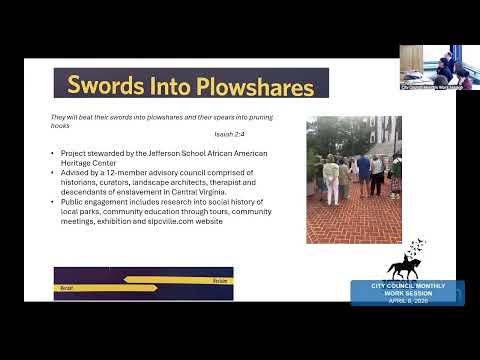
The Heritage Center’s advisory process and outreach have included a 12-member advisory council (historians, curators, landscape architects, therapists and descendants of enslaved people), tours of public sites, an exhibition through May 30, and an online hub of materials. Douglas said the exhibition and associated tours have drawn community members and that organizers have collected about 173 public responses so far. She said the project plans to announce the finalist on July 10, the fifth anniversary of the statues’ removal, and that the finalist team will lead a more intensive community-engagement phase before any final design is presented to the city.
City staff and presenters repeatedly emphasized that the current images are concept drawings. James Priest, deputy city manager, told the council the formal step that would make the artworks part of the city’s portfolio is a council vote: "From a process perspective, what we know absolutely has to happen is that there needs to be a vote by council to accept this work into the city's public art collection." Staff said after that acceptance the city would own and maintain the work and that detailed engineering, materials and maintenance plans would be completed during a design-finalization stage with relevant departments.
Several council members pressed whether Market Street Park had effectively been assumed as a location. Presenters said Market Street was identified in the parks master plan and surfaced repeatedly during designers’ site visits and earlier public-input work, but they emphasized no formal council decision had yet been made to fix a location. Douglas said the process is intended to be co-creative and that juried finalists were chosen to lead community engagement rather than to present a finished, non-negotiable product.
The presentation also covered technical and stewardship topics: the two tons of bronze from the melted statue are not sufficient for the envisioned sculptural scale, presenters said, so designs may combine the original bronze with added material and reuse of granite from the original monument for site elements. Organizers said a hired community-engagement consultant will lead an intense six-week outreach period and that the Heritage Center is steward, not sole director, of the project.
No formal action was taken at the April 8 work session. Staff indicated that future procedural steps and any required resolutions on location, funding or adoption into the city’s public-art collection will come back to council for vote. Douglas said organizers will return with more detailed plans after the finalists are announced and community engagement concludes.
Ending
The council did not vote on the project at the work session. Presenters said the finalist would be announced July 10 and that staff would present a formal adoption item for council consideration in a later meeting, at which time the city would decide whether to accept the project into its public-art collection and assume maintenance responsibilities.