Get Full Government Meeting Transcripts, Videos, & Alerts Forever!
Get email alerts on the Land Use Development topic
No spam. Unsubscribe anytime.
Bee Cave planning commission recommends approval of Spanish Oaks PDD amendment after technical issues flagged
Summary
The Bee Cave Planning and Zoning Commission on Dec. 16 recommended that city council approve an amendment to the Village at Spanish Oaks planned development district, with the condition that outstanding technical review comments be closed prior to council consideration; residents had raised concerns about traffic, access, dark‑sky impacts and water.
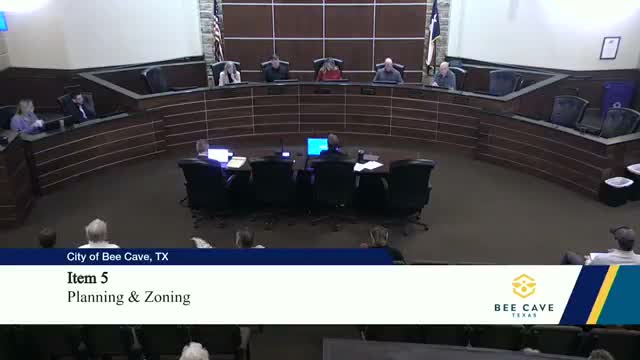
The Bee Cave Planning and Zoning Commission recommended approval on Tuesday of an amendment to the Village at Spanish Oaks Planned Development District, but asked staff and the applicant to close outstanding technical review comments before the matter goes to city council.
Senior planner Sean opened the staff presentation with a summary of the amendment to ordinances that govern the 80‑acre Village at Spanish Oaks, describing roadway simplification, parcel reallocations and changes to development standards. The staff report and applicant materials show a reallocation of multifamily units among parcels and adjustments to building areas and levels on several parcels; staff and the applicant said the PDD’s absolute caps — 600 multifamily units and a fixed total rentable area — will not change.
Applicant Jack, speaking for the development team, told commissioners the amendment is an internal reallocation rather than an increase in density. “There is no add in density that would impact any of the traffic impact work that has already occurred,” he said, and reiterated that the PDD retains a cap on multifamily units and total square footage.
Residents who spoke during the public hearing urged the commission to slow the process and pressed the applicant and staff for more information. William Ball said neighbors were given material only seven days before and requested a delay to allow time for review and dialogue. Julie Johnson described concerns about emergency‑vehicle access, turning radii for trailers and heavy vehicles, and whether Village Oaks Drive can safely accommodate the redirected traffic. “The amount of people that will be using these roads is concerning and virtually unknown,” she said.
Several residents raised environmental and utility concerns. Shikhar Singh urged stronger protections for dark skies, warning that taller, more reflective facades would increase light pollution and could affect wildlife and nearby neighborhoods. Commissioners and the applicant also discussed water supply: the applicant said potable water for the project comes through the PUA and surface water from Lake Austin and that irrigation will use an existing gray‑water line; staff noted that those arrangements date back to earlier agreements associated with the master plan.
On technical specifics, staff and the applicant described parcel‑level changes presented in the amendment: reductions in senior‑living unit counts on certain parcels (parcel A/B combined from 275 to 225 units in the current proposal), an increased allowed building area on parcel B if used for senior living, and a reallocation that increases Parcel E’s unit allotment while keeping the overall multifamily total unchanged. The proposal also requests a multifamily parking ratio of 1.4 spaces per unit (the 2018 code baseline cited in testimony was 1.5). The plan retains the existing height framework tied to Highway 71: a 50‑foot/three‑story band near the highway, with the ability to extend to 75 feet and five stories once a 130‑foot setback is reached.
After questions from commissioners about sight lines, excavation and whether the changes would intensify traffic, Commissioner Wright moved to recommend approval with the condition that the third round of technical comments be resolved and a final comment review be completed before council review. Commissioner Davis seconded. The commission voted unanimously to recommend approval and forward the amendment to city council.
The commission’s action is a recommendation; final approval will be decided by the City Council, which the applicant indicated the team hopes to approach in January. Staff told the commission several technical comments remain open and those items must be cleared as a condition of the forwarded recommendation.