Lifetime Citizen Portal Access — AI Briefings, Alerts & Unlimited Follows
Palliative Care Advisory Council discusses training standards, possible DPH funding and IV-medication diversion concerns
Loading...
Summary
At an informational meeting without a quorum, the Palliative Care Advisory Council reviewed annual-report recommendations, discussed standardizing palliative training for nursing-home staff, explored applying to a DPH civil money penalty reinvestment fund for certification work and agreed to follow up with drug-control on alleged IV-medication diversion.
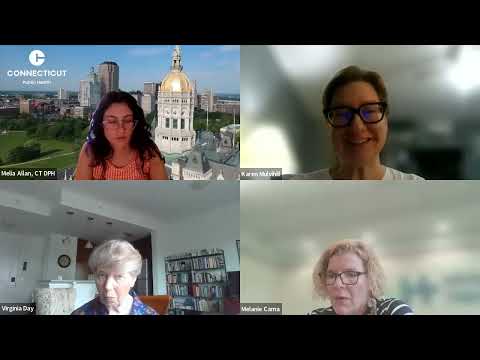
Karen, the council chair, opened the meeting without a quorum and said members would proceed informally while they waited to reconvene with full attendance. She asked members to review minutes from Feb. 6 that had been circulated and to send any feedback before formal approval at the next meeting.
The meeting’s substantive discussion focused on three interrelated matters: whether to retire a prior recommendation about medication access and diversion, efforts to standardize palliative-care training for nursing-home staff, and possible funding sources to support training and certification.
Virginia, speaking as a member of the public, reported on recent continuing-education events and outreach. “I did attend the Connecticut Nursing Association presentation yesterday on pediatric grief,” she said, and cited a joint chaplain and palliative-care training program at George Washington University Medical Center (GWISH) with a new cohort beginning in September.
Members debated whether reluctance by agencies to order IV medications for home use reflects actual diversion or a perception. Karen said the group should check with drug-control leadership to test the assumption that diversion is driving agencies’ decisions. Billy noted staff changes in drug-control after Rob Marriott moved to a different post; Barbara offered to try to facilitate a meeting with the current lead, Troy, and to follow up with Adam to confirm whether the commissioner had reviewed the council’s annual report.
Tracy cautioned that diversion is not a required reportable category outside police reports, so existing data are likely incomplete. “Typically it has to be… reported to police at this point,” she said, adding that facility staff sometimes call drug-control for informal guidance, which may yield high-level but non‑scientific information.
On training and workforce readiness, Tracy described a grant-funded research collaboration with the Yukon Center on Aging that examined hospice use among dually eligible Medicare–Medicaid patients and found education gaps. She said UConn has applied for grant funding to update a 2016 training curriculum and members said they expect that work to produce contemporary, standardized training for nursing-home staff. Members emphasized avoiding duplication between UConn’s work and a separate Yukon-funded project and agreed to coordinate.
Barbara flagged a potential funding source for training: “DPH through CMS has a civil money penalty reinvestment fund,” she said, explaining that a portion of fines issued to nursing homes can be repurposed for resident-centered projects. She advised that any council application would go through Facility Licensing and Investigations (FLIS) and noted a conflict-of-interest constraint that would prevent her from submitting an application directly, though she offered technical assistance.
Members discussed certification logistics. Barbara estimated certification costs in the low hundreds per person—“I think it was about $300 to certify a person”—and Karen said she could deliver train-the-trainer instruction at cost. They also discussed eligibility questions for certification and the value of a certified trainer model to validate staff capacity to provide palliative care.
Other business included scheduling and outreach: members confirmed the annual conference (May 21 at the Aqua Turf) and a palliative-care education day on June 24, 2026, at the Culinary Institute of America in Hyde Park, N.Y.; Karen said Sarah Potter of the Hospice and Palliative Nurses Association was seeking to designate April 19 (Florence Wald’s birthday) as National Hospice and Palliative Nurses Day and was contacting state leaders for proclamations.
Before adjourning, Barbara said she would email Malia with follow-up details and coordinate meetings to pursue the drug-control check-in and grant-application discussions. Karen moved to adjourn; members confirmed the next meeting date (June 5 at 10:30 a.m.). No formal votes on motions or ordinances were recorded in the transcript.
The council’s immediate next steps are to confer with drug-control leadership about IV-medication diversion data, coordinate training and grant efforts with UConn and Yukon partners, and explore an application to the DPH civil money penalty reinvestment fund for training support.