Get Full Government Meeting Transcripts, Videos, & Alerts Forever!
Get email alerts on the Economic Outlook topic
No spam. Unsubscribe anytime.
Panelists flag Middle East conflict, tariffs and demographics as risks to Arizona growth
Summary
University of Arizona economist George Hammond and JLBC panelists told the Finance Advisory Committee that a mix of geopolitical risk, tariffs, slow hiring and demographic shifts are likely to slow Arizona job and income growth; speakers singled out health services as the main current source of job gains and noted housing permits declined in 2025.
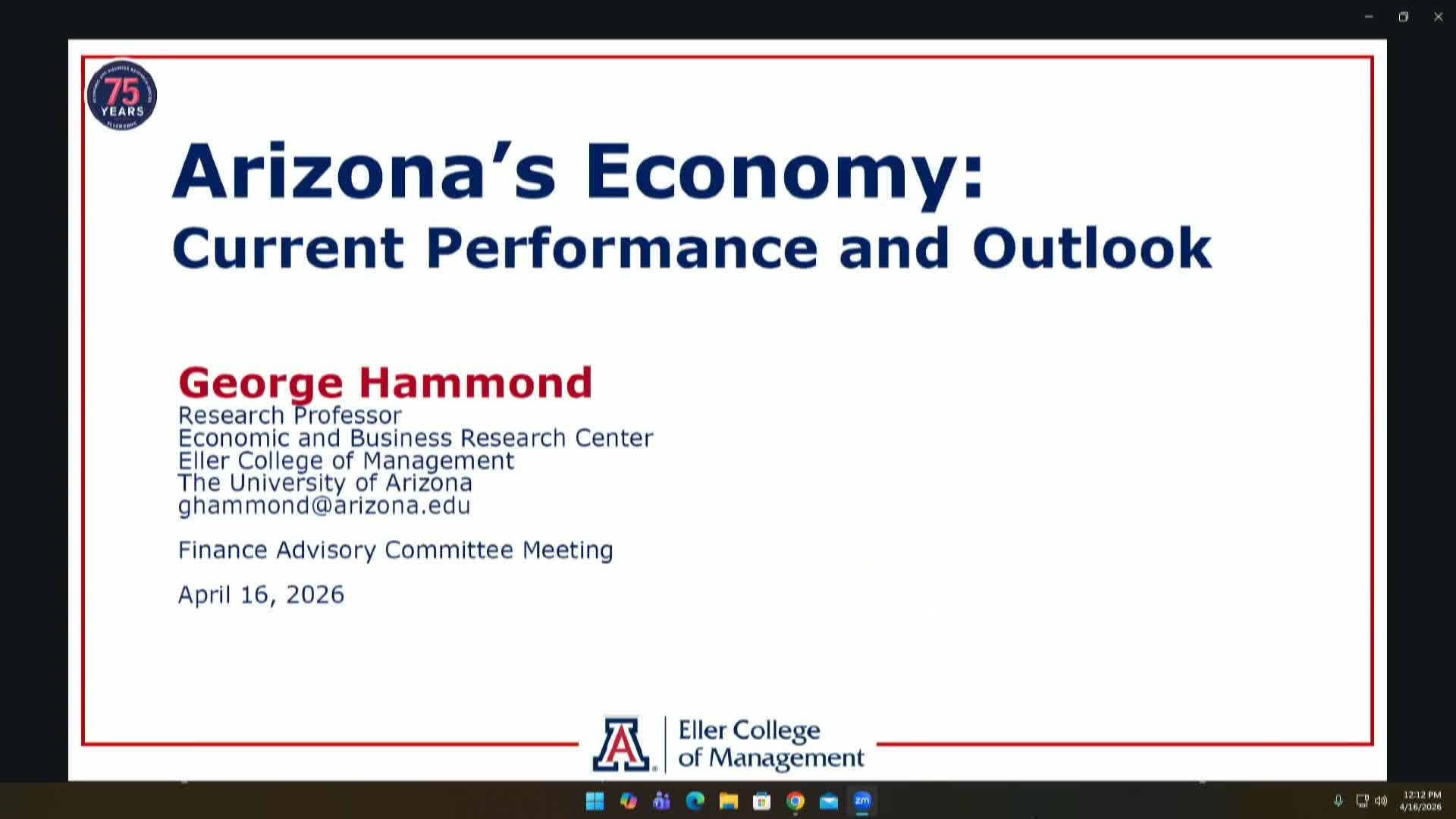
George Hammond of the University of Arizona told the Finance Advisory Committee that the war in the Middle East is “back on the radar” and presents a key upside/downside risk for fuel prices, inflation and economic momentum.
Hammond summarized several near‑term risks: geopolitical uncertainty and oil price shocks, sticky inflation above the Federal Reserve’s 2% target, a low‑hire/low‑fire labor market that has left net job growth muted, and demographic headwinds as natural increase (births minus deaths) declines. He cited Moody’s Analytics benchmarks to quantify energy shocks: a sustained $10 per barrel crude price increase would roughly add 0.15 percentage points to inflation and reduce real GDP about 0.1 percentage points, other things equal.
Panelists then reacted to the presentation. Jack Brown (JLBC staff) framed forecast scenarios tied to the Iran conflict. Jim Rounds said Arizona must prioritize productivity and workforce development even as high‑wage tech jobs arrive in waves; he called for attention to workforce volume and appropriate use of rainy‑day funds. Danny Cart (panelist) and others noted that single‑family housing permits fell sharply in 2025 while multifamily and rental markets provided some affordability relief as average rents eased about 8% since their 2022 peak. Doug Wallace outlined benchmark and survey issues with BLS employment data that have produced larger revisions and urged caution interpreting month‑to‑month job numbers.
Speakers generally agreed Arizona will likely see continued but slow growth if the national economy holds, with downside risks tied to the duration of geopolitical conflicts, tariff policy, and immigration dynamics affecting labor supply. No formal policy actions were taken during the meeting; the panel closed by thanking presenters and noting the committee will revisit forecasts at its October meeting.
Key quantitative and contextual points recorded in the meeting: Hammond said Arizona’s job growth was weak in the prior year driven by low hiring; healthcare accounted for much of the recent job gains; housing permits declined in 2025 with single‑family permits down roughly 20% in Greater Phoenix and further year‑to‑date declines; and benchmark revisions to employment data shifted 2025 estimates materially.