Lifetime Citizen Portal Access — AI Briefings, Alerts & Unlimited Follows
Sponsor says SB 977 restates supremacy of U.S. and Missouri constitutions; members raise arbitration and family-law concerns
Loading...
Summary
Sen. Nick Schroer told the Committee SB 977 clarifies that U.S. and Missouri constitutions and state law cannot be superseded by foreign laws; members questioned effects on arbitration, family law and whether the measure targets specific foreign or religious laws. A witness from Liberty Link Missouri spoke in favor.
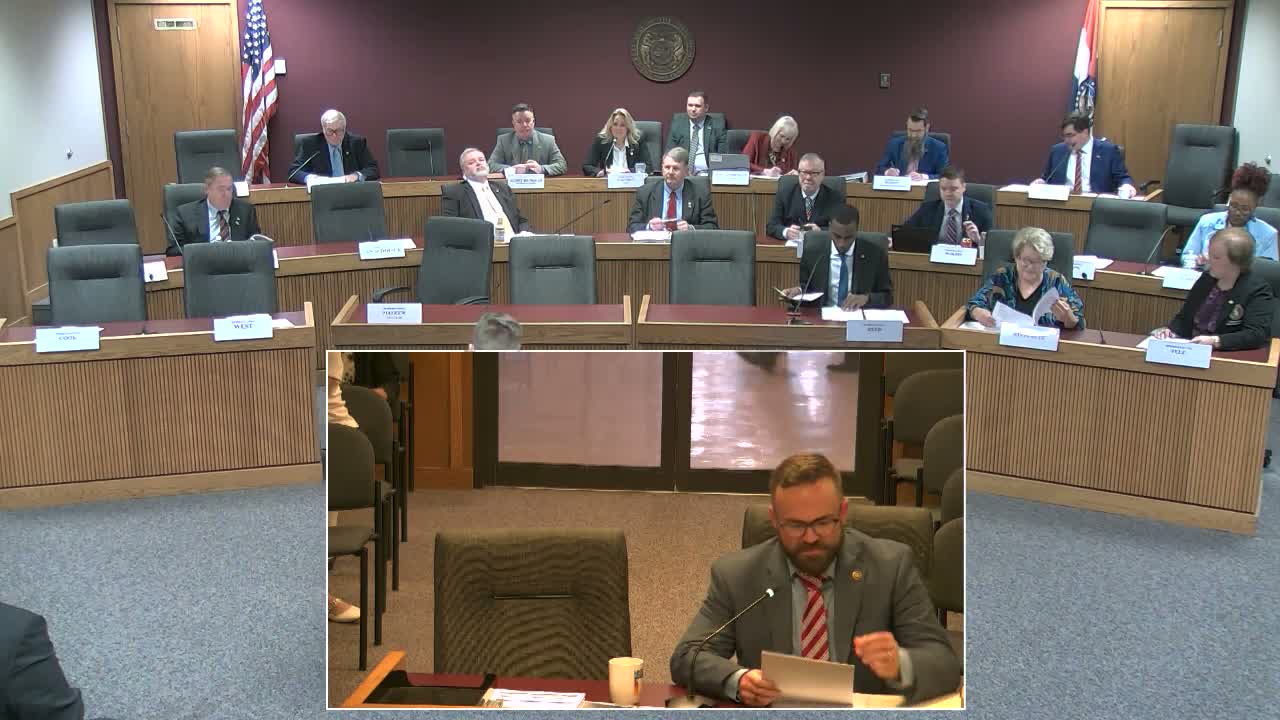
Senator Nick Schroer (Senate District 2, St. Charles County) told the Committee on Government Efficiency that Senate Bill 977 is intended as "a restatement of our supremacy clause," designed to make explicit that the U.S. Constitution, the Missouri Constitution and state law will not be superseded by foreign laws or treaties except in narrowly specified and consented circumstances.
"Essentially, what this bill does, it's a restatement of our supremacy clause," Schroer said in his opening remarks, adding that the measure is narrowly tailored to avoid unintentionally nullifying lawful, consented arrangements and to guide courts that might otherwise "legislate from the bench." He said the language includes carve-outs for businesses that voluntarily choose foreign law and for situations where federal law preempts state law.
Why it matters: committee members probed whether the bill would impair private arbitration agreements or affect international family-law arrangements. Representative Boiko pressed the sponsor on arbitration, asking whether parties could still agree privately to resolve disputes by arbitration or other methods. Schroer replied that binding arbitration exists but that courts retain authority to review awards; the bill would bar enforcement of foreign laws or arbitration decisions that would violate "fundamental rights," as defined in the draft language.
Representative Smith asked for documented Missouri examples where foreign law supplanted constitutional protections; Schroer pointed to pandemic-era litigation against county executives as an example of disputes that raised constitutional issues and said the bill clarifies how courts should treat foreign-law references in disputes over marriage, custody, adoption and property when fundamental rights are implicated. Schroer also noted one specific amendment intended to preserve Hague-Convention child-custody processes and that the change reduced the fiscal note to zero.
Contention and clarification: several members asked whether the bill targets specific religious laws or international organizations; Representative Chappell and others used historical court errors (citing Dred Scott) to argue for legislative clarity, while others questioned whether this restatement was necessary. Representative Burton and others said they were unsure this problem required a new statute if existing law already protects rights. The sponsor said litigation in other states has produced mixed results—some courts upheld similar language and others struck it down—and that the bill was drafted to reflect constitutional limits recognized by courts.
Public testimony: Beth Aylin, representing Liberty Link Missouri, spoke in favor of the bill, saying "the law is the teacher" and that repeating clarifying language can help the public and courts understand the legislature's intent.
Next steps: The committee concluded the public hearing on SB 977 after taking testimony in favor; no committee vote on SB 977 is recorded in the provided transcript.
Direct quotes: "Essentially, what this bill does, it's a restatement of our supremacy clause," — Senator Nick Schroer. "The law is the teacher, the law is the standard," — Beth Aylin, Liberty Link Missouri.
Closing: The sponsor said he would be available for follow-up questions and encouraged members to consult the bill text and amendments for carve-outs; the chair closed public testimony and moved on to the next item on the agenda.