Get AI Briefings, Transcripts & Alerts on Local & National Government Meetings — Forever.
New Canaan subcommittee reviews three downtown sites, flags parking, traffic and cost trade-offs
Loading...
Summary
The Project Development Subcommittee examined conceptual plans for Richmond Hill, Locust Avenue and the Lumberyard, hearing staff analyses on parking ratios, drainage and constructability and agreeing to socialize all three options with the public before making a recommendation.
The New Canaan Project Development Subcommittee met March 11 to review three conceptual site plans for possible affordable housing — Richmond Hill, Locust Avenue and the Lumberyard — and agreed to present all three options to the public as part of a forthcoming engagement and survey process.
Krista Nielsen, a member of the subcommittee, opened the meeting and said the committee’s aim is to ‘‘do our homework’’ so it can advise elected officials on which town-owned sites the town should pursue. The committee voted to approve the minutes of its March 4 meeting at the start of the session.
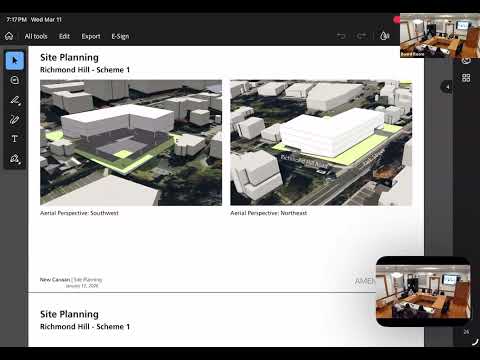
The Richmond Hill options include a single large apartment building over a two-level parking structure and a smaller, townhouse-style two-building alternative that would yield about 18–20 units. Committee members and staff discussed whether nearby offsite parking — including an underbuilt underground lot at the neighboring Walgreens property — could be negotiated to reduce displacement during construction. Jane Williams, who provided parking permit data, said the Richmond Hill lot had an 18-person wait list earlier in the pandemic and that permit usage patterns have shifted as commuters have returned to offices.
Town planner Sarah Carey said the townhouse-style option ‘‘could be a much easier project’’ for the neighborhood and noted that if the town did not need to replace every existing parking space, the smaller option might be more palatable. Several committee members echoed concerns that a boxy, multi-story building could ‘‘loom’’ over adjacent single-family homes.
At Locust Avenue, staff described two schemes that use split-level parking to take advantage of grade changes and a variant that wraps residential frontage around parking. Engineers raised drainage and downstream storage issues tied to a private pond built for the Heritage Hill condominiums that has filled with sediment; a town engineer said creating subsurface detention on the Locust site could help mitigate downstream surcharging in heavy storms.
On the larger Lumberyard parcel near the train station, consultants’ schemes showed potential for a transit-oriented, phased development that could deliver the most units but would also require replacing approximately 354 current commuter spaces with a large parking structure (the renderings modeled a 500-plus space garage in some options). Nielsen briefed the committee on a rough order-of-magnitude cost: ‘‘assuming $30,000 per parking spot and $550,000 per unit,’’ the Lumberyard schemes came in ‘‘just over $100,000,000,’’ a figure members called substantial.
Members weighed trade-offs between unit counts, visibility of garages from downtown and constructability next to the rail right-of-way. Tiger Mann and other attendees noted that work adjacent to active tracks would require coordination with rail authorities and compliance with additional construction controls.
Committee members also asked for comparative density figures for local projects (Canyon Parish, The View) and requested more detail on unit mix and lot areas to determine whether proposed schemes would be denser than existing local developments. Krista Nielsen said the committee will collect those figures and return to them at the next meeting.
No formal land-use decision or site selection occurred at the session. The subcommittee agreed to ‘‘socialize’’ all three site plans to the public and run a survey to assess which trade-offs residents find acceptable; the committee will reconvene March 25 to begin planning that public process. "We’re not making a recommendation without hearing from you first," Nielsen said.
The committee adjourned after a brief public-comment period.