Lifetime Citizen Portal Access — AI Briefings, Alerts & Unlimited Follows
Missouri committee hears bill to fund resilient roofs, add disaster mediation and tighten adjuster rules
Loading...
Summary
House Bill 3,328 would create a Missouri Stronger Homes Fund seeded with $12 million, establish a voluntary Disaster Mediation Act for declared emergencies, and update rules for public adjusters and fraud investigations; witnesses split over fee caps, fortified-roof standards and mutual‑company carve-outs.
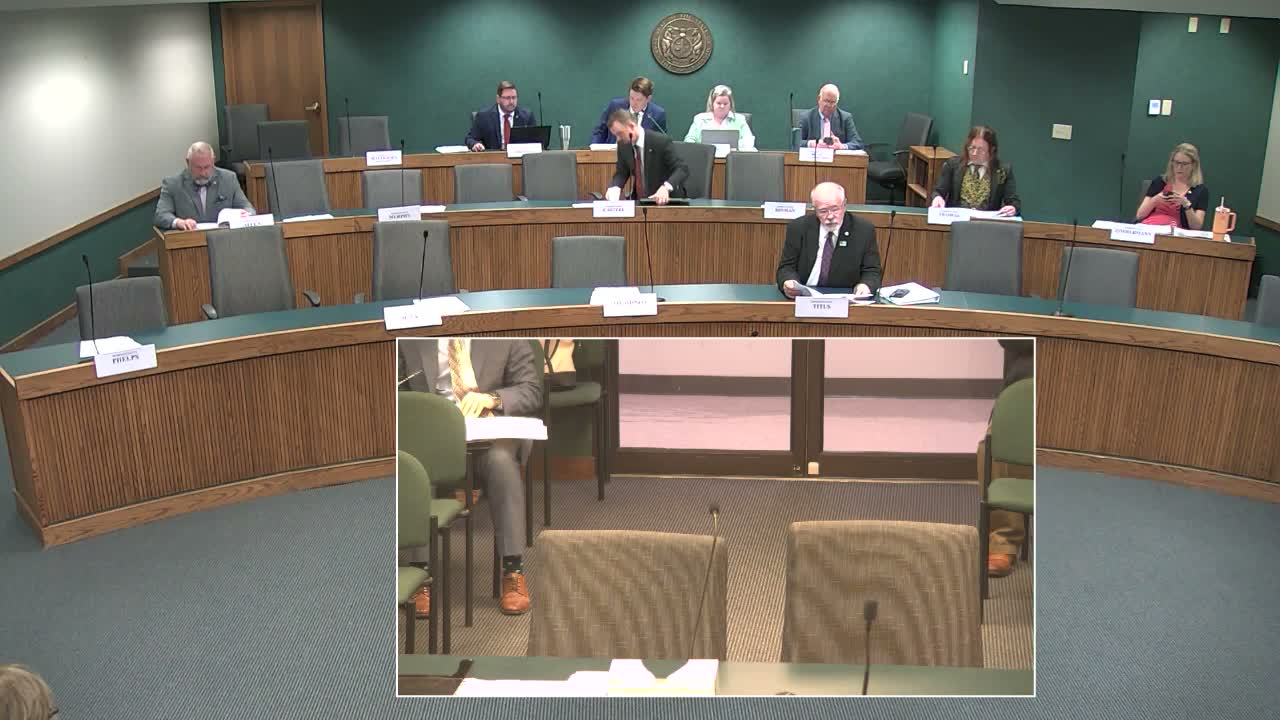
State Representative David Castile introduced House Bill 3,328 to the Missouri House Committee on Insurance as a broad homeowner-protection package that would redirect dedicated insurance‑department fees to a new Missouri Stronger Homes Fund, create a structured disaster mediation process and tighten regulation of adjusters and fraud statutes.
"My name is state representative David Castile from the 97th District," Castile told the committee, summarizing the bill as "relating to homeowners insurance, the Missouri disaster mediation act, and the Missouri Stronger Homes Program." He described 28 new sections in chapter 379 and said the measure aims to encourage stronger, more resilient homes while improving claims outcomes for consumers.
Under the version described at the hearing, the bill would direct a one‑time seed transfer of $12,000,000 on July 1, 2027, and thereafter transfer 20% of the insurance‑dedicated fund’s value each year up to $2,000,000 through July 30, 2037 into the Missouri Stronger Homes Fund. That money would underwrite grants for mitigation and fortified roofing work; the department described initial grants of up to $10,000 per household (with a future allowance up to $15,000 as costs rise). Steven Marion, legislative director at the Department of Commerce and Insurance (DCI), said the dedicated fund consists of fees insurers pay to the department and called it "our checking account, if you will." He estimated the $12 million seed could support roughly 1,200 grants in the first year.
The bill also creates the Missouri Disaster Mediation Act, a voluntary alternative‑dispute process to be available during a governor‑ or president‑declared state of emergency. Castile and Marion said the mediation program is intended to provide a faster, less adversarial way to surface coverage disputes and direct complaints to DCI; Marion said typical DCI timelines for similar interventions are between 30 and 90 days.
Several consumer‑protection provisions would standardize how insurers handle replacement‑cost claims and recoverable depreciation, and require clear notices on residential policies directing policyholders to DCI resources and a hotline.
The measure drew mixed reaction from affected industries. The National Insurance Crime Bureau urged the assignment‑of‑benefits ban in the bill, arguing it would reduce opportunities for predatory contractors to exploit homeowners. "By eliminating the ability to assign post loss benefits, the bill closes a loophole that has been exploited for fraudulent purposes," said Adam Effington, director of government affairs for the NICB, citing a high‑profile Springfield case as an example.
Public adjusters and some trades raised objections. Earl Scissors, speaking for the American Association of Public Insurance Adjusters, opposed an across‑the‑board cap on adjuster fees and said most public adjusters charge 10–15%. "We are opposed to caps, in general," Scissors said, while adding he is working with the sponsor and the department on language changes. The sponsor and DCI officials said they have been negotiating with stakeholders and that a committee substitute will alter the public‑adjuster language; Marion said the sentence in current draft that set a 10% cap would be removed in the substitute.
Manufacturers also flagged technical problems with the bill’s fortified‑roof standard. A representative for CertainTeed said some of the company’s products could be excluded by the draft standard; the sponsor and industry witnesses said they were working to replace a specific reliance on IBHS standards with a technology‑neutral definition of "risk‑reduction" standards.
Committee members asked for more benchmarks for the mediation program’s termination criteria and pressed DCI to involve affected places such as St. Louis in stakeholder workshops. Castile told the committee stakeholders remain engaged and that the committee substitute will reflect negotiated fixes before any executive session.
The committee closed the public hearing after receiving support, opposition and technical comments and signaled further work on a committee substitute and an executive session to consider next steps.