Lifetime Citizen Portal Access — AI Briefings, Alerts & Unlimited Follows
Lake Oswego planners review draft tree-code changes, debate 45% retention, incentives and golf-course permit eligibility
Loading...
Summary
At a joint April 13 meeting, Lake Oswego planning commissioners and the Development Review Commission reviewed draft tree-code amendments that would add a clear-and-objective track, set a 45% retention standard (or DBH equivalent), create fee-in-lieu options and sparked debate over whether municipal and private golf courses should be eligible for a forest management permit.
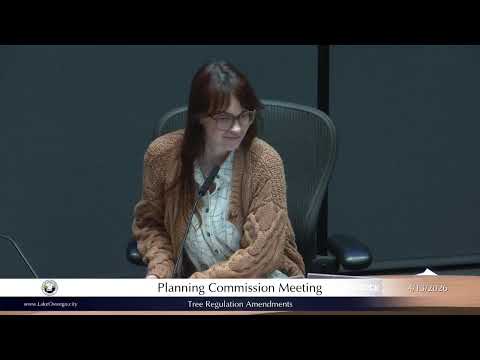
The City of Lake Oswego’s Planning Commission met jointly with the Development Review Commission on April 13 to study proposed amendments to the city’s tree regulations, focusing on a two-track type 2 permit structure, a proposed 45% minimum tree-retention standard and whether golf courses should remain eligible for consolidated forest management permits.
Jessica New Manalu, the project manager for the code update, said the effort responds to the city’s urban community forestry plan and to an Oregon statute requiring clear-and-objective standards for regulations that affect the development of housing. "We are required to offer this clear and objective track," she told commissioners, noting the changes will guide a council work session in May and public hearings this summer.
Sarah Goldstein, the project consultant with Cascadia Partners, described how the draft would let applicants choose between two measurable retention options: retaining 45% of trees on a lot that are 15 inches or larger in trunk diameter or retaining at least 45% of the total DBH (diameter at breast height) of trees 6 inches and larger. "In the draft, it's 45% of all the trees on the lot or 45% of the total DBH on a lot," Goldstein said, explaining staff selected the thresholds after reviewing local permit data and peer jurisdictions.
Staff told the commission the goal is to preserve Lake Oswego’s existing canopy (staff cited a citywide canopy of about 53%) while complying with state law and making permitting more predictable for projects that add housing. The proposal also includes a fee-in-lieu, described as a per-inch payment into the city’s tree fund, for applicants who fall short of the retention standard; staff said the fee level would be set so it is not a trivial path to clear-cutting nor so high as to make the clear-and-objective track unusable.
Public testimony focused on one draft change in particular: a proposed exclusion that would bar municipal and private golf courses from the forest management permit. "Excluding golf courses from the forest management permit does not advance these goals," said Nolan Winker, head superintendent at Oswego Lake Country Club, citing permit data and saying the club accounted for "less than one-half of one percent" of total tree removals citywide in 2021–2025. Jeff Shearer, a former DRC chair and current tree committee member, urged the commission to reject the exclusion as unnecessary and targeted.
Staff explained the provision grew out of public outreach on the urban and community forestry plan, which flagged managed landscapes as a concern for some residents. Jessica New Manalu and other staff said the draft can be revised and that the inclusion of the golf-course exemption in the draft does not bind the final decision.
Commission discussion covered several tradeoffs: whether additions and remodels should be treated like new dwelling units (staff and counsel noted unresolved case law on what counts as "development of housing" and advised caution), whether the clear-and-objective track should be allowed to be combined with other site-improvement permits for administrative simplicity, and what incentive threshold would justify removing public notice and appeal. Some commissioners said a higher incentive threshold (70–75%) would be appropriate if the city removes notice/appeal rights; others favored a lower threshold and keeping the 45% minimum.
On the definition of "significant tree," staff proposed adding a species-and-size table to make determinations more objective and to preserve the two-to-one mitigation requirement where appropriate. Morgan Holen, the city’s contract arborist, said mitigation should be "similar" in species and stature when feasible.
No final legislative action was taken at the session. Commissioners generally asked staff to incorporate the feedback from tonight’s joint meeting and from upcoming advisory-board meetings into Draft 4, and to bring the revised draft to a City Council work session in May; a public hearing on the tree-code amendments is scheduled for June 8. "We'll be incorporating feedback from this session into Draft 4 that we'll bring to City Council," Jessica New Manalu told the boards.
Minutes and routine business were approved at the start of the meeting; the commission adjourned after the tree-code discussion.