Get Full Government Meeting Transcripts, Videos, & Alerts Forever!
Get email alerts on the Climate Commitment Act topic
No spam. Unsubscribe anytime.
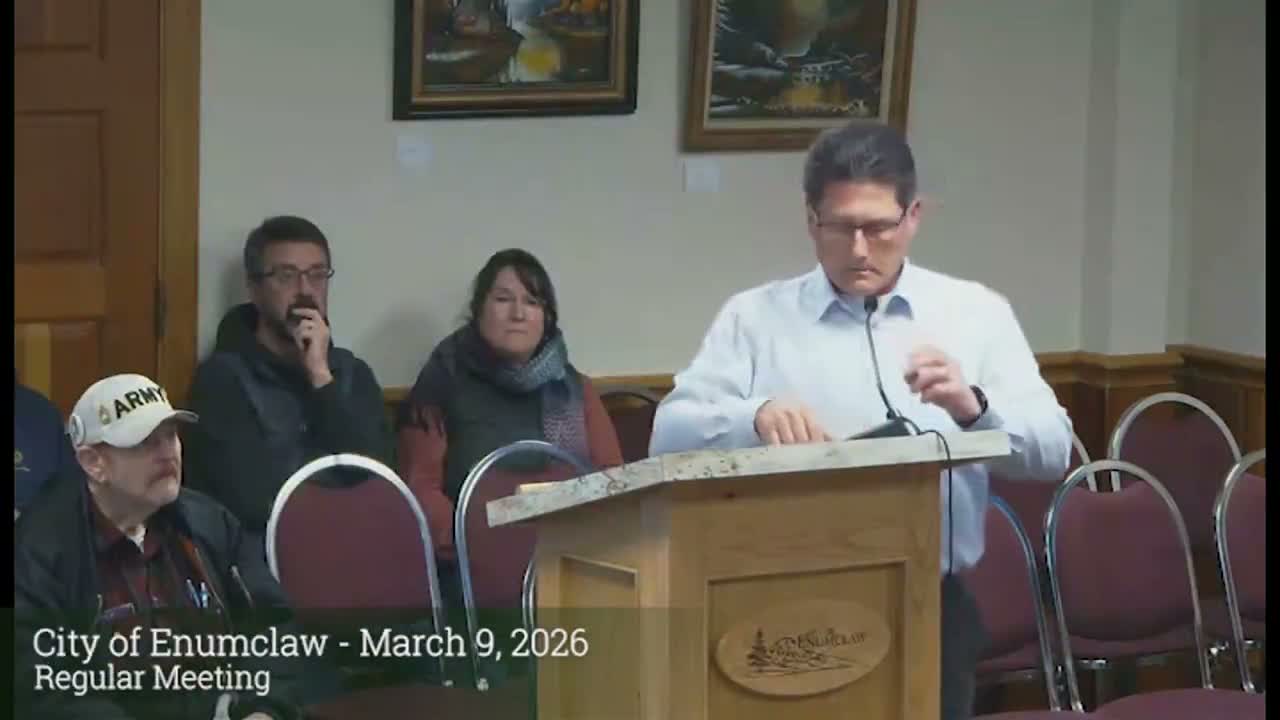
City administrator outlines Climate Commitment Act costs and options for municipal gas utility
Summary
City administrator Chris Searcy presented a March 9 workshop on Washington's Climate Commitment Act, explaining why Uniontown's municipal gas utility is currently a covered entity, the mechanics of allowances and auction proceeds, likely bill impacts for legacy and new customers, and policy options including seeking alternative compliance paths or full cost recovery for new development.
City administrator Chris Searcy told the Uniontown City Council on March 9 that Washington’s Climate Commitment Act (CCA) has drawn the city’s municipal gas utility into a regulated program and that the city is “just marginally over the threshold” that defines covered entities.
Searcy, who led a workshop rather than a decision session, said the program requires covered entities to obtain carbon allowances equal to their greenhouse‑gas emissions and that the Department of Ecology runs quarterly auctions that set market prices. He said ecology provides “no cost allowances” based on a baseline (2015–2019) but that those allowances decline each year and a growing share must be consigned to auctions, increasing the city’s out‑of‑pocket compliance costs over time.
“The first year was about $250,000 in 2023,” Searcy said when asked for ballpark figures; he added later that recent annual compliance costs have approached “a little over $400,000” and that projections could exceed $1,000,000 in future years depending on allowance prices and program linkage.
Searcy explained the customer‑billing distinction the city applies: legacy customers connected before July 25, 2021 receive the benefit of auction proceeds and lower per‑CCF charges (historically in the range of roughly 5–7¢/CCF), while non‑legacy customers pay a higher direct conversion that initially produced an estimated 23–33¢/CCF impact. “For the new customers, they’re starting to feel the pain now,” he said.
He noted the city’s average emissions for 2023–2025 slightly exceeded 25,000 metric tons — the program threshold — and that Ecology can keep utilities in the program if they remain within 10% of the threshold. “So the goal for us would be to get below 22,500,” Searcy said, while acknowledging the city’s seasonal load and weather make year‑to‑year emissions uncertain.
Searcy described policy options the council may want to consider later: (1) seek state legislative carve‑outs or alternative compliance paths for municipal gas utilities (an approach pursued with Ellensburg), (2) pursue full cost recovery from new development so the utility is not financially penalized for extending service, or (3) implement local decarbonization programs (such as incentives or conversions to heat pumps) that would require additional staff or technical resources. He emphasized the city currently manages reporting and auctions with existing staff but that program expansion would likely require new personnel.
Council members asked for clearer fiscal projections. When asked for updated numbers, Searcy said he would provide refined projections based on the last three years of experience and noted uncertainty about future market linkage (for example, potential connection to California’s cap‑and‑trade market) that could tighten or loosen allowance prices.
Searcy closed by recommending the council let the topic “sink in,” seek constituent and peer‑city input, and revisit the topic in May with more detailed cost scenarios and potential legislative coordination.
What’s next: council requested additional numeric projections and agreed to return to the item for further policy guidance in a future meeting. No formal action was taken on March 9.