Get AI Briefings, Transcripts & Alerts on Local & National Government Meetings — Forever.
Howard Brown urges Philadelphia to track 'capital readiness' and fund back-office support for diverse firms
Summary
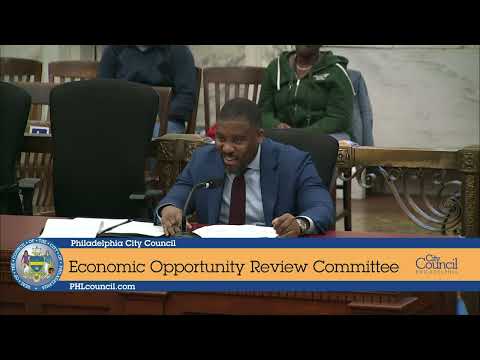
Howard Brown, founder of Advantage Capital, told the Economic Opportunity Review Committee on March 30 that the city should measure "capital readiness"—bookkeeping, financial statements, compliance and planning—and invest in advisory and back-office supports so minority- and small-business owners can access existing capital.
Howard Brown, founder of Advantage Capital, told Philadelphia's Economic Opportunity Review Committee on March 30 that improving access to capital for small and minority-owned firms requires measuring and financing what he calls "capital readiness" — the bookkeeping, financial statements, compliance and strategic planning that lenders require.
Brown spoke to the committee during a guest presentation and Q&A, arguing that policy debates often treat access to capital as purely a supply problem while overlooking whether businesses are structurally prepared to receive and manage funds. "Access to capital is not just about a question of whether money exists, but whether businesses are structurally ready to receive it," Brown said.
The recommendation matters because, committee members said, many local firms that appear successful on the surface lack the financial documentation or back-office capacity lenders and prime contractors need. Regina A. Hairston, president and CEO of the African American Chamber of Commerce for Pennsylvania, New Jersey and Delaware, told the committee that "96% of African American businesses do not have employees," stressing the difference between solopreneurs and mid-sized firms and the need for tailored supports.
Brown outlined a four-part readiness framework: clean financial recordkeeping; up-to-date financial statements (P&L, balance sheet, cash flow) that match tax returns and bank records; documentation and compliance (licenses, insurance, registrations); and strategic planning for how capital will be used and repaid. He gave examples of firms with strong sales being turned down by lenders because their financial paperwork was inconsistent, and advised the city to adopt more precise language and tracking around readiness.
"Banks can't approve what they can't see," Brown said, summarizing why lenders often decline otherwise promising businesses. He urged the city to treat financial structure as "capital infrastructure," and recommended three practical steps: explicitly track capital readiness in reports and hearings; fund back-office capacity (through grants or subsidized services, not only loans); and pair capital with hands-on advisory services so loans or equity close with firms that can manage the funds.
Committee members from local chambers generally endorsed the thrust of Brown's recommendations. Jennifer Rodriguez, president and CEO of the Greater Philadelphia Hispanic Chamber of Commerce, described a gap in equity instruments for firms that cannot meet traditional venture expectations and urged product innovation. Kyne Arthur, president and CEO of the Asian American Chamber of Commerce of Greater Philadelphia, raised language and cultural barriers and asked about multilingual advisory capacity.
Brown responded that cultural competence among advisers is essential and that the city should assess whether existing contractors and intermediaries truly serve diverse communities. He suggested OEO partner with trusted local organizations — chamber partners, CDFIs and other intermediaries — to increase participation in workshops and advisory programs. "Many of these businesses don't want to participate unless there's something they can benefit from," he said, recommending clearer incentives and partnerships to bring owners to the table.
On funding models, Brown clarified that his call for support for bookkeeping and back-office services meant grants or subsidized support rather than pushing only loans for those expenses. He also recommended that business owners build relationships with financial institutions before they need funds and that the city consider funding models that support both capital and capability-building.
No motions or votes were taken. Lynn Newsome, deputy director of the City of Philadelphia's Office of Economic Opportunity, closed by announcing OEO workshops (third and fourth Wednesday of each month, 1–3 p.m.), an April 15, 2026 presentation from SEPTA on contracting with the agency, and an April 22 OEO business development session on doing business with the live casino. The committee adjourned with plans to continue the discussion at future meetings.
Contact and next steps: OEO posts transcripts and resources at the OEO website and invites potential presenters to contact (215) 683-2057 or ariana.d.forde@phila.gov. The EORC meets quarterly; the committee said it will continue to consider how to operationalize capital-readiness tracking and funding.