Get Full Government Meeting Transcripts, Videos, & Alerts Forever!
Get email alerts on the Housing Policy topic
No spam. Unsubscribe anytime.
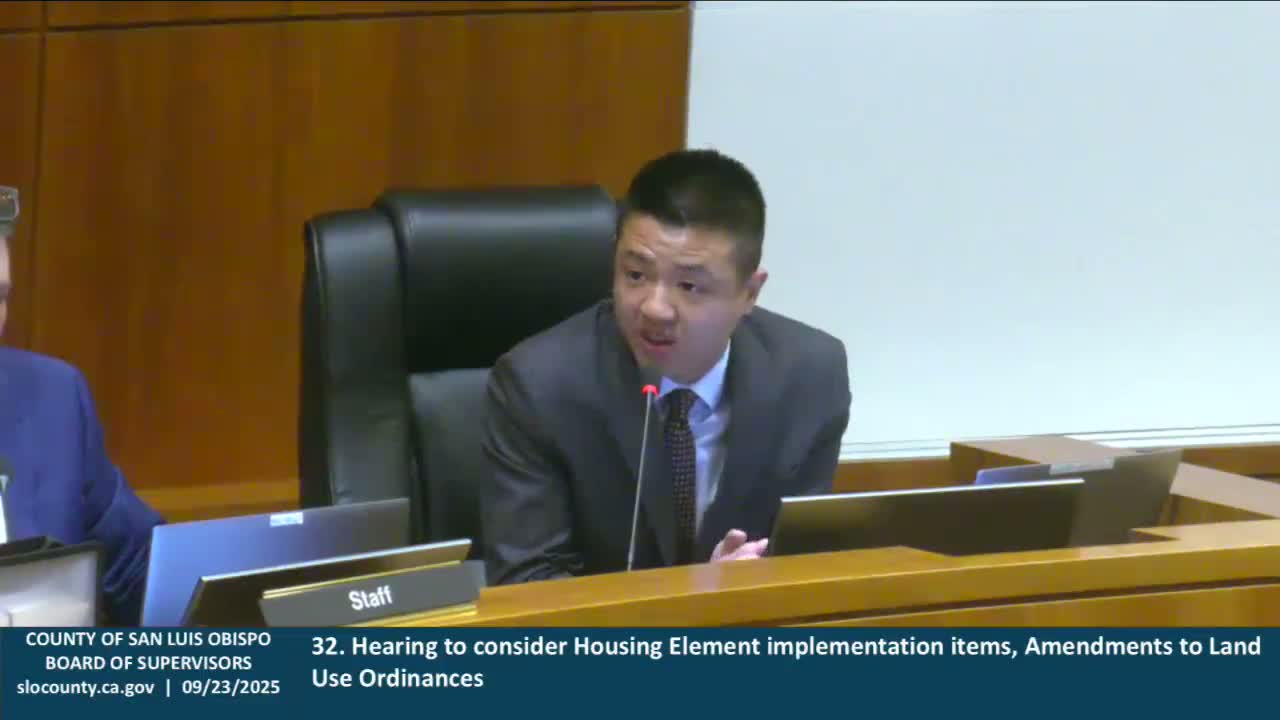
Board adopts multifamily baseline changes and tentatively approves a voluntary housing incentive fund
Summary
The board adopted countywide baseline changes to encourage multifamily development (removing a minimum‑density requirement and ordering an annual review) and tentatively approved a voluntary regional housing incentive program that lets builders earn or buy points (initially $30,000/point) to access concessions and generate funding for deed‑restricted housing and transit.
The San Luis Obispo County Board of Supervisors took two major housing actions Sept. 23: it adopted amendments to county land‑use rules that update baseline multifamily standards and it tentatively approved a voluntary regional housing incentive program and associated Title 31 regional housing fund to generate local funds for affordable housing.
On Action 1, the board adopted amendments to the county’s multifamily baseline regulations, including removing interim commercial/residential constraints and allowing 100% residential development on qualifying commercial parcels when certain affordability thresholds are met. The board also removed a proposed minimum density requirement and directed staff to perform an annual review of outcomes. "I think timing and...we have been painstaking in our accountability efforts to ensure the nonprofits are going to be taken care of as best as possible," Chairperson (S1) said in explaining support for change while retaining oversight tools.
For Action 2, planning staff described a voluntary, point‑based incentive program intended to let market developers either provide on‑site deed‑restricted affordable units (each affordable unit would accrue two incentive points) or pay an in‑lieu fee into a proposed regional housing fund. Staff proposed an initial in‑lieu fee of $30,000 per point (range discussed: $30k–$50k). The fund would target roughly $450,000 in annual receipts from in‑lieu contributions (about 15 points a year) and allocate 75% of receipts to affordable housing projects and 25% to public‑transportation improvements. Sean LeSiong (planning staff S15) said the fund’s balance and the fee level would be adjusted annually based on participation.
Supporters — including the County Housing Authority, nonprofit builders and the Home Builders Association — told the board the incentives and the fund together could unlock projects by creating predictable options for developers and financing sources for nonprofit builders. Nonprofit speakers said local seed funds help them leverage state and federal tax credit equity for deed‑restricted units. Critics, including Supervisor Gibson (S8), urged stronger analysis of how much revenue the program will raise and whether the point‑pricing is calibrated to capture a fair share of increased land or development value. Gibson asked staff whether a market study had tested whether a $30,000 or $50,000 point price would be viable; staff said the ad hoc steering committee recommended the $30,000 starting point to encourage participation, and that the number was developed from past density‑bonus projects and a county nexus study, not a fresh market valuation.
Votes and next steps: the board adopted Action 1 with the amendment to remove minimum density and to require an annual review. The board tentatively adopted the regional housing incentive program and directed staff to return with finalized ordinance text, advertising, and the Title 31 fund ordinance for a final hearing on Oct. 21. Staff will also scope further public outreach and analysis on program mechanics, including whether to extend eligibility to single‑family developments in a future phase.