Get Full Government Meeting Transcripts, Videos, & Alerts Forever!
Get email alerts on the Virtual School topic
No spam. Unsubscribe anytime.
Board weighs closing Leon County Virtual School as budget savings strategy
Summary
At a Feb. 9 workshop the Leon County School Board discussed possibly sunsetting Leon County Virtual School to save roughly $660,375 in staffing costs, while staff warned the move could cost related FTE revenue and affect students with special needs; no decision was made.
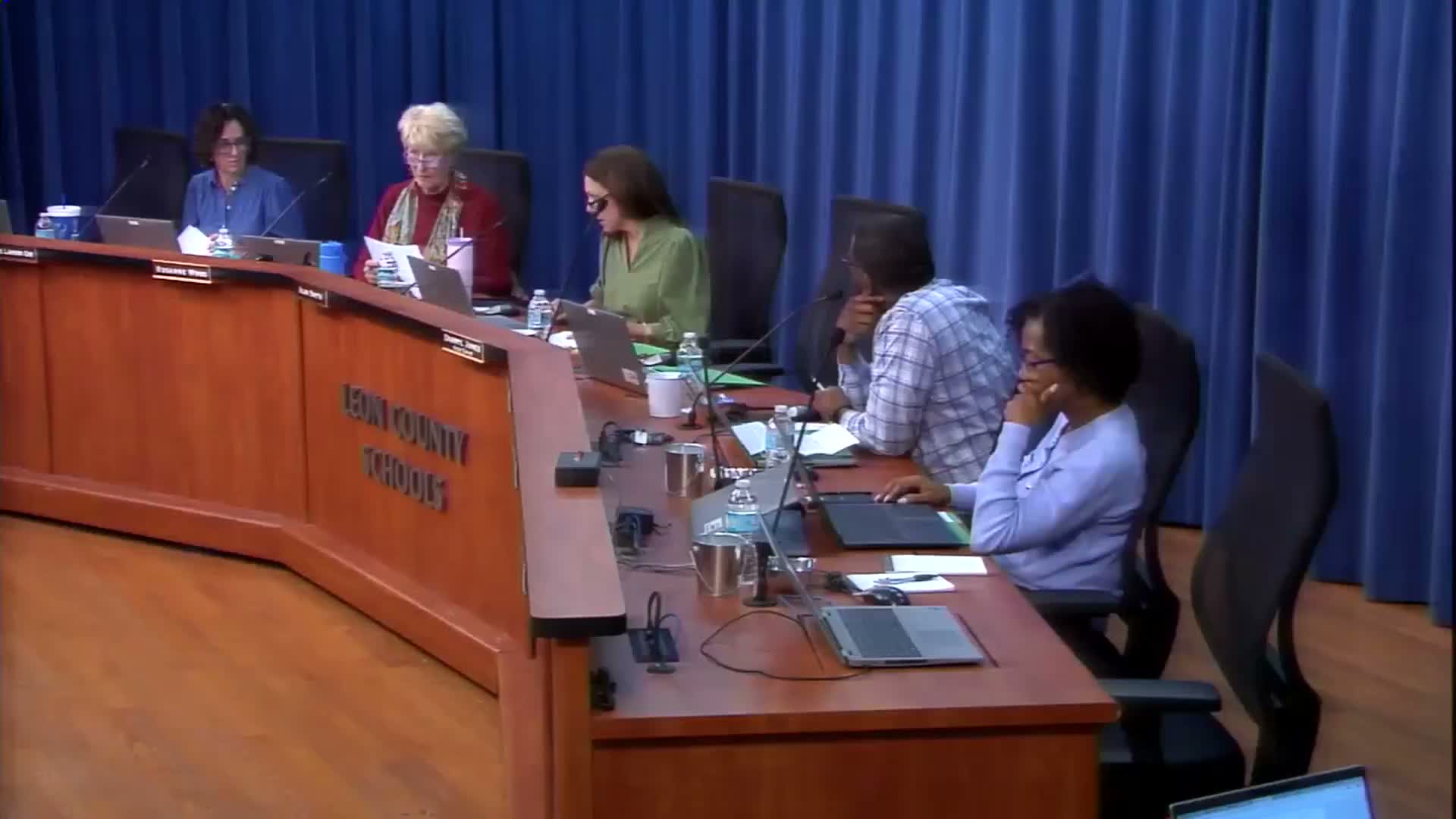
The Leon County School Board spent the bulk of a Feb. 9 workshop reviewing staff analysis of the Leon County Virtual School and how closing the program could affect district finances and students.
District assistant superintendent Dr. Sunny Chancey told the board the staff packet includes a three‑year comparison of Leon County Virtual School revenues and expenditures and an impact analysis that ties each recommended superintendent budget cut to concrete effects. "The number here at the end of 2425 being 660,375 and 66¢," Dr. Chancey said when pointing to the savings estimate the packet shows.
Why it matters: the district pays teacher salaries and benefits for the virtual program and also pays Florida Virtual School (FLVS) for platform access or a la carte course delivery. Staff said the roughly $660,375 savings figure reflects absorbing virtual‑school positions into next year’s staffing plans (reducing above‑staffing lines). But staff cautioned the savings depend on whether the students who currently generate FTE remain in the district or enroll with FLVS. "If we lost all those FTE next year and none of them came back, we would lose 562,000 in revenues," one presenter said, noting the net effect depends on both expenditures forgone and revenue forfeited.
Student and staffing impacts: staff described about 60 full‑time virtual students (including roughly 34 seniors expected to graduate this year) and about 506 students taking one‑off FLVS courses such as driver’s ed. Dr. Chancey said completion data that dictates exact FTE will not be final until June. She also said some full‑time virtual students have special needs: "Right now in our virtual program for full time students, we have, I wanna say 7 students that have P.S. so we'll certainly need to take some care and consideration with our students that have I.E.P.S.," she said, adding the district would counsel families and coordinate transfers if the board directs closure.
On teachers, staff said vacancies exist in certification areas and the district would encourage (but not require) virtual teachers to apply for open brick‑and‑mortar positions. "Those teachers would get absorbed into their current staffing plans that we've budgeted," another presenter said, describing the mechanics by which staff think the FY24/25 line items would be removed from above‑staffing if the program were eliminated for the next budgeting cycle.
Board members pressed for equity and operational details, including which students choose virtual instruction and why, how medical or homebound cases would be served, and whether closure would create gaps in supports. Board members also asked staff to provide exact reconciliations of 'actuals vs. budgeted' numbers to determine whether the "juice is worth the squeeze." Dr. Chancey said staff will double‑check the budget comparisons and bring answers back at the next meeting.
What’s next: the board did not vote or direct an immediate closure; members repeatedly said a final decision has not been made and requested additional data (exact budgeted vs. actual staffing amounts, updated completion/FTE figures after June, and transition plans for students with IEPs).