Get Full Government Meeting Transcripts, Videos, & Alerts Forever!
Get email alerts on the Budget topic
No spam. Unsubscribe anytime.
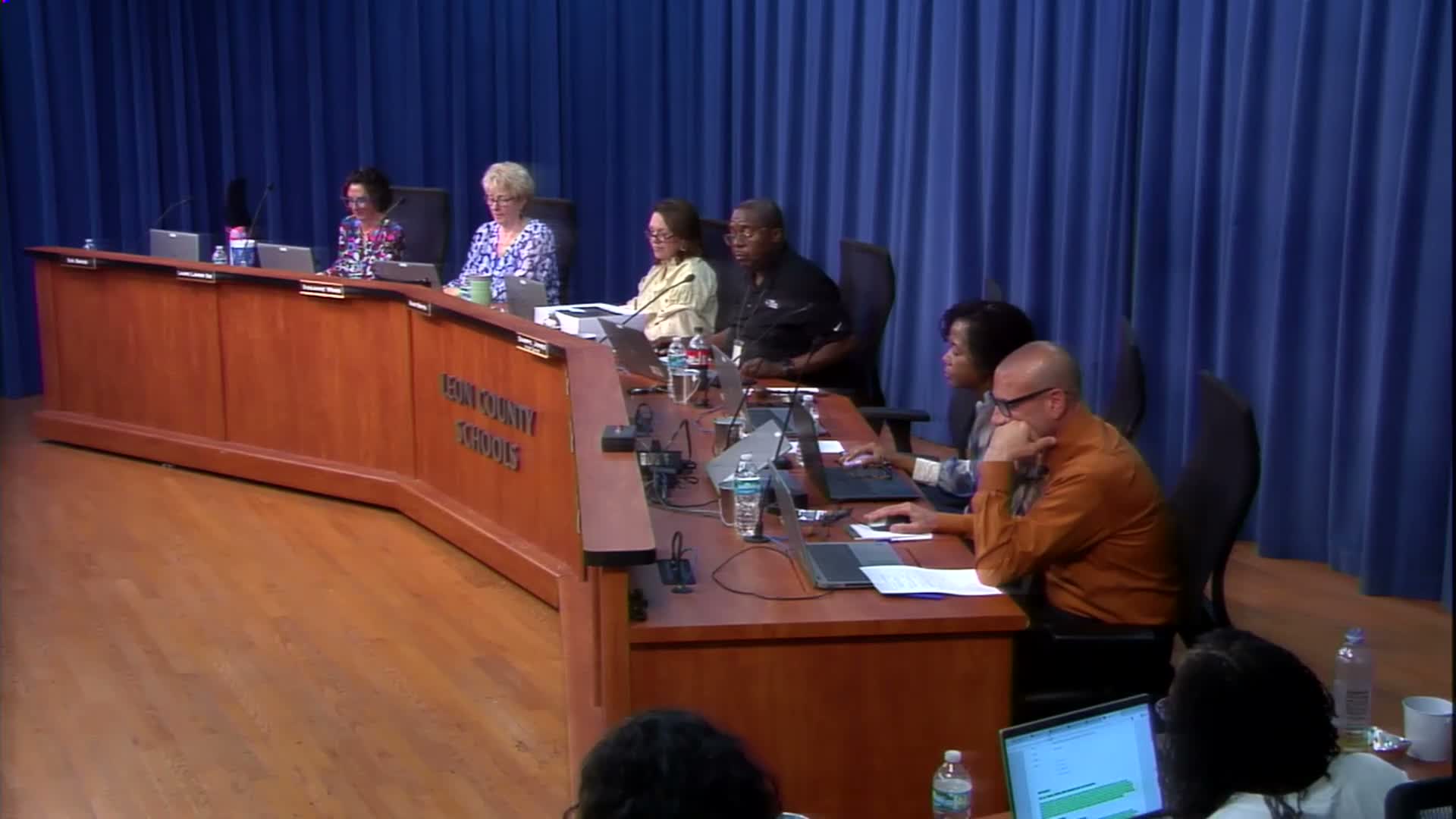
Leon County School Board weighs staffing cuts, halves arts/athletics allocation and pauses virtual-school closure
Summary
At an agenda review March 23, Leon County School Board members reviewed superintendent recommendations that would trim district cost centers roughly $2.3 million (about 5.7%), shift staffing decisions to school-level reviews and reduce arts and athletics funding from $1 million to $500,000. The superintendent removed a proposed closure of Leon Virtual School and proposed alternative virtual-course models.
The Leon County School Board on March 23 heard detailed budget recommendations from the superintendent that would reduce district cost-centers spending by roughly $2,300,000 (about 5.67% of the roughly $41,000,000 district cost-centers line) and cut the districtwide arts and athletics allocation in half to $500,000.
Superintendent (unnamed in the transcript) told the board the district must "start preparing to make decisions, you know, preparing for what potentially may be the worst and then hoping for the best," noting the state legislature had adjourned without a final budget and leaving uncertainty about next-year revenues. On the Leon Virtual School he said, "I am no longer requesting that the school board close Leon Virtual School. We are in the process of, looking at a different model to see how we can reduce costs, drastically, but still offer a virtual platform and program for our students." The superintendent said staff will explore offering targeted virtual courses (drivers education, HOPE, financial literacy) rather than full-time virtual enrollment.
The superintendent quantified several budget pressures shaping the recommendations: he estimated $2.3 million in cost-center reductions from freezes, consolidations and eliminations; projected health-insurance cost increases of roughly 8% (which he said would be about $3.2 million); a utility increase of about $1,000,000 year over year; and roughly $2.8 million pegged to salary adjustments discussed with bargaining units. He said together those items could total $7–8 million in added cost depending on the legislature's final actions.
To preserve classroom and support services where possible, the superintendent proposed a school-by-school staffing review instead of blanket cuts. He explained that the district added 150 positions with federal ESSER funds during the pandemic and has retained about 60–70 of those positions; the recommendation is to meet principals one-on-one to determine which roles should remain, drawing on site-level funding streams (Title I and others). "We added 150 total positions with the ESSER money, nearly $100,000,000 that flowed through our district from March 2020 through September 2024," he said.
Board members pressed for clarity on who would decide which positions are preserved. Several members warned that reductions could cost social workers, math interventionists or other direct supports. Board member Cox (identified in the meeting) noted many social workers are funded by mental-health categorical allocations but that the district supplements those grants from the general fund; she urged caution before eliminating positions that directly affect students. Board member Jones urged collaborative arrangements with local universities for internships and clinical placements as one way to extend capacity.
The superintendent also recommended redirecting arts and athletics funding, proposing that high schools receive $25,000 for arts and $25,000 for athletics (down from $50,000 each) and that middle-school allocations be reduced (example: $25,000 to $12,500). He said the district will maintain instrument-replacement and some capital outlay commitments. "One of my recommendations is to reduce that million down to 500,000," he said, adding the move seeks to preserve core extracurricular opportunities while shrinking a discretionary line.
The meeting included an extended debate over whether the district should consider school consolidation to reduce fixed costs. Board member Smith said the district has "lost over 1,000 students just in the last 5 years" and called declining kindergarten enrollment a warning sign; she argued consolidation could free up resources to retain interventionists and social workers. Other members warned that closing schools would disrupt families, risk rezoning across the district and could produce transportation and transition costs that offset some savings. The superintendent said consolidation remains under study but that he did not believe the district had reached the threshold for closures at this time.
Before adjourning the agenda review, the chair outlined how the full board vote on the superintendent's recommendations will be structured the next day: option 1 would approve the superintendent's slate as presented; option 2 would allow board members to craft a board-discretion motion specifying which items to accept and which to return to staff. The chair and staff emphasized that any board motion must be clear about timeline impacts for principals' staffing plans.
The superintendent and staff said they will provide more detailed, itemized savings and will return to the board after the legislature's final actions if revenue assumptions change. The board did not take formal action during the agenda-review meeting; the recommendations were set to come before the full board for a vote at the next meeting.
Ending: The superintendent's recommendations—the staffing-review approach, proposed arts/athletics reductions and the alternative model for Leon Virtual School—are scheduled for the board vote at the full meeting the following day; the board and staff will produce more detailed line-item savings and staffing impacts before that vote.