Get Full Government Meeting Transcripts, Videos, & Alerts Forever!
Get email alerts on the Transportation Infrastructure topic
No spam. Unsubscribe anytime.
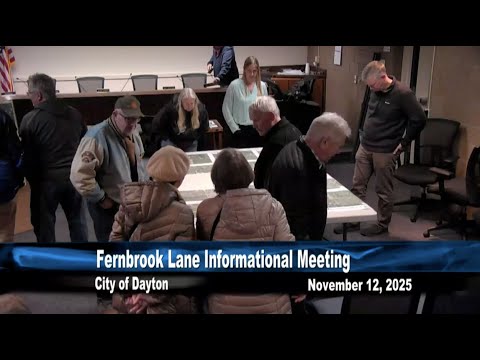
Dayton staff present Fernbrook corridor study, residents warn roundabouts could affect driveways and safety
Summary
City of Dayton staff presented a preliminary corridor study for Fernbrook Lane that favors roundabouts and targets construction around 2028 if funding is secured; residents pressed officials for clearer vehicle counts, driveway protections, pedestrian facilities and details on property impacts and timing.
City of Dayton staff presented preliminary designs for a Fernbrook Lane corridor study at a community open house, saying developer contributions and county funding opportunities could fund intersection improvements, and that roundabouts are the preferred treatment for safety and traffic flow.
Jason Quisberg, Dayton’s city engineer, told residents the city has identified roughly $2 million from the DCM Farms development and a $125,000 contribution from Braeburn Trails toward initial work and engineering. Quisberg estimated construction at about $2.5 million per intersection and said a corridor-level total in the low single-digit millions (roughly $7–8 million) is a working estimate for multiple intersections; he emphasized those figures are preliminary and will be refined in engineering.
The nut of the project, staff said, is to study access, speed and future development impacts along Fernbrook Lane, produce designs that accommodate private driveways where possible, and pursue funding rather than commit City general-fund dollars now. Staff said a targeted construction window of 2028 would let the city coordinate work with planned county bridge and trail reconstruction to limit repeated detours.
At the meeting, residents questioned the trade-offs between roundabouts and signals, and whether a roundabout would intrude on private property. “Why does it have to encroach on somebody else?” one resident asked, arguing a developer should locate improvements on his own land. Nicole Gulick, the roadway designer, said designers typically center a roundabout in the intersection and adjust alignment where feasible, but shifting a center can require new roadway and raise costs; staff said raised medians or cut-throughs can often preserve driveway access in many designs.
Residents also pressed staff on near-term traffic: several speakers said development phases could bring added traffic by 2026 and that, in morning and afternoon peaks, drivers already struggle to exit driveways near existing roundabouts and stop signs. Staff said the county performed traffic and speed counts, that reported crash data for 2022–2025 showed only a small number of reported vehicle collisions in the study area, and that enforcement and reporting gaps could undercount incidents. The city recommended residents report crashes to the police and provide parcel-specific constraints (wells, septic, driveways) so designers can avoid or incorporate them into right-of-way plans.
On funding, Quisberg described a Hennepin County cost-participation program that can contribute toward county-road intersection projects (staff said the county’s program can provide up to roughly $500,000 per project and that treating intersections separately might increase total county support across the corridor). Staff cautioned county funds are limited and competitive.
Residents suggested short-term, lower-cost measures—four-way stops, targeted signals or enforcement—as interim relief. Staff said the county controls changes to county roads, that signal or stop installations require a formal warranted analysis, and that staff can submit requests but cannot guarantee county approval without data.
Staff said the guaranteed near-term action is the corridor study (paid by developer contributions for this phase), and that there will be additional open houses and email follow-ups for residents to share property-level concerns. “We’ll keep everybody posted,” staff said. The city asked residents who live on corners or who have wells/septic near the right-of-way to provide that information so designers can consider it during detailed layout.
The next steps: the city will complete the corridor study, refine cost and design options, pursue county and other funding, and hold further public meetings before any property acquisition or construction is finalized.