Get Full Government Meeting Transcripts, Videos, & Alerts Forever!
Get email alerts on the Parks And Recreation topic
No spam. Unsubscribe anytime.
Oro Valley council approves additional funding to restore Vistoso Trails pond, 6-1
Summary
After hours of public comment and technical questioning, the Oro Valley Town Council voted 6–1 to authorize up to $461,399 from the general fund contingency to cover the bid gap for the Vistoso Trails Nature Preserve pond restoration (base bid plus alternate parking), with staff directed to proceed under council oversight.
The Oro Valley Town Council voted 6–1 on April 8 to authorize additional funding to complete the Vistoso Trails Nature Preserve pond restoration, approving staff's recommendation to fund the base bid plus alternate parking and cover a budget shortfall from the general fund contingency.
Supporters of the project filled the public comment period, urging council to finish a multi-year restoration that residents and volunteers have advocated for since the golf course failure. Mark Napier, an Oro Valley resident who has addressed the council previously, told members: "The question before us tonight is not whether or not this project should go forward. This body's already decided that in March that that we would support this project with a $2,000,000 budget." Multiple speakers urged the council to pursue community partnerships and active oversight to keep the project on budget and on schedule.
Opponents raised engineering and health concerns tied to reclaimed water and sediment removal. Charles Stack, who said he has experience building ponds, warned staff and council about potential disposal challenges: "If I am correct in that material at the bottom of the pond contains forever chemicals like PFAS ... you may have a hazardous waste disposal problem here." He also argued that some historic pond features would be removed under the current plan.
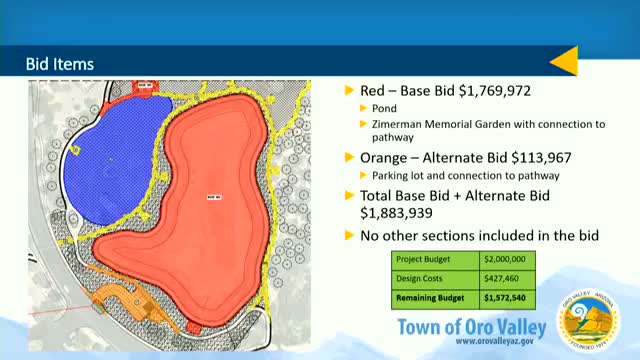
Parks and Recreation Director Roz Epting summarized the bidding and funding options for council. She said the base bid (the pond footprint and immediate connections) returned at roughly $1.7 million, and an alternate bid for a small parking lot was about $113,000, for a combined base+alternate of a little over $1.8 million. After subtracting design costs and an allocated $50,000 memorial-garden offset, staff calculated a shortfall of $461,399 if council authorized both the base and the alternate work. "Total base bid and alternate bid was a little bit over $1,800,000," Epting said in her presentation.
Councilmember Nicholson moved to authorize funding for the base and alternate bids and to take $461,399 from the general fund contingency; the motion drew a second and passed with six ayes and one nay. Mayor Joseph C. Winfield announced the result: "The ayes have it, 6 to 1." Councilmembers who spoke in favor cited the long delay on the project, anticipated community benefits, and the relative scale of the overrun compared with earlier town expenditures.
Before the vote, staff acknowledged the remaining uncertainties: the bid includes a 10 percent contingency and staff said there are opportunities for value engineering, close oversight, and philanthropic partnership for later phases. Epting told council they could fund the project in multiple ways (full contingency draw, staged use of site-improvement line items plus next-year allocations, or other combinations) and recommended a staff report back on cost controls and project milestones.
What happens next: Staff will execute the construction contract under the funding authorization, monitor contingency use, and return to council with periodic updates. Council did not specify a separate schedule for the work at the meeting; staff said they would circulate timeline and reporting checkpoints during project execution.