Lifetime Citizen Portal Access — AI Briefings, Alerts & Unlimited Follows
WAG told DFW will seek rule changes to clarify who may act when wolves attack livestock
Loading...
Summary
Department staff told the Wolf Advisory Group that the Fish and Wildlife Commission has directed rulemaking to fix ambiguous WAC language governing livestock‑wolf interactions. The department said it will address three ambiguities—who qualifies as an 'agent,' how timing is defined, and what counts as an 'attack'—and will share draft language with WAG before public comment.
The Department of Fish and Wildlife informed the Wolf Advisory Group on Thursday that the Fish and Wildlife Commission has asked the agency to begin formal rule changes to clarify existing WAC language about how and when people may respond to wolves attacking livestock. The department said the commission’s direction follows prior petitions and work dating back to 2019.
DFW policy lead Shubh Bhattachar told members the department is preparing a CR101/CR102 filing and expects to share a more detailed draft with the advisory group after an overlapping compensation rulemaking finishes its work. "We were instructed by the commission…to go ahead with modifying this," Shubh said, adding that staff plan to submit a detailed draft by July 1.
Shubh flagged three specific ambiguities the rulemaking will aim to resolve: the definition of an "agent" (who may respond without a permit), the timing or window tied to allowances for "one wolf" responses (how many incidents or what time‑frame applies), and what counts as an "attack" — whether the legal definition should include not only physical contact but chasing or pursuing behavior.
Members urged the department to circulate written drafts before rule filings so WAG can provide substantive feedback. Producer and WAG member Sammy Cherry said this was the first time some members had heard of the commission direction. "I have questions in my notes… it says one per event. What is an event?" Sammy asked, pressing the need for concrete language.
Several producers and WAG members also expressed frustration that individual WAG members’ public comments had been mentioned in commission meetings in a way that some perceived as representing WAG as a whole. "We are not doing it as WAG," one member said, noting that individuals may submit public comment separately from official WAG recommendations.
The department said it will contract a small business economic impact statement (SBEIS) vendor—the same industrial economics firm used in previous rule work—to interview producers and help characterize effects on small businesses. Shubh also said the department will coordinate with the Department of Agriculture and with WAG subgroups to develop a legislative report tied to a pay‑for‑presence idea; that report is due June 30 unless the group seeks an extension.
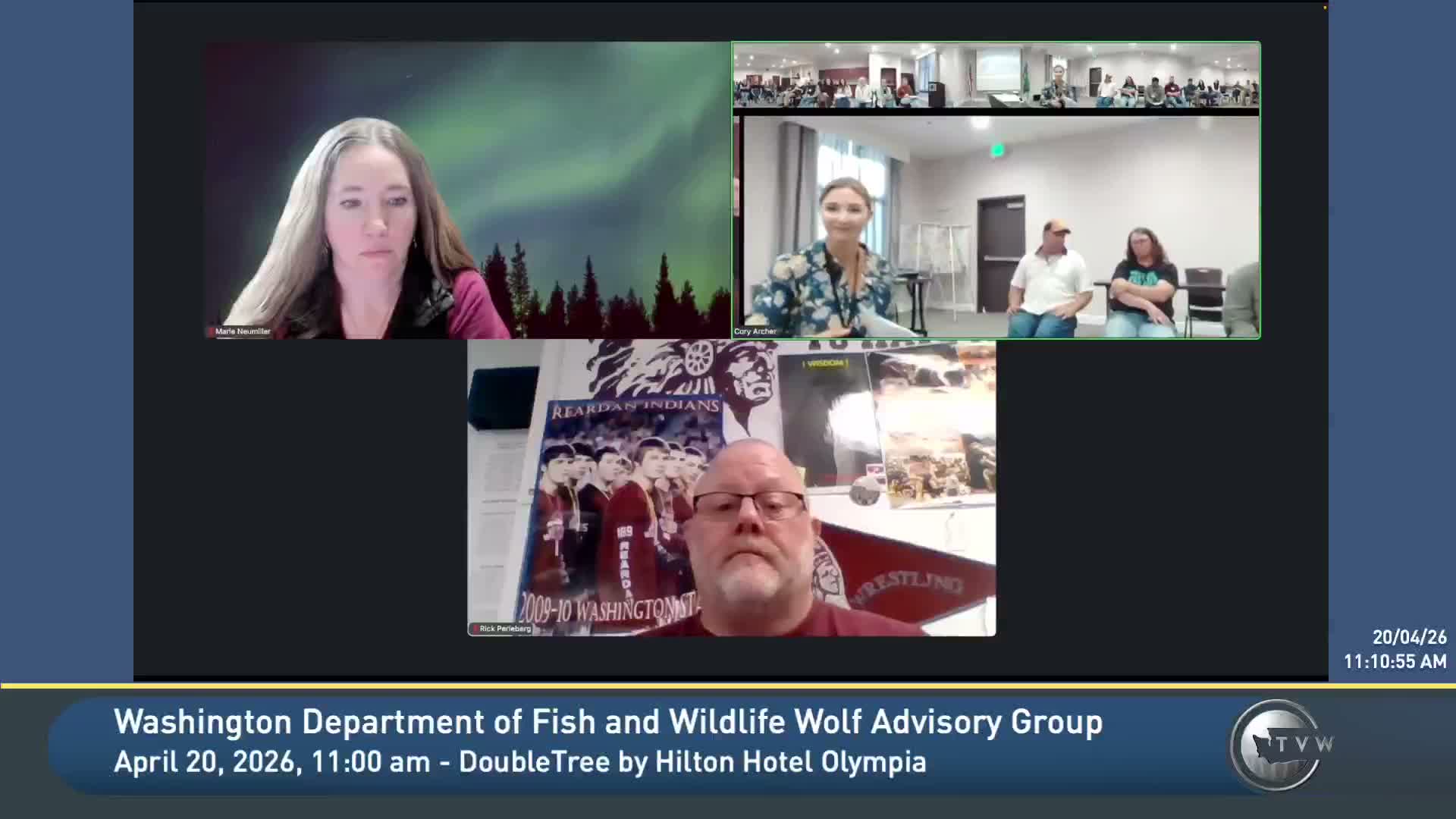
Corey Archer, the facilitator, said WAG will be given the draft CR102 language for review and that the group could convene a short special full WAG session or a subgroup to provide more concentrated input. "Let's make plans for that subgroup to come together," he said, proposing a May session to allow member input before the legislative deadline.
What happens next: DFW will finalize internal coordination with compensation rule staff and the SBEIS contractor, circulate draft rule language to WAG when available, and work with WAG members to form a subgroup for timely review and asynchronous input. Members said they want clearer documentation and transparent tracking of comments so individual public submissions are not conflated with WAG consensus.