Get Full Government Meeting Transcripts, Videos, & Alerts Forever!
Get email alerts on the Facilities Planning topic
No spam. Unsubscribe anytime.
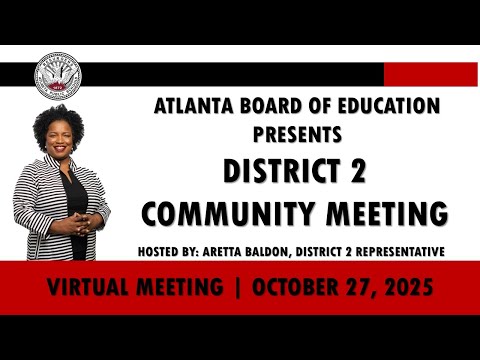
Board member Arata outlines APS Forward scenarios as community voices concern over school consolidations
Summary
Board member Arata said Atlanta Public Schools reported a 90.5% graduation rate and reviewed draft APS Forward facilities scenarios for District 2, including proposed repurposings and consolidations; community members raised concerns about losing neighborhood schools and asked for more engagement before a November first read and a December final read.
Board member Arata, the Atlanta Board of Education representative for District 2, opened the community meeting by announcing that Atlanta Public Schools achieved a 90.5% graduation rate for the cohort of 2025 and then reviewed draft APS Forward facilities scenarios affecting District 2.
Arata listed several proposals in the current scenarios: Kipsel Primary and Academy is proposed for repurpose; Finch Elementary and Pircheson Elementary are proposed to combine at a converted Sylvan Hills Middle School facility; Perkerson, Finch and Giddens elementaries are proposed to join the Washington cluster while Slater and Price are proposed to join the South Atlanta cluster. Hollis Innovation is proposed to remain a K–8 school rather than convert to K–5. Arata said the School of the Arts at the Carver campus is proposed to expand to a 6–12 campus, and an Early College program is proposed as 9–12 with districtwide preference. She also noted Dunbar Elementary is proposed for boundary realignment and repurpose and that FL Stanton’s attendance area would be split between Washington and Douglas clusters. Arata emphasized these scenarios are draft and subject to change.
Community members asked how proposed consolidations would preserve neighborhood identity and walking access. "We're losing our school," said community member Abby Greenbaum, describing a common sentiment in meetings: "they're taking our school away." Arata replied that she was not running the administration’s facilities process but that, under policy, there would be community engagement and that administration would lead conversations about programming, design and how both communities would feel ownership of a new or repurposed facility: "there will need to be engagement with the communities, to build what that new school would look like." Carolyn Barnett, speaking for administration, said the next iteration of engagement will focus on "what does the future look like for the communities that may be merging" and invited people to participate in additional community meetings.
Arata reiterated procedural timing: the first read of the plan is scheduled for the November board meeting and the final read for December; she urged residents to submit feedback to administration before the final vote. The board did not take a vote at the community meeting.
The administration encouraged attendees who want to influence programming and design to provide concrete input on priorities for facilities and student experience. Further details, including any refinements to scenarios, will be posted to the APS facilities website when available.