Get Full Government Meeting Transcripts, Videos, & Alerts Forever!
Get email alerts on the Land Use Development topic
No spam. Unsubscribe anytime.
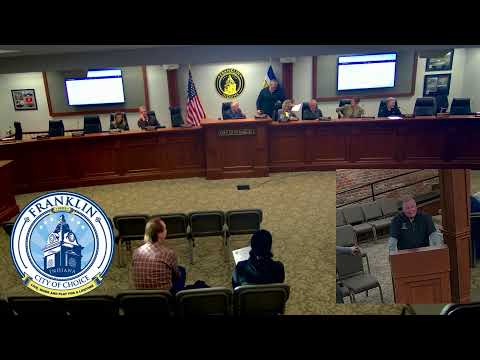
City council approves rezoning for Innovation Park at Franklin College after public hearing
Summary
After a public hearing and questions from council members, the Franklin City Council approved ordinance 2026-08 to rezone roughly 249 acres as the Innovation Park at Franklin College PUD; the petitioner committed in writing to prohibit most subsidized housing except for enrolled Franklin College students and agreed to enforceable language to bind future owners.
Franklin City Council on April 20 approved ordinance 2026-08 to rezone roughly 249 acres on the city’s north side as the Innovation Park at Franklin College planned unit development.
Carey Prather, president of Franklin College, told the council the college bought the land in 2006 and has held about 249–250 acres while waiting for a thoughtful development opportunity. “The Innovation Park itself, which is the 40 acres that sit closest to the existing eastern perimeter of the campus, is envisioned…to attract small and medium sized high-tech businesses,” Prather said, describing plans to pair office and lab space with residential and retail to create jobs and internship opportunities for students.
Tim Oakes, an attorney with Ice Miller representing the college, outlined the conceptual plan for the PUD, including a mix of detached single-family, attached units, multifamily and a concentrated innovation district. He said the PUD includes buffers, design guidelines and an architectural-review process the college will administer. “We will enter into a written commitment,” Oakes said, describing a voluntary restriction the college will record to prohibit tenant-based vouchers such as the Housing Choice Voucher program ("section 8") and project-based subsidies ("section 42") on the property, "with the exception of students enrolled at Franklin College." He stated the commitment would be placed of record and bind future owners and cited the ordinance-recording authority as spoken in the hearing.
Neighbors and stakeholders generally voiced guarded support but pressed for safeguards on traffic and neighborhood compatibility. Glenn Karlstrand, representing the Jefferson neighborhood, said his group supported the development "but with some modifications," and repeatedly asked how voluntary commitments would be enforced. Tristan Pruitt, executive director at Morning Pointe Assisted Living, and other residents urged the city to address safety at the Milford and Jefferson/King intersections before build-out. Cookie McWilliams requested simple fixes such as repainting lane arrows to reduce confusion.
Oakes and college representatives said the commitments will include explicit enforcement provisions and offered to vest enforcement either with the city or with nearby neighbors, and they emphasized that traffic and drainage will be addressed through the required platting and permit reviews. Planning Director Joanna Tennell summarized the post-approval steps: primary platting (technical review committee and plan commission public hearing), secondary plat and construction plans, site-development reviews for nonresidential uses, state land-disturbance permits for work over an acre, and county drainage-board oversight for existing legal drains.
Council members questioned density, lot sizes and whether the development would attract custom builders or track builders. The petitioner estimated the Gold single-family area could accommodate roughly 75–80 homes at maximum density but said final lot counts and product types would be market-driven.
Council member (speaker 6) moved to adopt ordinance 2026-08 with the petitioner's voluntary written commitments; the motion carried by roll-call vote with unanimous support recorded by the clerk. The ordinance approval does not allow immediate construction: developers must return with primary and secondary plats, construction plans and any required permits before ground is broken.
Next steps identified at the meeting include the primary plat submittal to the technical review committee and plan commission, subsequent traffic and drainage studies, and additional public notices and hearings at the platting stage.