Get Full Government Meeting Transcripts, Videos, & Alerts Forever!
Get email alerts on the Council Votes And Allocations topic
No spam. Unsubscribe anytime.
Votes at a glance: El Cajon approves CDBG/HOME allocations, expands emergency sleeping-cabin village, backs SANDAG fee update and adopts vaping-device ban
Summary
In addition to adopting an IHRA-based antisemitism resolution, the El Cajon City Council unanimously approved the staff-recommended CDBG/HOME allocations for FY25–26, authorized a phased expansion of an emergency sleeping-cabin village, adopted a SANDAG-required fee increase and approved an ordinance banning vaping devices disguised as other products.
The El Cajon City Council took a series of budget, housing and regulatory votes at its meeting following a lengthy public hearing on Item 12.
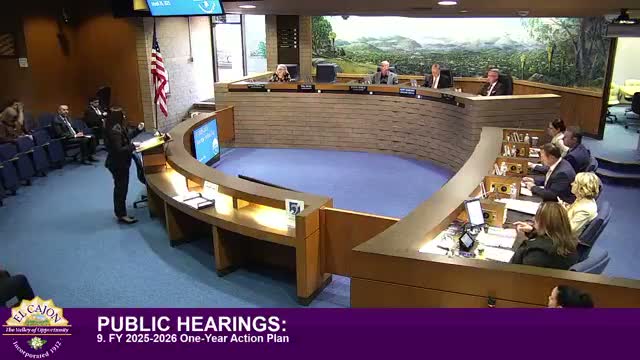
CDBG and HOME funding: Staff presented the draft FY 2025–26 action plan for Community Development Block Grant (CDBG) and HOME funding, recommending programs serving low- and moderate-income residents, public-services grants and a housing rehabilitation loan program. Staff summarized a recommended CDBG total of $1,302,273 and noted reauthorization/prior‑year funding of $2,365,757 for previously approved projects, bringing the total pool discussed to about $3.1 million. Laura Tancredi Bacy, CEO of Home Start, told council the nonprofit has been a longtime El Cajon partner on housing and rapid-rehousing services. After public testimony and council Q&A, the council approved the staff recommendations by unanimous vote.
Emergency sleeping cabins expansion: Councilmembers considered a joint report to authorize staff to pursue a phased expansion of the Meridian-Amicus emergency sleeping-cabin village (Meridian Village). Council guidance recommended smaller phased increases (for example, moving to six cabins before any larger jump) and asked staff to handle zoning and implementation details. Herb Kelly, vice president of Amicus, and Lisa Cogan, who manages the village, said the site has housed residents since late 2022 and reported that 31 women and 18 children have used the village; speakers described success connecting participants to social services and permanent housing. Council moved and unanimously approved directing staff to return with implementation plans.
SANDAG RTCIP fee adjustment: Staff presented the mandated SANDAG Regional Transportation Congestion Improvement Program fee adjustment, explaining it is tied to construction cost indices. SANDAG recommended a 6% increase; staff recommended adopting a new fee of $3,047.57 per newly constructed single‑family dwelling unit. Public comment criticized the fee as a housing-cost driver, but council members said they would approve the adjustment to avoid jeopardizing regional transit funding; the motion to adopt staff’s recommendation carried unanimously.
Vaping devices ordinance: On second reading the council adopted an ordinance amending the municipal code to prohibit sale of vaping devices disguised as other products (no speaker cards were received); the motion to adopt passed unanimously.
AB 1333 (castle doctrine/justifiable homicide): Staff briefed the council on Assembly Bill 1333 as amended, which the staff report characterizes as changing the statutory standards for justifiable homicide/castle-doctrine defenses in certain circumstances. After public comment and council deliberation, councilmembers directed staff to draft and send a letter opposing AB 1333 to the bill’s author and local legislative offices; that direction will be implemented through the city’s legislative-report process.