Lifetime Citizen Portal Access — AI Briefings, Alerts & Unlimited Follows
Riverview council approves SRF loan application and project plan for landfill leachate PFAS treatment
Loading...
Summary
On April 26, 2026 the Riverview City Council unanimously adopted the final project plan and approved submitting a Clean Water State Revolving Fund loan application to expand treatment of landfill leachate for PFAS; the city selected a granular activated carbon plus ion-exchange system with an estimated 20-year present-worth of about $44.7 million and a design capacity of roughly 116,000 gallons per day.
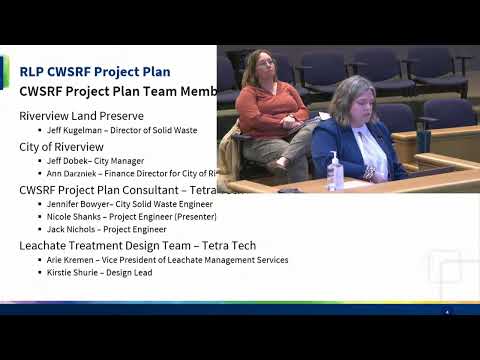
Riverview City Council on April 26 voted unanimously to adopt the revised 2026 Clean Water State Revolving Fund (SRF) loan application and final project planning document to expand the Riverview Land Preserve leachate pretreatment plant and address new PFAS discharge limits.
Nicole Shanks of Tetra Tech, the project presenter, told the council the city's leachate generation has ranged from about 17.7 million gallons in 2022 to roughly 32.8 million gallons in 2023 and noted recent revisions to the Downriver Utility Wastewater Authority (DUWA) industrial pollution permit that add limits for PFOS and PFOA. "Alternative C was selected based on that lowest total present worth cost, the constructability, and the implementation feasibility of the project," Shanks said, describing the chosen granular activated carbon (GAC) system with ion-exchange resin.
Why it matters: new DUWA permit limits and evolving PFAS standards mean Riverview must pretreat all landfill leachate from its three monitored outfalls rather than treating only the one outfall that currently receives PFAS removal. The selected plant is intended to centralize pretreatment, reduce off-site hauling of contaminated leachate and help the city meet permit requirements during the landfill's 30-year post-closure stewardship period.
The project team evaluated three short-listed options: (a) GAC plus foam fractionation; (b) reverse osmosis (RO); and (c) GAC with ion-exchange. Shanks said the GAC-plus-ion-exchange alternative offered the lowest total present-worth cost over the 20-year evaluation window, provided operational redundancy and growth capacity, and was judged most likely to meet current DUWA IPP PFAS limits as standards evolve. The team presented a total present-worth estimate of about $44,700,000 for the selected alternative over 20 years, a figure that includes capital, engineering and operations and maintenance costs.
Project capacity and schedule: the centralized pretreatment plant is being designed for about 116,000 gallons per day with an engineered buffer (the team noted average historical flows closer to 80,000'85,000 gpd and seasonal peaks higher). The schedule presented calls for final design in March (final design milestone), construction to begin in June 2027 and substantial completion by May 2028.
Operations and funding: the Land Preserve will operate the plant and train staff to manage routine maintenance and media replacements, the presenters said. The city intends to apply for a low-interest SRF loan (presented to council as roughly 2.5 percent) and pursue grant funding where eligible. Council and staff acknowledged potential revenue or cost impacts from changes in tipping fees but said raising fees requires care so the landfill remains competitive.
Council questions and public points: council members pressed for clarity on whether the existing leachate equipment would be decommissioned (staff said usable equipment will be salvaged or repurposed and that the building may remain for storage) and on the possibility of hauling leachate off-site. Presenters said hauling is increasingly difficult and costly, in part because fewer receiving facilities are equipped for PFAS removal; landfill staff estimated hauling costs have risen markedly in recent years. When asked about RO'based systems, the project engineer noted RO removes a greater share of contaminants but was shown to be the most expensive option in the team's 20-year comparison.
A public commenter raised a timing question about a perceived mismatch between a 20-year equipment-life evaluation used for cost comparison and the 30-year post-closure stewardship obligation; Tetra Tech responded that the 20-year horizon is an accounting tool for apples-to-apples cost comparison and that equipment replacements or updates will be required to meet the full 30-year obligation.
Next steps: the council adopted waiving the relevant council policy and approved submitting the SRF loan application and final project plan; staff will incorporate any comments received during the draft comment period into the final plan and submit the project plan to the state by the posted deadline. Construction, if funded and permitted, is expected to start in mid-2027 with substantial completion by May 2028.