Lifetime Citizen Portal Access — AI Briefings, Alerts & Unlimited Follows
Assembly committee advances emergency mortgage-forbearance package amid industry pushback
Loading...
Summary
The Assembly Banking and Finance Committee recommended AB 1842 and AB 1847 to the Judiciary Committee after extended debate. Authors said the bills create statewide forbearance tools for homeowners after declared disasters; mortgage‑industry groups warned of conflicts with federal investor guidelines and liquidity risks.
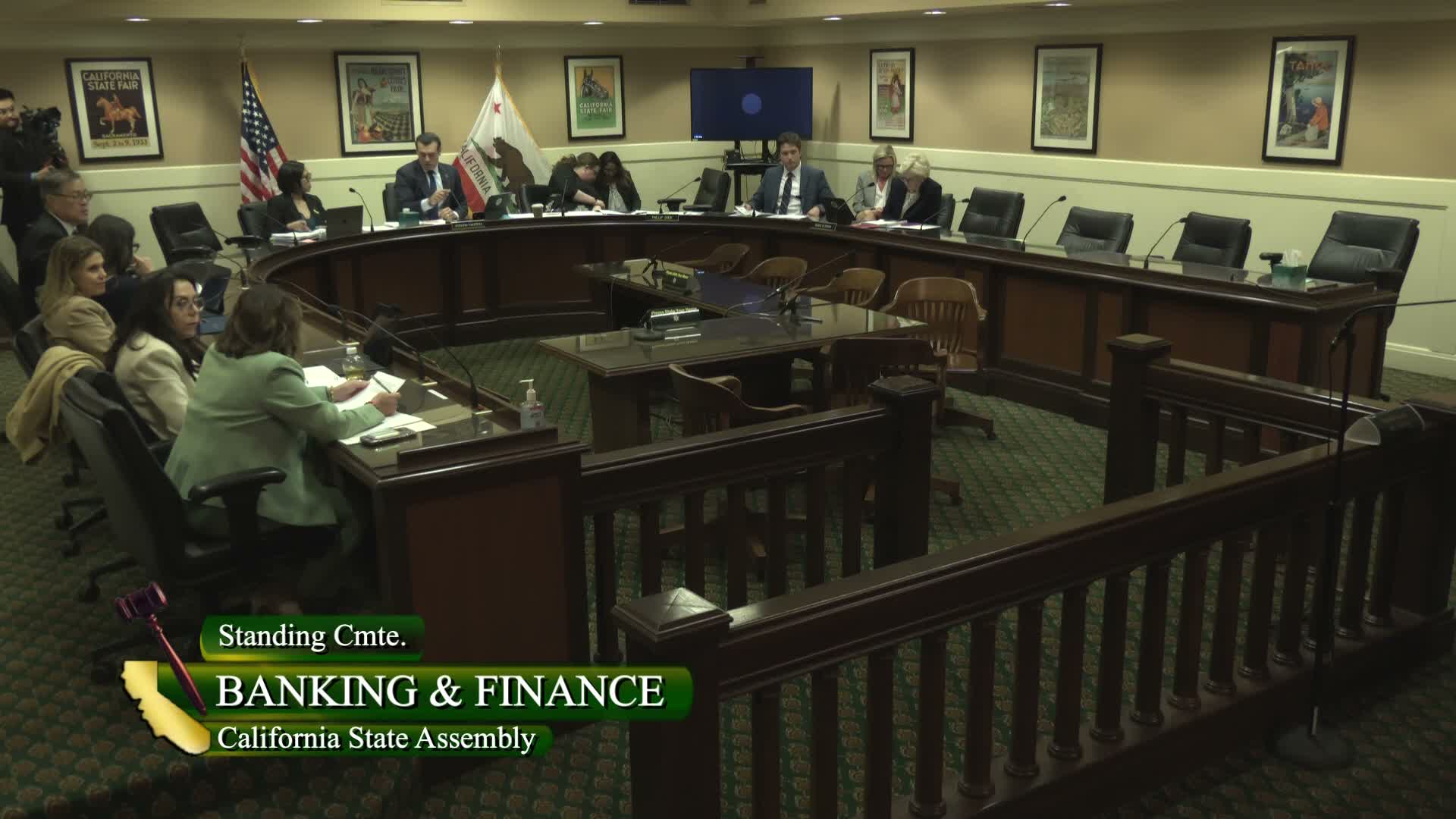
The Assembly Banking and Finance Committee voted to advance a pair of bills aimed at giving homeowners more time and clarity to recover after disasters, but the measures drew sustained pushback from mortgage servicers and banking groups.
Assemblymember Harabedian, the author, told the committee AB 1842 (the California Emergency Mortgage Act) would create a statewide framework for mortgage forbearance when a residence is uninhabitable because of a state or federally declared emergency. "It would give the banks and the mortgage servicers clarity as to what the requirements would be," he said, describing a structure that mirrors protections enacted earlier for wildfire victims.
Harabedian also presented AB 1847, which would extend the existing AB 238 forbearance protection from 12 months up to 36 months in total. Survivor Robert Fagnani, who lost his home in the Palisades fire, described long rebuilding timelines and urged lawmakers to extend relief. "Rebuilding a home right now ... takes 2, 3, even 4 years," Fagnani said, arguing that longer forbearance can be the difference between rebuilding and losing a neighborhood.
Industry witnesses cautioned that many mortgages are subject to federal investor agreements. Vanessa Lugo of the California Bankers Association told the committee that state-only mandates can create conflicting compliance duties for servicers required to follow Fannie Mae, Freddie Mac, FHA and private‑label investor guidelines. "When state requirements differ from those obligations, it can create conflicting compliance duties and uncertainty for both servicers and borrowers," she said.
Mortgage‑servicer representatives further warned that extended forbearance periods could create liquidity pressures for smaller institutions that must continue advancing payments to investors. They said investor contracts sometimes limit the options servicers can offer and that some exit strategies after long forbearance periods can lead to balloon payments unless a negotiated refinancing path is available.
Members pressed both sides for data. "We have asked the mortgage servicers to provide us data about financial distress," the author said, noting requests for the number of forbearances granted, denied and in effect in the fire zones. He acknowledged gaps in available data and committed to continue working with stakeholders to narrow the bill language to avoid conflicts with federal law.
Several members emphasized that the bills contain language requiring compliance with federal guidelines where applicable. "The language couldn't be clearer that to the extent that any requested forbearance doesn't adhere to GSE Fannie and Freddie investor guidelines or any contractual obligations ... forbearance doesn't have to be granted," Harabedian said.
After extended questioning and offers to negotiate amendments on enforcement and private-right-of-action language, the committee recommended both AB 1842 and AB 1847 be passed to the Committee on Judiciary. The author said he would continue work to reconcile state and federal requirements and to provide clearer consumer education on what forbearance does and does not cover.
Next steps: Both bills move to Judiciary, where authors and stakeholders are expected to pursue amendments to address investor‑guideline alignment, data collection, and implementation mechanics.