Lifetime Citizen Portal Access — AI Briefings, Alerts & Unlimited Follows
Brigham City Council discusses building indoor recreation facility; staff to pursue engineered designs for two options
Loading...
Summary
City staff presented a 20-year usage analysis showing reduced access to gym space and proposed two design options — engineer estimates of $9 million and $12 million — while council raised concerns about operating costs, program quality and funding; staff will get engineering and return with detailed cost and operating estimates.
Brigham City leaders discussed a proposed indoor recreation facility and two conceptual designs during a council meeting, with staff saying long-term declines in rentable gym hours have reduced the city’s ability to run youth and adult programs.
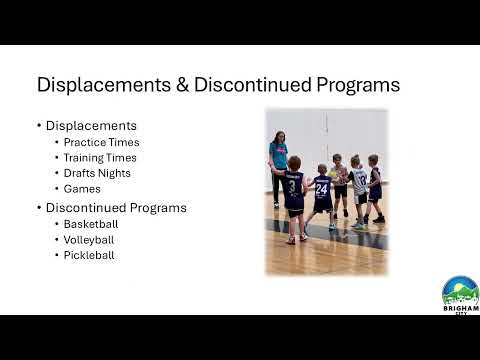
Parks and recreation director Chris told the council the department compiled a 20-year snapshot of gym hours and program participation that showed a high point in 2013–2017 of “over 900 hours a year” of rented gym space and a decline in the last five-year average to about 387 hours. Chris said that reduced access to partner facilities has forced staff to double-book practices, cancel some leagues and curtail staff training, which can lower program quality and participation.
The presentation outlined specific reductions: the department has discontinued adult men’s and women’s basketball leagues and scaled back volleyball and indoor pickleball programs because of lost access. Chris also cited research from national programs — including an Aspen Institute initiative and Sports & Fitness Industry Association data — to underscore that community-based leagues remain a primary participation channel for families.
City administrator Derek presented two footprint concepts staff asked the council to weigh. The larger concept would include two full-size gyms plus six cross-court youth courts; an engineer’s estimate for that option was approximately $12,000,000. The smaller concept would include two full-size gyms plus four cross-court courts and carried an engineer’s estimate of about $9,000,000. Derek emphasized these figures are engineer estimates, not bids.
On funding and taxes, Derek told the council staff sees a path to deliver either option "that would not include a property tax increase, to get those or a bond to get those accomplished," and later stated, "There will not be a property tax increase to build a recreation facility." He and other staff said operating and maintenance costs would be recorded in future budgets and would depend on final design choices for HVAC, lighting and square footage.
Several council members pressed staff for more disaggregated data. One councilor asked for attendance figures specifically for the Junior Jazz program over recent years rather than a combined sports total, saying mixed metrics can be misleading. Staff agreed to return with parsed program-by-program participation numbers.
Councilors also raised program-quality concerns — trained referees, adult supervision and consistent staff training — saying families sometimes pay more for private leagues because those programs offer more consistent staffing and perceived quality. "How the heck are you gonna maintain it and pay for the operating cost for a gym?" a council member asked, pressing staff to provide operating-cost estimates that include insurance, utilities and replacement cycles.
The council discussed tradeoffs between the two layouts: the six-court option increases capacity and casual public access but risks tighter spacing between courts; the four-court layout offers more spectator room and buffer space. Staff said the concept drawings are preliminary and can be refined (for example, by adding drop-down screens and additional buffer space) during the engineering phase.
On next steps, staff said they would pursue engineered designs, refine construction and operating cost estimates, explore potential partnerships (including discussions already underway with local organizations), and return to the council with bid-ready documents. Derek asked whether the council was comfortable funding the engineering work within existing budgets; council members expressed general support and directed staff to proceed, without a formal recorded vote at the meeting.
Staff estimated the earliest start for detailed engineering would be this summer and said actual construction would likely take on the order of about a year once the project is bid and awarded. Councilors asked staff to include scenarios that show operating cost sensitivity to square footage and HVAC choices and to provide clear estimates of net budget impacts (offsets from reduced leasing costs versus new operating expenses).
The council did not take a formal vote on construction but authorized staff to pursue engineering and return with detailed cost and operating analyses at a future meeting.