Get Full Government Meeting Transcripts, Videos, & Alerts Forever!
Get email alerts on the Receivership Mental Health topic
No spam. Unsubscribe anytime.
Court-appointed receiver outlines 6-goal action plan, seeks funding for mental-health staffing and telehealth
Summary
Colette Peters, court-appointed receiver in Coleman v. Newsom, presented a six-goal action plan to fix decades of unconstitutional mental-health care in CDCR and requested funding for the receiver's office and tele-mental-health staffing; LAO and Finance urged targeted measures and cautioned about licensing and workload impacts.
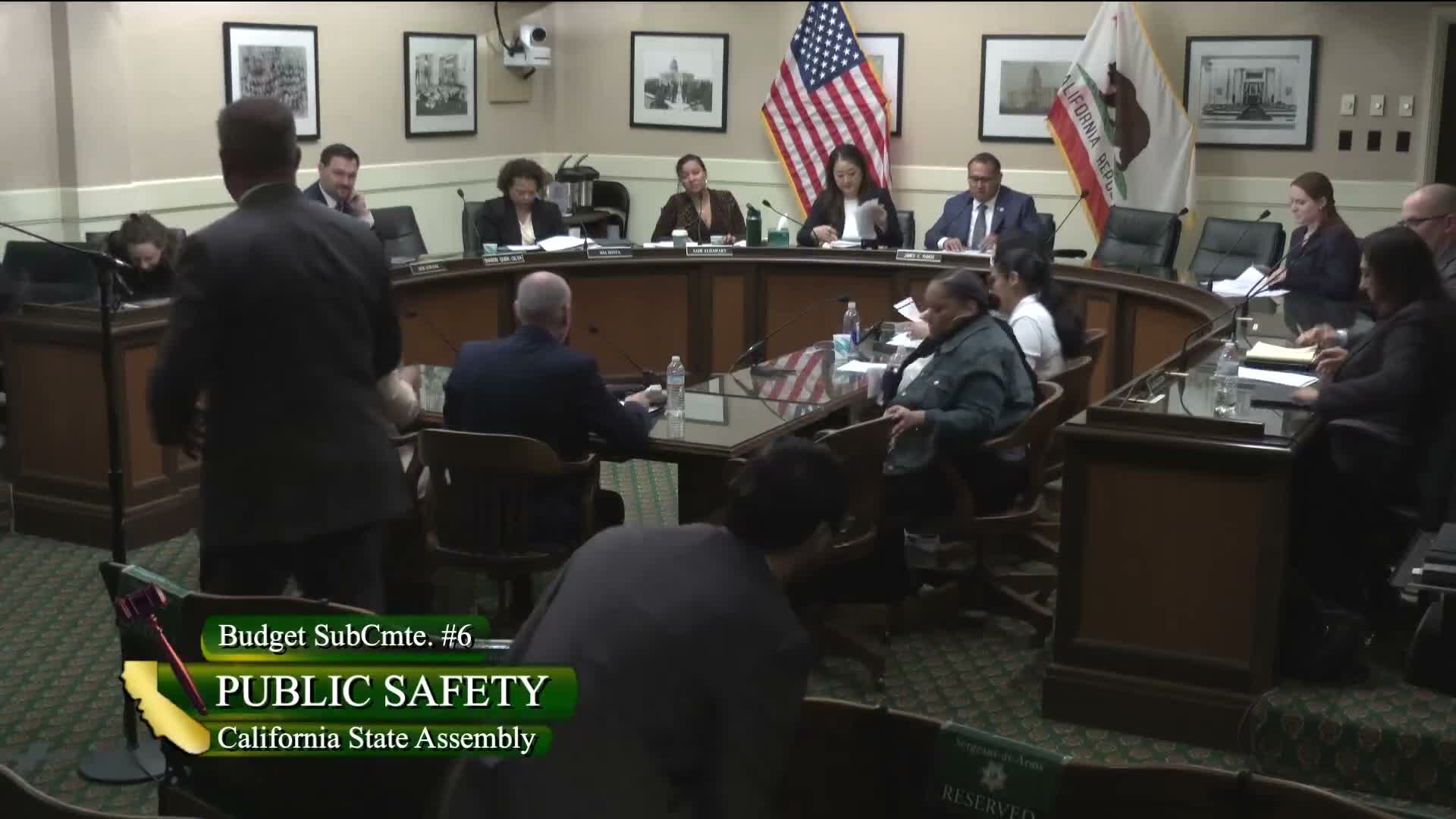
The court-appointed receiver in Coleman v. Newsom told a legislative budget subcommittee she will implement a six-goal action plan aimed at restoring constitutional mental-health care in California's prisons, and officials presented budget requests to staff tele-mental-health programs and sustain the receiver's office.
Colette Peters, appointed receiver in August 2025, told the subcommittee the action plan focuses on culture change, staffing and workforce development, consistent care at all levels, suicide prevention, quality assurance and measurable demonstration of remedies. "If we don't have people available who are qualified to provide mental health, we will have a huge barrier to compliance," Peters said, describing five actions aimed at filling clinical vacancies and tracking implementation with an audit matrix.
Dwayne Reeder of California Correctional Health Care Services summarized budget components: a request of $33.9 million in 2026' 27 to establish the receiver's office (with $8.2 million for the office and $25.3 million to continue bonus payments that began over the summer) and a tele-mental-health staffing augmentation seeking 69 positions and $8.9 million in 2026' 27, growing to 119 positions in later years.
The Legislative Analyst's Office advised targeted approval and stronger use of tele-mental-health options. LAO staff argued the department should expand remote-provider exemptions up to the court's 50% cap for tele clinicians and strategically deploy telehealth in the most understaffed prisons. LAO recommended reducing the proposed on-site supervisory and equipment requests and monitoring the pilot to determine whether telehealth shifts higher-risk patients to remaining in-person staff.
Department of Finance staff cautioned that allowing out-of-state licensure exemptions or remote out-of-state practice could raise statutory and liability issues, and would likely require trailer-bill language. Receiver Peters said she plans to work with the Department of Consumer Affairs to explore options to expand the staffing pool while complying with statutory constraints.
Peters described an aggressive implementation timeline of three to 18 months for many action-plan items and said the receivership will publish quarterly reports to the court and to the public. She said the plan's success depends on reduced litigation, CDCR implementation of recommended actions and available funding. The receiver estimated a 5'7-year trajectory to durable compliance but cautioned that timelines could extend given the case's 35-year history.
Committee members asked about clinicians' safety, retention, the feasibility of clustering mental-health units to improve staffing, and potential fiscal impacts of prolonged receivership work such as construction. Peters said the receivership will do infrastructure assessments and hire a senior adviser for recruitment and retention to target shortfalls in supervisory clinical staff. LAO recommended the Legislature monitor the salary and retention impacts of proposed pay changes.
The subcommittee requested additional details on equipment needs, telepresenter-to-clinician ratios, the cost of licensure transitions for out-of-state hires, and the receiver's quarterly court reports. No votes were taken; the committee signaled interest in targeted funding with follow-up oversight.