Get Full Government Meeting Transcripts, Videos, & Alerts Forever!
Get email alerts on the Public Health topic
No spam. Unsubscribe anytime.
Berkeley unveils Community Health Improvement Plan; dashboard highlights 13‑year life‑expectancy gap
Summary
City staff presented the Community Health Improvement Plan (CHIP) and a public dashboard showing strong overall health in Berkeley but stark racial and neighborhood disparities — including a 13‑year life‑expectancy gap — and outlined a community‑driven implementation process with advisory groups and annual council updates.
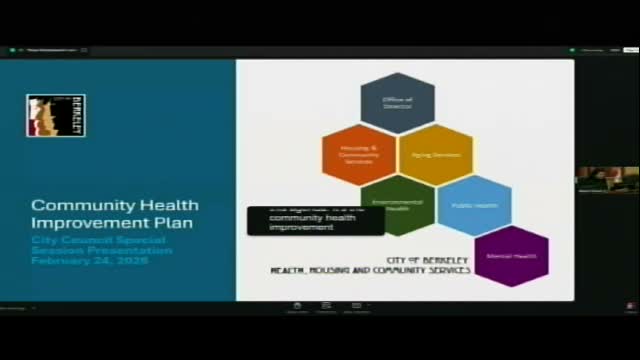
Berkeley officials presented a community‑driven Community Health Improvement Plan (CHIP) and a public dashboard preview at a special City Council work session, underscoring a 13‑year life‑expectancy gap between neighborhoods and calling for targeted, accountable implementation.
The CHIP, staff said, synthesizes a community health assessment conducted with consultants JSI, four focus groups and a citywide survey that yielded more than 320 responses. Scott Gilman, Director of Health, Housing and Community Services, told the council the plan identifies two overarching goals—addressing disparities in life expectancy and increasing community power—and four priority pillars: housing, environmental health, behavioral health and community safety.
Gilman demonstrated a new public dashboard intended to go live in the fall that will let residents and policymakers drill into the CHIP data. "If we can't measure it, we can't track it, we can't change it," Gilman said, showing maps and charts that compare Berkeley with Alameda County and the state. The demo highlighted stark geographic and racial gaps: life expectancy in the Berkeley Hills was shown at 91 years versus roughly 78 in parts of South and West Berkeley, a 13‑year difference staff called a "call to action." The dashboard will also surface cause‑of‑death trends; Gilman noted that drug overdoses and suicide rose between 2022 and 2024 into the top 10 causes of death, moving toward roughly the sixth leading cause.
Deputy Director Tanya Bustamante said the CHIP is required for national public health accreditation and must align with behavioral‑health planning. Bustamante described the planning process as "comprehensive and community driven," with a 10‑member steering committee that reviewed data and helped distill six key findings into the plan's priorities.
Councilmembers pressed staff on next steps and specificity. Councilmember Jacob asked how focus groups were selected and whether equity screens guided recruitment; staff said JSI identified priority populations and conducted four focus groups (including transitional‑age youth and groups representing African American and Latino residents) and offered to return with more detail. Councilmember Bartlett asked why some chronic diseases appeared less prominent in the CHIP; Gilman said disease‑level data are in the community health assessment and will be available through the dashboard.
Public commenters and commission members urged coupling the CHIP's high‑level framework with programmatic investment and accountability. Andy Katz, chair of the Community Health Commission, said the CHIP risks remaining "high level" without commitments to prevention, public‑health nursing and peer education. Commissioner Thomas Baptiste urged the council and city manager to align budget, interdepartmental work plans and performance metrics with the CHIP’s two central goals. "Words and reports alone do not create change without accountability or dedicated funding," he said.
Staff outlined an implementation timeline that places the work in a preparation phase through July, with action steps and advisory groups formed for each pillar; they said the budget process will affect the pace of formal implementation and pledged at minimum annual updates to council, with a more substantive report expected in January or February 2027. Gilman stressed that the city will seek community partners and measurable outcomes and asked the council to "walk this path with us."
The council did not take action on the CHIP at the meeting. Staff recognized the 10 steering‑committee members and the mayor adjourned the session after a brief motion to adjourn.