Get Full Government Meeting Transcripts, Videos, & Alerts Forever!
Get email alerts on the Police Annual Report topic
No spam. Unsubscribe anytime.
Berkeley police report 2025 drops in several crimes, but council and public press for more data on hate crimes and ALPR use
Summary
Police officials told council the city saw declines in several serious crimes in 2025 and credited data-driven tools and new CSO/flex-team strategies, while council members and public commenters sought more disaggregated hate-crime data and raised privacy and racial‑disparity concerns about ALPR/Flock systems.
Berkeley police on Wednesday told the City Council their 2025 annual report shows declines in several serious crime categories even as staffing gaps persist and the department expands use of technology and nonprofit partnerships. Chief-level officials and staff highlighted a drop in overall Group A offenses, stronger clearance rates and new programs they say are helping the city respond more efficiently.
"So, in total, Berkeley recorded about, 9,800 Group A offenses in 2025, which is down 11% from the year before," Arlo Momburg, the department's strategic planning and accountability manager, said during the presentation. He cited a 48% local decline in motor-vehicle thefts, a 31% drop in commercial burglaries and a 40% fall in shootings.
The department attributed improvements to a mix of enforcement and prevention strategies, including the gun‑violence intervention and prevention partnership (GVIPP), a nascent community‑based referral program run by the nonprofit Live Free, a newly expanded community‑service‑officer (CSO) patrol program and a data‑driven flex team focused on organized retail theft. "For the first time in over a decade, we had 0 fatal or injury shootings last year," Captain Mike Durbin said, describing enforcement and community interventions as complementary.
Officials also described investments in investigative technology. The department said automated license‑plate readers (ALPRs) and a regional ALPR network have supported investigations and assisted detectives, noting "58 arrests" directly tied to ALPR hits and that ALPR records supported additional cases. A senior department official said the tools help identify suspects more quickly and can improve clearance rates, but acknowledged that proving direct causation across multiple interventions is difficult.
Several council members and members of the public raised questions about the department's data and policies. Council members asked for clearer definitions and dispositions for complaint categories ("sustained," "not sustained," "admin closed"), metrics for proposed drone and dispatch pilots, and more years of comparable NIBRS data before treating recent trends as long‑term.
Public commenters and university student groups urged greater transparency and caution around surveillance tech. A Cal ACLU student representative said examples of ALPR/Flock use nationally show a risk that local ALPR data can be queried by federal agencies, and called the technology "not the right" way to address staffing shortages. Other commenters asked the department to publish more detailed demographic breakdowns of hate crimes and stop data.
Department leaders responded that some apparent increases—especially in a category labeled "crimes against society"—reflect reporting changes tied to the adoption of NIBRS in 2024 that separate certain offenses (for example drug equipment violations) into new subcategories. They also said the transparency hub contains much of the reported data, and flagged plans to improve the user experience and add contextual dashboards so council and the public can track outcomes over time.
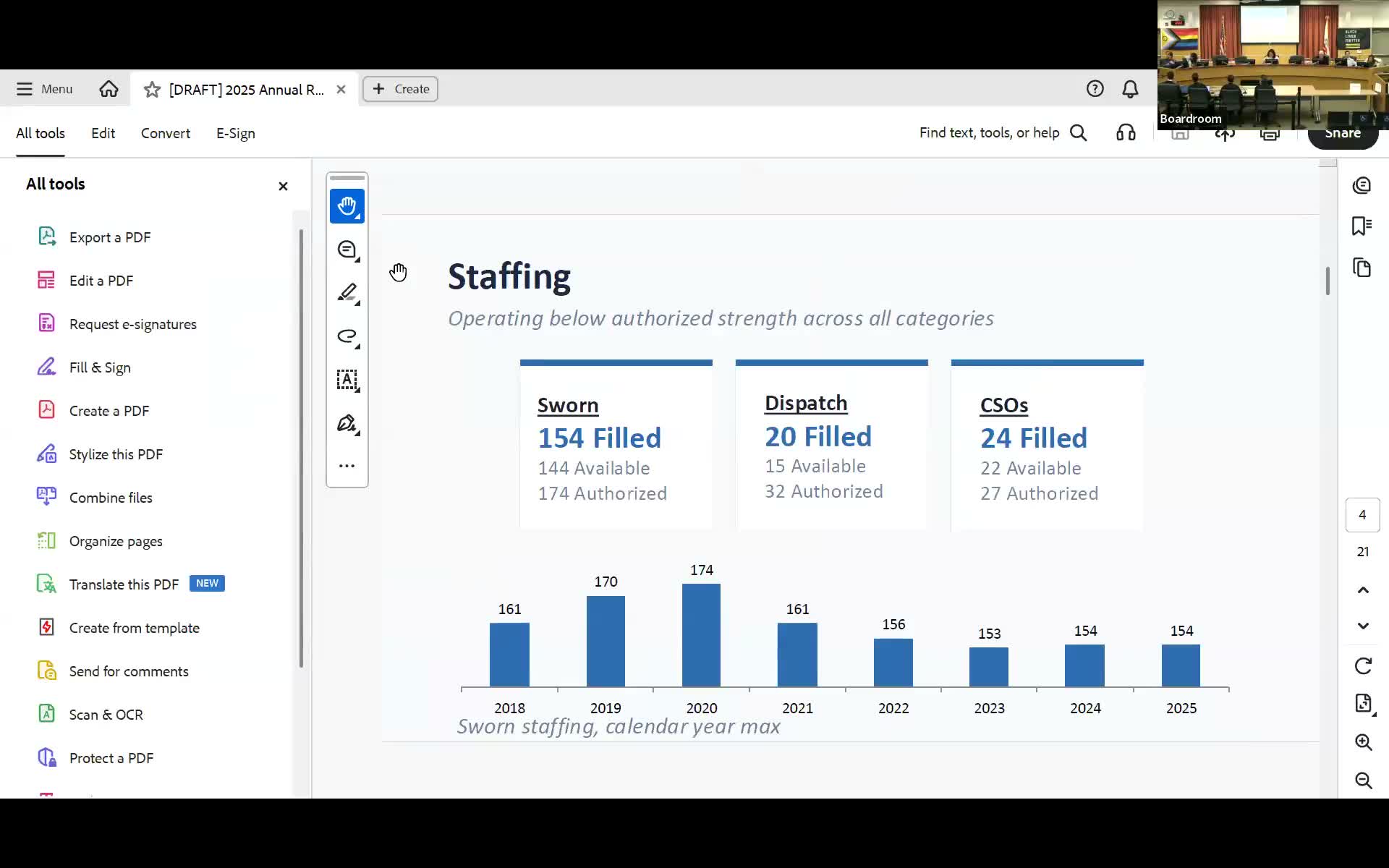
Staffing and dispatch capacity remain unresolved priorities. Officials said nearly half of dispatch positions were vacant at the start of 2025; while hiring events and changes to testing and onboarding produced gains, attrition and training completion issues mean the communications center remains a major operational and overtime cost driver. The department described plans to pursue facilities and systems upgrades and to pilot an AI‑enabled triage agent for nonemergency phone traffic to reduce dispatcher burden.
The council did not take any votes at the meeting. Council members generally praised the department's reported reductions in shootings, vehicle thefts and burglaries while urging follow‑up reports on hate‑crime composition, racial disparity analyses of stops, and an accountable plan for any expansion of ALPR/Flock access. The special meeting was adjourned with no immediate policy changes.