Get Full Government Meeting Transcripts, Videos, & Alerts Forever!
Get email alerts on the Zoning And Development topic
No spam. Unsubscribe anytime.
Berkeley council affirms zoning board, clears way for 8‑story, 110‑unit project at 2109 Virginia Street
Summary
After a lengthy public hearing and robust public comment over contamination, parking and neighborhood character, Berkeley's City Council voted to deny an appeal and affirm the Zoning Adjustments Board approval for an 8-story, 110-unit mixed-use development at 2109 Virginia Street.
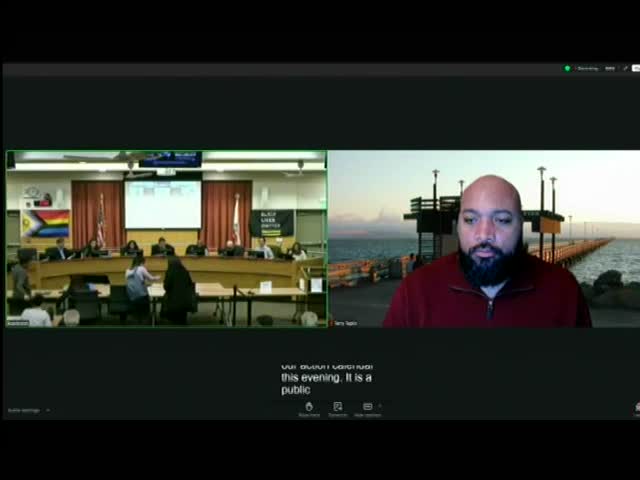
The Berkeley City Council on Feb. 10 denied an appeal and affirmed the Zoning Adjustments Board decision to approve a use permit for a proposed 8-story, 110-dwelling-unit mixed-use building at 2109 Virginia Street.
The project, presented by the planning department as a housing development entitled under state SB 330 rules, would replace a two-story commercial building and surface parking with roughly 112,900 square feet of new development, including 110 units (18 of which are below-market-rate: nine very-low-income and nine moderate-income), about 7,000 square feet of usable open space, and 109 off-street parking spaces. Staff said the base project was 55 units and the applicant is taking a 100% density bonus to reach 110 units.
Singh Saleki, senior planner, summarized the review history and environmental analysis, saying the site had been remediated under oversight of state agencies and that project-specific phase I and II environmental site assessments and CEQA screening found no new significant impacts beyond the housing element EIR. "The applicant submitted phase 1 and 2 ESAs, which were reviewed by Toxics and a CEQA consultant," Saleki told the council.
Opponents, led by Vijay Shrini Krishnan representing the North Shattuck Alliance, urged denial on process and health-safety grounds, citing the site's former dry-cleaner use and proximity to a pediatric clinic and schools. "The site sits above a toxic waste site," Krishnan said, urging the council for a full site-specific environmental review before allowing construction.
Applicant Patrick Kennedy, the developer, said the project targets older Berkeley residents who want to downsize and argued the development will free up single-family homes and add significant tax revenue. "It would generate a huge amount of additional taxable property in the neighborhood of around a $100,000,000 to the city of Berkeley," Kennedy said. Mark Loper, the project's counsel, said remediation and permit conditions will be managed through standard state and local processes.
Councilmembers asked detailed questions about the civic-arts in-lieu fee being waived as a concession, the legal standard of review under the state density-bonus and Housing Accountability Act, and whether the council had discretion to deny a project that complies with objective standards. Multiple members noted that state law constrains local discretion: if a project meets objective standards, denial generally requires specific, quantifiable findings of adverse impacts to public health or safety.
In deliberations, several councilmembers emphasized the city's need for housing near transit and the limited ability to impose additional conditions once projects are vested under state law. "Absent additional evidence to the contrary, and I've heard none, I'm compelled to affirm the decision of the Zoning Adjustments Board," Councilmember Humbert said.
The council then voted by roll call to deny the appeal and affirm the ZAB approval for use permit ZP2024-0066. The vote was recorded in the clerk's roll call and the motion carried.
Next steps: with the council's decision the project may proceed to the building-permit stage, where remediation measures and building and fire code compliance will be reviewed and enforced by the city and relevant state agencies as part of the permitting process.