Get Full Government Meeting Transcripts, Videos, & Alerts Forever!
Get email alerts on the Housing Development topic
No spam. Unsubscribe anytime.
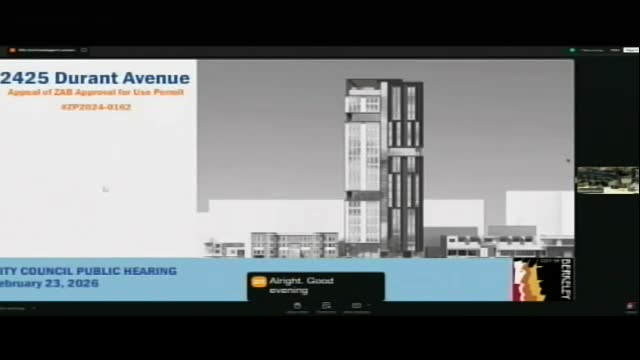
Berkeley council affirms ZAB approval for 2425 Durant, approves 169-unit tower with labor concessions intact
Summary
After hours of testimony from labor groups and developers, BerkeleyCity Council voted to deny the Building and Construction Trades Councilappeal and approve the use permit for 2425 Durant Avenue, a proposed 20-story building with 169 units (32 below-market-rate), citing legal risk under state density-bonus law and noting staffcorrections to the conditions of approval.
The Berkeley City Council on Feb. 23 voted to deny an appeal of the Zoning Adjustments Board approval for a 20-story housing project at 2425 Durant Avenue, affirming staffrecommendation and approving the use permit. The project would demolish three existing residential buildings (19 units) and build a roughly 149,000-square-foot tower with 169 units, including 32 below-market-rate units.
The appeal, filed by the Building and Construction Trades Council and Northern California Carpenters Regional Council, challenged three density-bonus concessions requested by the applicant: exemptions from apprenticeship requirements, the cityhard-hats health-care expenditure, and a prevailing-wage requirement in the South Side plan. Appellant attorney Jolene Kramer urged the council to reject the concessions, saying the city should not use the state density-bonus law "to waive local labor standards" and that the concessions would "undermine local ordinances that promote worker retention and worker well-being."
Staff and project representatives argued the state density-bonus statute permits broad categories of concessions. Senior planner Nilu Karamzadegan told the council staff had analyzed the appeal points and concluded the city could not make the specific legal findings required to deny the requested concessions; staff also reported the applicantestimated cost reduction from the three concessions at about $16,560,000. The applicantrepresentative said the cost figures "are based on actual bids" and that the narrow statutory standard for denying a concession (a "specific adverse impact on public health and safety" supported by objective written standards) was not met in the record.
The hearing included lengthy public comment, with dozens of union members, labor organizers and residents urging the council to uphold the Hard Hats ordinance and reject concessions that would strip health-care, apprenticeship and prevailing-wage protections. Daniel Gregg of the North Coast States Carpenters Local 713 said the concessions would "strip health care from hundreds of construction workers here in the city of Berkeley." Local workers and union representatives described apprenticeship pathways, safety benefits and long-term community gains from the labor standards.
During deliberations council members were split between the policy case for protecting labor standards and the legal risk of litigation under Californiadensity-bonus law. Multiple councilmembers said the courts and the Department of Housing and Community Development have interpreted the statute to favor production of housing and that denying the concessions risked costly litigation that the city, facing budget pressure, might not win. Citing that legal exposure, the council moved to deny the appeal and affirm the ZAUB approval; the motion carried in a recorded roll call with five yes votes and four abstentions. The council also accepted a staff correction to Condition 65 clarifying that rooftop projections and elevator equipment exceeding approved roof height require a use-permit modification and board review.
Council action approves the use permit and leaves in place the concessions permitted by staff and ZAUB. Several councilmembers urged the state legislature to clarify the law so local labor protections cannot be waived by density-bonus concessions in the future.