Lifetime Citizen Portal Access — AI Briefings, Alerts & Unlimited Follows
PGCPS midyear data: high DIBELS participation, gains on benchmarks but rising expectations complicate interpretation
Loading...
Summary
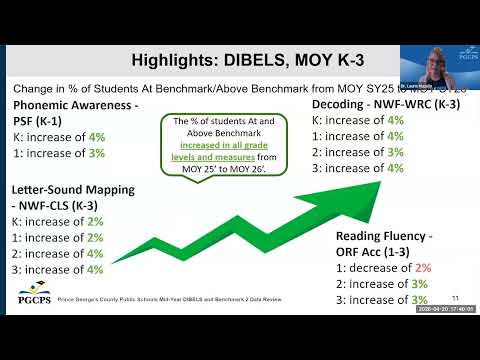
Prince George's County Public Schools reported a 98% midyear DIBELS completion rate (35,912 students) and year-over-year gains on Benchmark 2 (RILA +4.7 pp; math +5.4 pp), while presenters cautioned that rising midyear expectations (e.g., kindergarten phoneme cutoffs) can make 'below benchmark' percentages look larger despite student growth.
Jonathan Briggs, chair of the Academic Achievement Committee, opened the April 20 meeting and recognized district academic leaders who presented midyear literacy and benchmark results for Prince George's County Public Schools.
Lori Maslin, who led the data review, said the DIBELS middle-of-year administration (as of Feb. 18) reached 98 percent completion — 35,912 students — with 23 elementary schools at 100 percent completion. "This particular middle of the year data is as of February 18th, and we had an overall completion rate of 98 percent," Maslin said.
The presenters emphasized two linked findings: measured growth at the student and cohort level, and an increase in assessment expectations across the year that can make midyear proportions labeled 'below benchmark' appear higher even when students have made gains. Maslin said many students classified as not yet meeting benchmark are within small margins — roughly "6 composite points" — of reaching the next performance level and could move to benchmark with targeted supports.
Why it matters: benchmark and universal-screen data guide school- and classroom-level interventions and are used to project readiness for MCAP standards. Maslin noted that DIBELS is a universal screener required by COMAR and that benchmark items align to district curriculum and MCAP item types.
Details from the presentation: - DIBELS completion: 98% of students who should have participated did so (35,912 students); 23 elementary schools had 100% completion. (Speaker: Lori Maslin) - Close-to-benchmark students: About 17% of kindergarteners, 16% of first graders, 13% of second graders and 13% of third graders were within 6 composite points of benchmark (i.e., one or two items away). (Speaker: Lori Maslin) - Phoneme expectations: Maslin illustrated how benchmark cutoffs increase through the year (example: kindergarten phoneme segmentation expectations move from 5 at BOY to 29 at MOY and 44 at EOY), which can increase the midyear 'below benchmark' share even when students gain skills. - Benchmark 2 results: RILA (reading/language arts) combined improvement of 4.7 percentage points year over year; mathematics combined improvement of 5.4 percentage points, with especially measurable gains in grades 3–5, 8, and 10 and in algebra/geometry courses. (Speaker: Lori Maslin) - Constructed responses and zeros: the share of students receiving a zero on a writing item fell from 32% last year to under 30% this year; modeling and reasoning zeros in math also declined. (Speaker: Lori Maslin)
Board members pressed for practical follow-ups. Laquita Reed described monthly individualized data 'spotlights' delivered to principals and instructional directors that combine DIBELS, progress monitoring (Amplify), Lexia usage and other diagnostics so school leaders can act on student-level needs. "These data snapshots are individualized for each principal," Reed said. Simone McQuage added that the district sends parent reports and a cover letter with activities families can use, and that the district has offered Amplify parent workshops and data-literacy trainings.
What the board asked for and what staff committed to do: - Provide a sample of the parent cover letter and the data snapshot sent to principals for board review and feedback (staff agreed). (Speakers: Simone McQuage, Lori Maslin) - Share cohort-level composite DIBELS analyses and end-of-year comparisons when available. (Speaker: Lori Maslin)
Authorities and methods cited: presenters noted that DIBELS is administered as a universal screener (COMAR referenced) and that some benchmark items are written in partnership with Pearson and aligned to MCAP standards.
Next steps: staff said they will share sample parent materials, additional cohort analyses, and end-of-year trends as those data become available. The committee will hear further updates at subsequent meetings.