Get Full Government Meeting Transcripts, Videos, & Alerts Forever!
Get email alerts on the Transportation Safety topic
No spam. Unsubscribe anytime.
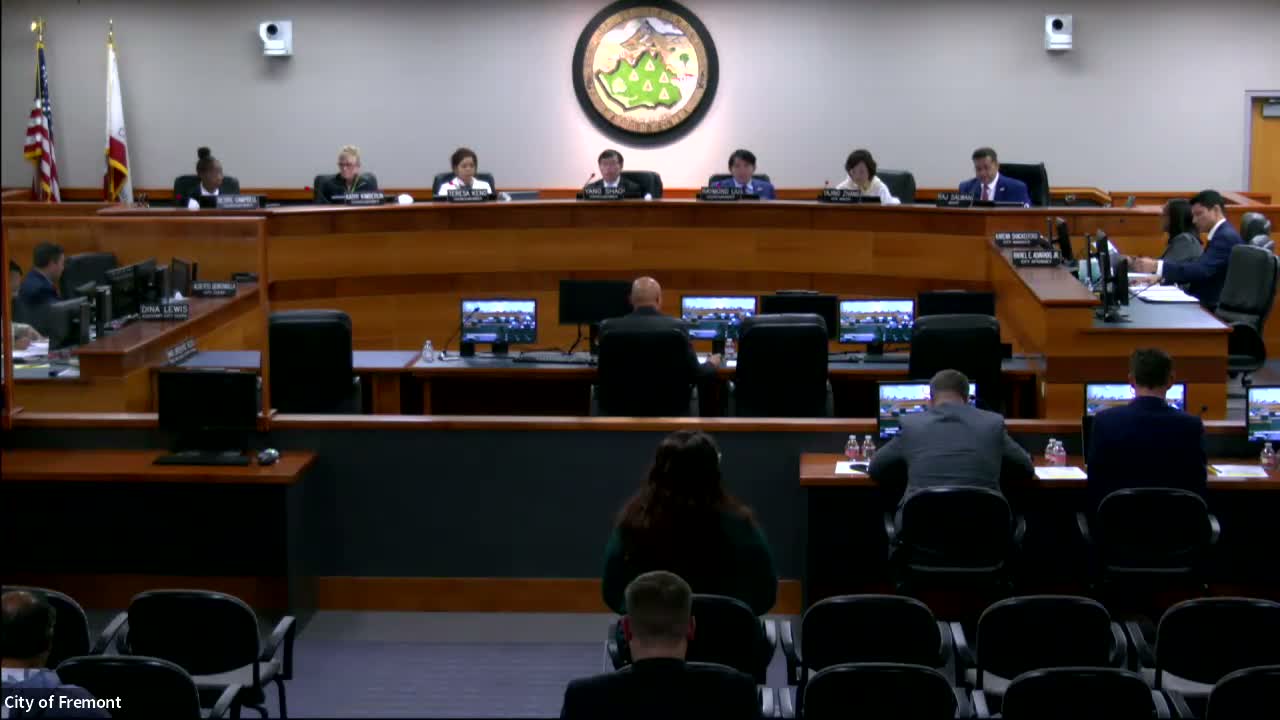
Fremont council backs quick-build safety fixes for Paseo Padre Parkway after months of debate
Summary
After lengthy public comment and staff presentations, the Fremont City Council directed staff to prioritize visibility improvements and a quick-build pilot (short painted lane reduction plus rapid flashing beacon) at Olive Avenue, keep most of Paseo Padre four lanes, and phase further work based on monitoring and available funds.
The Fremont City Council on April 14 directed city staff to pursue near-term, low-cost safety measures for the Paseo Padre Parkway corridor, focusing first on visibility improvements and a quick-build pilot at Olive Avenue that would combine a narrowed travel zone and a rapid flashing beacon for pedestrian crossings.
City staff presented an alternatives analysis that evaluated traffic signals, roundabouts and a lower-cost package of visibility improvements, lane reduction and a rapid flashing beacon (RRFB). Public Works Director Hans Larson said the corridor is unique — a four-lane arterial with fronting residences, curves and a hill — and that Paseo Padre currently carries about 10,000 vehicles per day, well below typical thresholds that require four lanes.
"We think roundabouts are a great solution for safety, but they cost more," Larson said during the staff presentation. "A package of signal, lane reduction and visibility improvements would, in our view, provide the optimal level of safety and fit within the budget." Assistant City Engineer Noe Veloso added that a lane-reduction/visibility package could be implemented faster and at lower cost than either a traffic signal or a roundabout.
Residents who live along Olive Avenue and nearby streets urged immediate action. "We were the first unfortunate responders to a little kid on a bike who got injured," said resident Monica Guhamajumdar, urging the council to adopt the visibility-and-lane-reduction package. "Human lives are really at risk." Several other speakers described crashes, property damage and near-misses at the Olive/Passeo Padre intersection.
Other residents cautioned against removing lanes on a major arterial. "Please vote no on lane reduction from Dorn to Olive," said a resident who said they are Paseo Padre property owner, arguing lane reductions could worsen driveway access and congestion during peak hours.
Councilmembers debated a phased approach. Multiple councilmembers supported testing visibility improvements and an RRFB first, and then using a short painted merge (staff noted roughly 250–300 feet of merge approaching the Olive intersection) as a pilot to assess effects on speeds and congestion before making permanent capital investments. Several members also said they preferred to retain four lanes for the majority of the corridor and to use paint and striping for a reversible, low-cost test.
Staff emphasized the technical tradeoffs: roundabouts generally produce better safety results but cost about $2.5 million per intersection and take longer to implement, while a traffic signal might cost roughly $1.5 million and the visibility/paint/RRFB option is roughly $500,000 and could be built in months. Staff also noted that because police reports are taken mainly for injury crashes, property-damage collisions are undercounted and community reports provided important local context.
The council voted 6–1 to direct staff to implement the council’s consensus: prioritize visibility clearing and RRFB installation at Olive, build a short painted merge as a pilot near Olive (about 250–300 feet approaching the intersection) to test lane reduction without permanent reconstruction, keep four lanes elsewhere on Paseo Padre, and pursue grant funding and other improvements elsewhere in the city. The motion, moved by Councilmember Campbell and seconded by Vice Mayor Zeng, asked staff to report back with monitoring results and recommended next steps.
Councilmembers and staff said the pilot is intended to be reversible and to provide performance data before committing to major capital work. Staff also said they would continue outreach and monitor the corridor after the flashing beacons and any quick-build treatments are in place.
The council discussion also reaffirmed interest in roundabouts at other locations citywide, but members agreed not to advance roundabouts on Paseo Padre at this time pending results from the quick-build pilot and further funding decisions.
The council asked staff to return with implementation timelines, performance measures, and recommendations for follow-up after the pilot.