Lifetime Citizen Portal Access — AI Briefings, Alerts & Unlimited Follows
City auditor urges narrow, outcome-focused performance measures to guide Berkeley budgeting
Loading...
Summary
The city auditor presented a guide recommending Berkeley adopt a small set of consistent performance metrics—one or two per department—to improve transparency and inform budget tradeoffs. Council members and public commenters broadly supported starting small and focusing on outcomes.
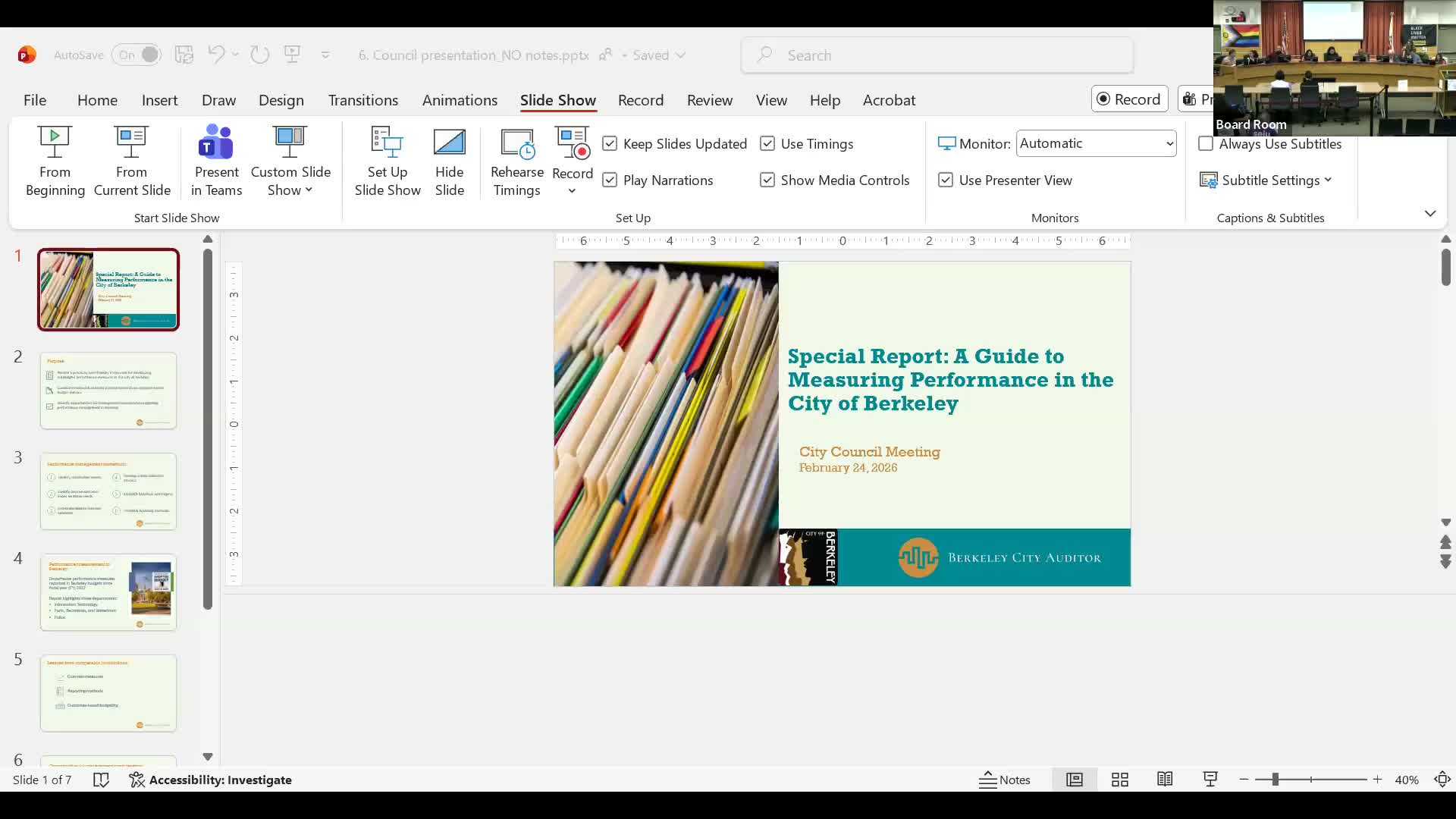
The city auditor presented 'A Guide to Measuring Performance in the City of Berkeley' during the Feb. 24 council meeting, urging the council to adopt a focused set of metrics the public can use to track results and inform budget choices. The auditor said the framework is intended to help staff and elected officials identify meaningful outcomes and avoid creating new, costly data burdens.
The auditor said a performance measure "is really just a qualitative or quantitative assessment of an agency's work," and recommended that the council start by asking departments to report one or two metrics that matter most to residents. The office highlighted three departmental case studies (IT, Parks, Recreation & Waterfront, and Police) and noted that making measures comparable across years requires standard reporting periods and consistent baselines.
Councilmember Blackaby and others praised the report as a practical starting point for outcome-oriented budgeting. Blackaby said the approach should avoid "boiling the ocean" and focus on measures departments already collect. Members asked staff to prioritize measures that can be reported without creating new data-collection burdens and to make the metrics useful for budget tradeoffs during a period of constrained revenue.
Public commenters supported the auditor's recommendations. One speaker urged the council to use performance metrics to demonstrate value to voters as Berkeley considers future funding measures and to bake accountability into bond programs and other investments.
The auditor said establishing fewer, well-chosen measures will help the public see how city work affects outcomes—such as emergency response times or parks satisfaction—and allow the council to communicate tradeoffs during the budget process. The council signaled broad support for taking the auditor's guide as the next step in developing outcome-oriented budget reporting and directed staff to continue work on implementation and reporting timelines.
Next steps: staff and the auditor's office will work with council committees to identify the 'critical few' measures by department and return with recommended reporting formats and a timeline for publication.