Get Full Government Meeting Transcripts, Videos, & Alerts Forever!
Get email alerts on the Ada Incentives topic
No spam. Unsubscribe anytime.
Antioch staff present tiered incentives to spur ADA-accessible units; council asks to fold the program into broader housing update
Summary
City staff proposed a tiered incentive program that would let multifamily developers access concessions (height, parking, fees) in exchange for building 6—+% accessible units; council asked staff to fold the proposal into the General Plan/IHO update and to add language ensuring accessibility endures.
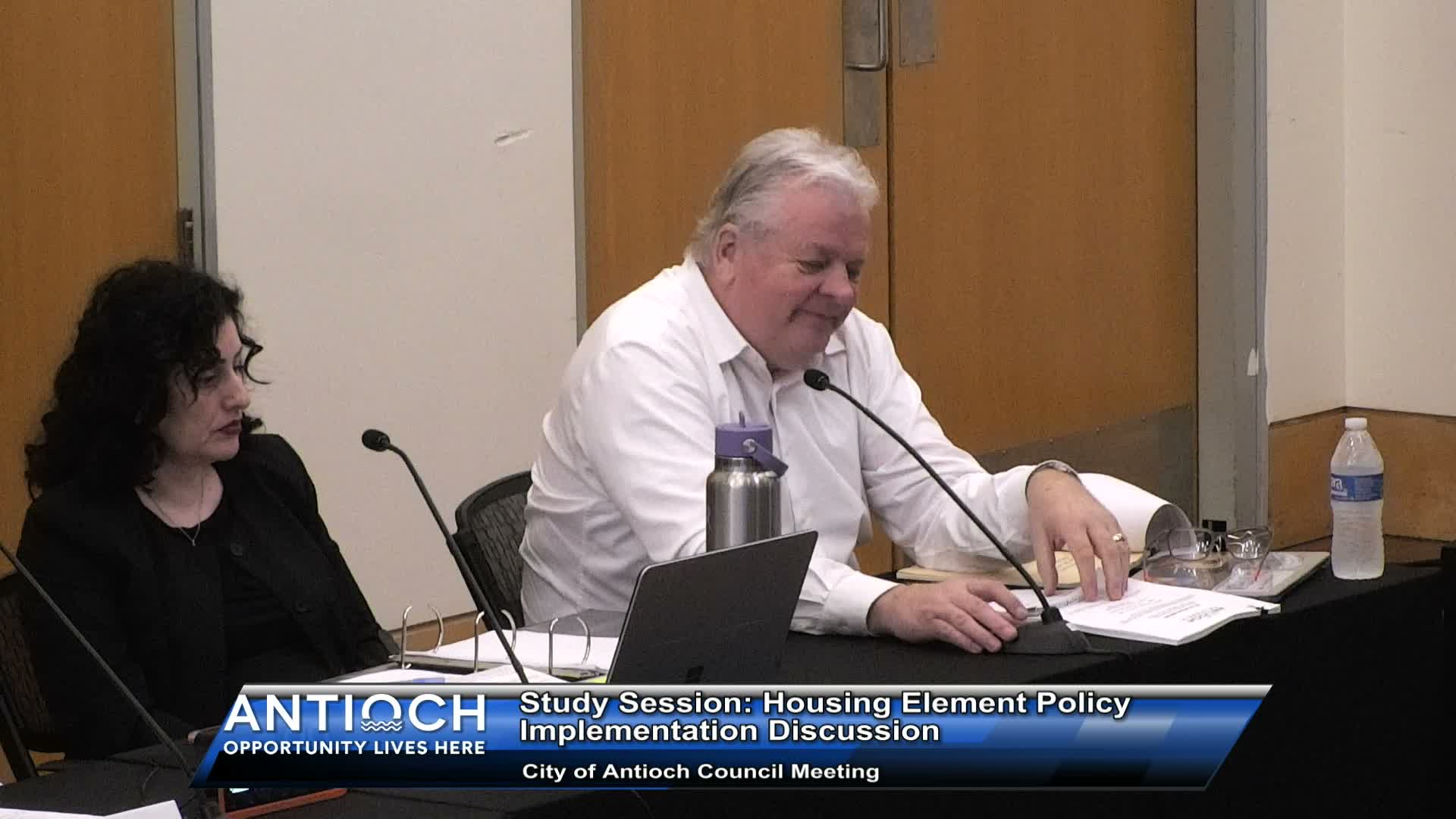
City of Antioch staff presented a proposed Accessibility Incentives Program on March 18, 2026, asking the City Council and Planning Commission to provide feedback on a tiered system that would give developers access to measured concessions in exchange for building ADA-accessible units in multifamily rental projects.
Monet Boyd, assistant planner, described a three-tier structure: Tier 1 for projects providing 6—10% accessible units, Tier 2 for 11—15%, and Tier 3 for more than 15%. "Applicants may access a maximum of three incentives," Boyd said, explaining that the incentives would include adjustments to building height, open-space calculations and guest-parking requirements, and could also include development-fee reductions or limited architectural waivers. Boyd emphasized that the program would not remove developers' obligations under federal law: "This would not remove the developer's obligation to comply with the Fair Housing Amendments Act of 1988," she said.
Council members asked how large the local need is and whether incentives would actually produce new accessible units. Boyd cited staff materials showing roughly 15.2% of Antioch residents report a mobility disability and said that outreach to about 10 developers indicated interest in the program. Nathan Tinclair, associate planner, and David Store, community economic development staff, said most Housing Element implementation measures have been adopted and that program 5.10.3 (incentivizing accessible units) is among the remaining items under discussion.
Debate focused on two implementation questions: permanence and scope. Councilmember Wilson pressed on how the city would make accessibility commitments endure: Boyd replied the city could require recorded agreements and tie incentives to building-permit review and enforcement steps so that units remain accessible over time. "With the agreement being part of the proposed ordinance, they would have to comply with that agreement," Boyd said, adding staff can flag projects that receive incentives and monitor future renovations.
Parking provisions drew sustained scrutiny. Mayor Pro Tem Freitas warned that reducing guest parking could create access problems for residents with mobility needs, describing personal experience getting out of a car while assisting a family member. Boyd and staff clarified the proposed 30% reduction applies to required guest parking only, not the parking required for individual units, and reviewed the city's current parking stall standard (generally 9 by 20 feet) and ADA-accessible stall layouts.
Staff also presented a threshold-based alternative to the tiered system: instead of a narrow tier menu, the city could establish one list of eligible incentives and permit projects that meet defined accessibility thresholds to select a calibrated number of items. The staff report also suggested fee reductions or partial waivers for accessible units as alternatives that would not alter site or building design.
Several council members asked for fiscal and legal analysis before adoption. Staff said development-impact-fee reductions are feasible as incentives but noted impact fees have restricted uses and cannot fund ongoing city services; the city is undertaking a development-impact-fee study that will inform any decision. Staff committed to returning with options on fee caps and the potential budget impact.
The council and commission expressed interest in ensuring the program aligns with other state rules, including the state density bonus and the Housing Crisis Act (commonly referred to as SB 330), which can grant waivers and concessions to qualifying projects. Staff noted that the ADA incentives are a local, discretionary program and that developers may choose routes (density bonus, IHO, or ADA incentives) that best meet their project's finance and design needs.
Outcome: Councilmembers signaled consensus to fold the ADA incentives discussion into the Inclusionary Housing Ordinance (IHO) and the General Plan update rather than advance an ordinance immediately. Staff was directed to return with revised language that addresses perpetuity/enforcement, a fiscal analysis of fee-based incentives, and documentation of developer outreach.