Get Full Government Meeting Transcripts, Videos, & Alerts Forever!
Get email alerts on the Climate Policy topic
No spam. Unsubscribe anytime.
City administrator outlines Climate Commitment Act impacts for municipal gas utility; council hears potential costs and options
Summary
City Administrator Chris Searcy presented a detailed Climate Commitment Act briefing for Enumclaw's municipal gas utility, warning the city is "just marginally over" the 25,000-ton threshold and outlining compliance mechanics, bill impacts, and possible policy options including cost recovery and legislative coordination. Council asked for financial projections and agreed to revisit the topic in May.
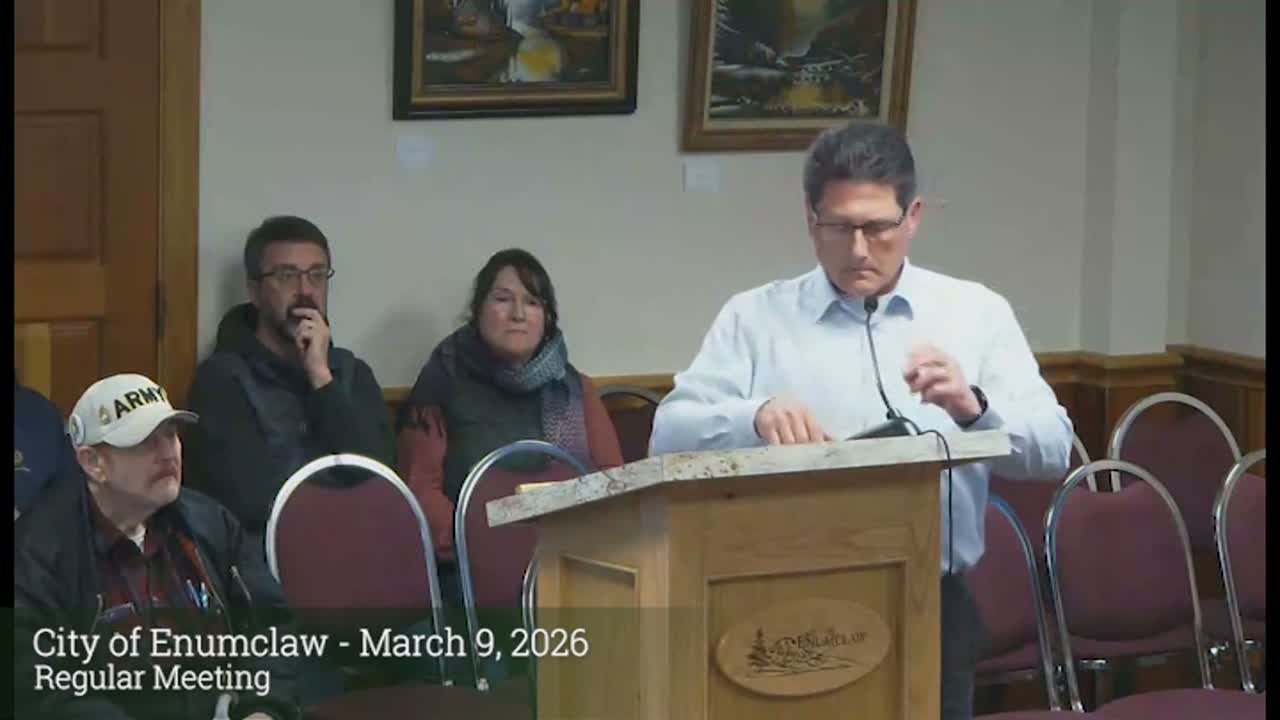
City Administrator Chris Searcy briefed the Uniontown City Council on March 9 about Washington State's Climate Commitment Act and how it affects the city's municipal natural gas utility. He said the city is "just marginally over the threshold" that defines a covered entity and described allowance auctions, no‑cost allowances, and customer billing mechanisms.
Searcy framed the CCA as a cap‑and‑invest program designed to reduce greenhouse gas emissions and explained that covered entities must secure annual carbon allowances equal to their emissions. "It is law. We must follow it," he said, noting Ecology’s rule‑making and the program’s intent to shrink available allowances over time.
Why it matters: Searcy said the city averaged a little over 25,000 metric tons of CO2e for 2023–2025, which pulled the municipal gas utility into the program. He emphasized that small year‑to‑year fluctuations — for example, a colder winter — can push the utility above or below the threshold and that Ecology can retain a utility that remains within 10% of the threshold.
Costs and bill mechanics: Searcy described two billing categories: legacy customers (connected before July 25, 2021) who benefit indirectly from auction proceeds and non‑legacy customers who pay full compliance costs. He outlined the two‑step revenue process the city uses — a forward estimate for the coming year and a look‑back true‑up — and cited earlier billing impacts: the CCA charge for legacy customers has been in the single‑digit cents per CCF range while new customers initially saw roughly a 23¢ per CCF impact. "We started out at about $250,000" in 2023 and later years approached "a little over $400,000," he said, adding that projections could exceed $1,000,000 in some scenarios depending on allowance prices and linkage with other markets.
Policy choices and next steps: Searcy described options for council consideration, including pursuing full cost recovery for service to new development, seeking a municipal‑utility alternative compliance path with other cities such as Ellensburg, and applying for grant funding for decarbonization planning. He noted Ellensburg received a $750,000 grant for decarbonization planning and that Ellensburg and Enumclaw (the state’s remaining municipal gas utilities) are exploring legislative approaches. He also warned that addressing customer load reduction (for example, switching customers to heat pumps) would require additional staff and technical resources.
Council response and procedure: Councilmembers asked for clearer financial projections and for Searcy to bring back refined estimates; Searcy agreed to provide additional modeling and recommended returning to the topic in May for a policy discussion. He said no formal council decision was required that evening.
The City Administrator’s presentation will be followed by staff‑provided projections and a May agenda item for further council direction.