Get Full Government Meeting Transcripts, Videos, & Alerts Forever!
Get email alerts on the Vacant Properties topic
No spam. Unsubscribe anytime.
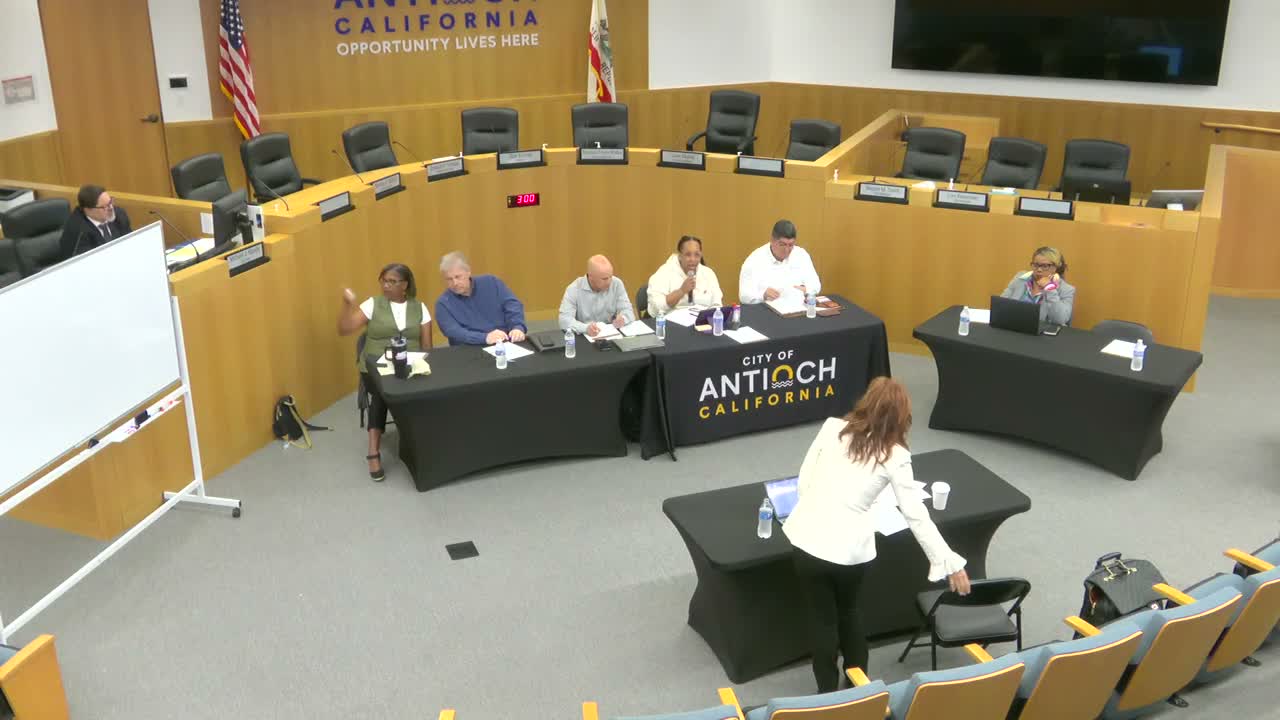
Antioch council demands inventory and options for tackling long-term vacant properties, weighs ballot route
Summary
Council members pressed for a citywide vacant-property inventory, asked the city attorney to compare existing ordinances to other cities, and discussed whether a stronger tool (including a ballot measure) is required to hold long-term property owners accountable.
The Antioch City Council asked staff to produce a citywide inventory of vacant properties and to return with legal options for stronger enforcement after long-term owners fail to maintain or reoccupy land or buildings.
Tracy Miller, the session facilitator, summarized the staged approach the council requested: obtain data, examine existing ordinances and enforcement pathways, then explore the feasibility and cost of placing options before voters. Council members referenced a district-level spreadsheet previously compiled for one district and asked the city manager to produce a comparable citywide dataset so all members have the same information.
Council discussion cited legal limits under state law and staffing implications. A council member, summarizing a conversation with former city attorney Derek Cole, said Cole believed "the only way to implement... a vacancy tax, it would have to go to the ballot," a point members said requires further research and budgeting.
Council directed three near-term actions: the mayor will contact the city attorney to reestablish the September action item and seek a short deadline for a written response; staff will aim to deliver a citywide inventory and related data by May 15; and the city attorney was asked to prepare a comparison of Antioch’s ordinances against other cities and cost estimates for any proposed ballot work or consultant support.
Members also flagged operational questions staff must answer before any ordinance or ballot decision: how large the vacancy problem is by zoning and district; whether existing fines and collection practices are being enforced and collected; and what additional enforcement staffing (including potential legal staff) would be required. The council asked staff to identify who would be responsible for overseeing enforcement, collection and any new program recommendations.
Next steps: staff will report back with the requested inventory and ordinance comparisons; the mayor will follow up with the city attorney; and the council will consider any formal ordinance changes or ballot proposals only after receiving these materials.