Get Full Government Meeting Transcripts, Videos, & Alerts Forever!
Get email alerts on the Housing Policy topic
No spam. Unsubscribe anytime.
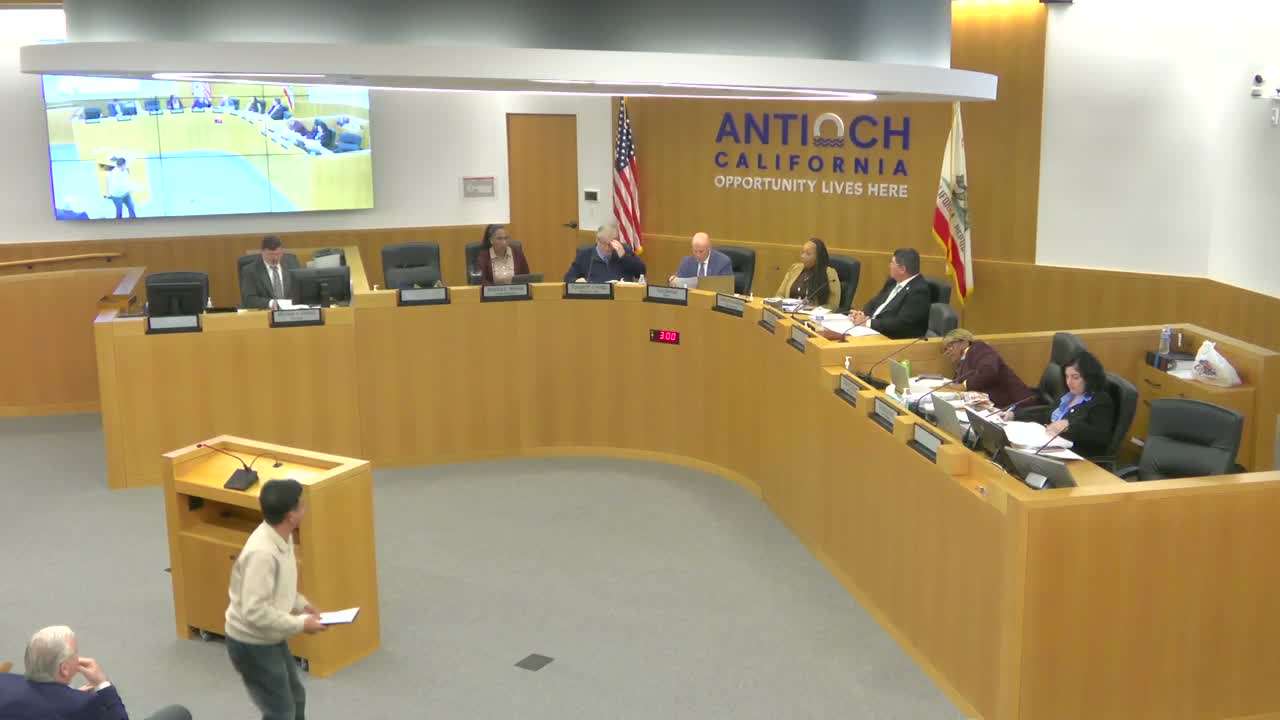
Long debate in Antioch over proposed inclusionary housing law ends with council pausing ordinance for general‑plan review
Summary
After hours of testimony for and against a proposed citywide inclusionary housing ordinance (15% requirement; $202,500 in‑lieu fee), the council voted 4–1 to continue the ordinance off calendar and fold further consideration into the ongoing general‑plan/land‑use update.
The City Council held a lengthy public hearing March 10 on a proposed inclusionary housing ordinance (IHO) and associated Affordable Housing Trust Fund and in‑lieu fee. The proposal would require market‑rate projects of five or more units to reserve 15% of units as below‑market‑rate (10% very‑low income, 5% low income) or pay an in‑lieu fee estimated at $202,500 per unbuilt affordable unit.
Planning staff and consultant PlaceWorks summarized community outreach, a financial feasibility analysis and the mechanics of the proposed ordinance: unit standards (deed‑restricted in perpetuity), an affordable‑housing plan submitted with project applications, monitoring requirements and an annually adjusted in‑lieu fee tied to the local financing gap for affordable construction. The consultant described the method used to estimate the fee: a local per‑unit cost model minus typical affordable financing yields the per‑unit financing gap used to set the fee.
Public testimony was extensive and sharply divided. Affordable‑housing advocates, community organizers, faith leaders and labor representatives urged adoption — several calling for a higher 20% requirement and steps to ensure extremely‑low‑income units and labor standards funded by the trust. Developers, business groups and at least one legal opponent warned of economic impacts, objections to fees they called mandatory takings, and legal risk: opponents cited pending litigation nationwide challenging mandatory developer obligations and argued fees would be passed to homebuyers.
Councilmembers expressed mixed views. Several praised the ordinance as an important tool to produce permanently affordable housing; others warned the measure must be coordinated with state housing laws, SB 330/SB 35 implementation and the city’s general‑plan land‑use update. Citing the many moving parts — new state statutes, pipeline projects whose vested rights could be unaffected, and staffing and monitoring costs — the council voted to continue the IHO off‑calendar and direct staff to integrate the topic into the general‑plan/land‑use work (motion passed 4–1). Councilmember Torres Walker voted against continuing, urging faster adoption to address pressing affordable‑housing needs.