Get Full Government Meeting Transcripts, Videos, & Alerts Forever!
Get email alerts on the Budget topic
No spam. Unsubscribe anytime.
Antioch council hears sobering budget outlook as reserves used to cover deficits
Summary
City staff outlined FY 2026–27 draft budget showing one‑year planning, projected deficits drawing on a $36M stabilization fund balance and rising personnel costs; council asked staff to return with mitigation options and more detail on police staffing, fees and service priorities.
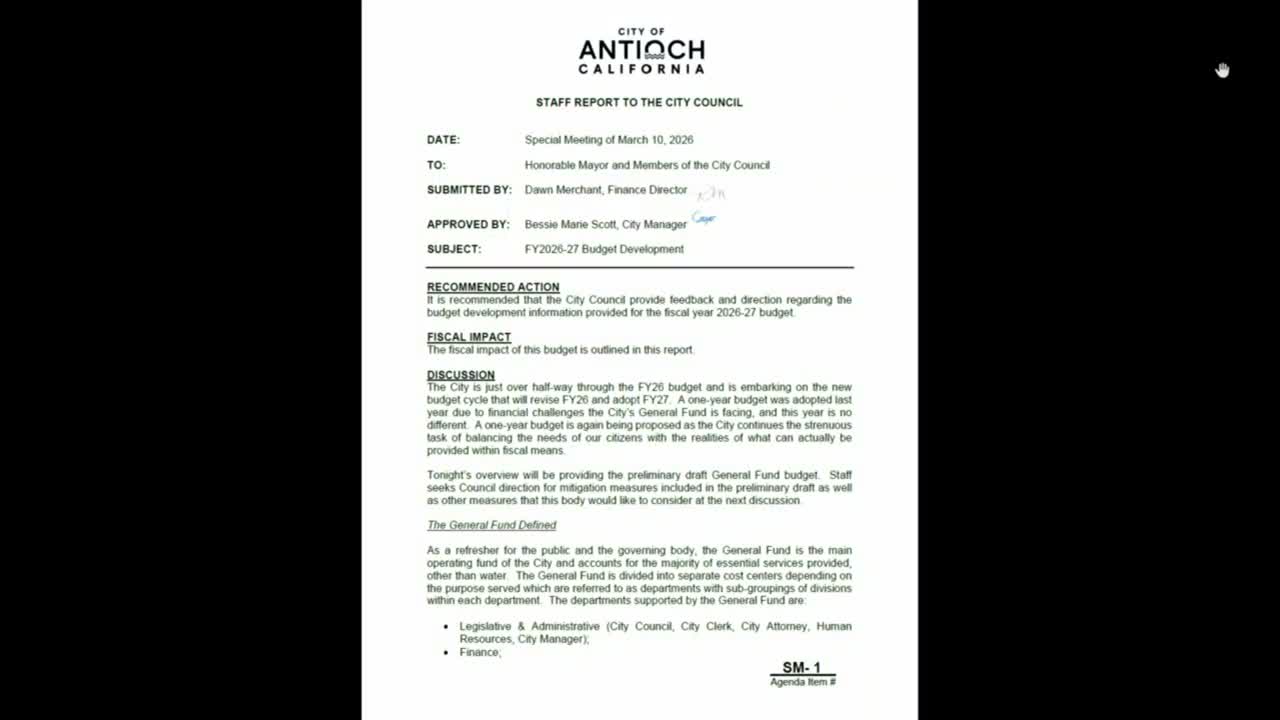
The Antioch City Council gathered March 10 for a special study session to kick off development of the fiscal year 2026–27 budget and to question staff about options to narrow a multi‑million‑dollar gap.
Finance staff presented a revised one‑year approach, telling council the General Fund remains above the city’s 20% unassigned‑balance policy in the current year (reported at roughly 43.8%) because of a one‑time, $5 million draw from the budget stabilization fund. With the proposed adjustments, staff projected total deficit spending of about $11.38 million in fiscal 2026 and $13.57 million in fiscal 2027; each year assumes a $5 million offset from the stabilization fund with the remainder drawn from general reserves.
The presentation described drivers of the gap: slower sales‑tax growth, rising personnel costs as vacancies are refilled, and rising contributions for safety pensions and OPEB. Staff said an actuarial report indicates no additional cash contribution for OPEB in FY27 but cautioned that unfunded liabilities remain material. The finance director also noted the city’s reliance on taxes (roughly 83% of revenues in FY26 and 85% in FY27) and urged early planning to address the sunset of a local 1% sales‑tax measure in the late 2030s.
Council members pressed for detail on several fronts. They asked for a clearer breakdown of the police personnel figures — how many sworn positions translate into street patrol compared with command and investigative assignments — after staff explained 105 budgeted positions versus previous authorizations near 115. Several members urged staff to present options to close the structural gap, including targeted program reductions, vacancy freezes (already used in draft numbers), potential new fee revenue from a user‑fee study under way, and an examination of centralized purchasing to reduce costs.
Staff said a follow‑up report will include mitigation options and a more detailed schedule; council directed staff to return with recommended actions and cost‑estimates to help the council weigh priorities as the budget process advances.
The study session closed with additional questions about departmental transfers, franchise revenues, and the forthcoming user‑fee study; staff said the study’s draft will be ready for council review in late April. No formal votes on the budget were taken at the study session.