Get Full Government Meeting Transcripts, Videos, & Alerts Forever!
Get email alerts on the Housing Policy topic
No spam. Unsubscribe anytime.
Oakley council directs staff to draft downtown short‑term rental changes under SB 346
Summary
Following a work session on SB 346, council directed staff to draft ordinance language to implement the law’s reporting requirements and to explore allowing unhosted or vacation stays in parts of downtown, while requesting law‑enforcement input and data from comparable cities.
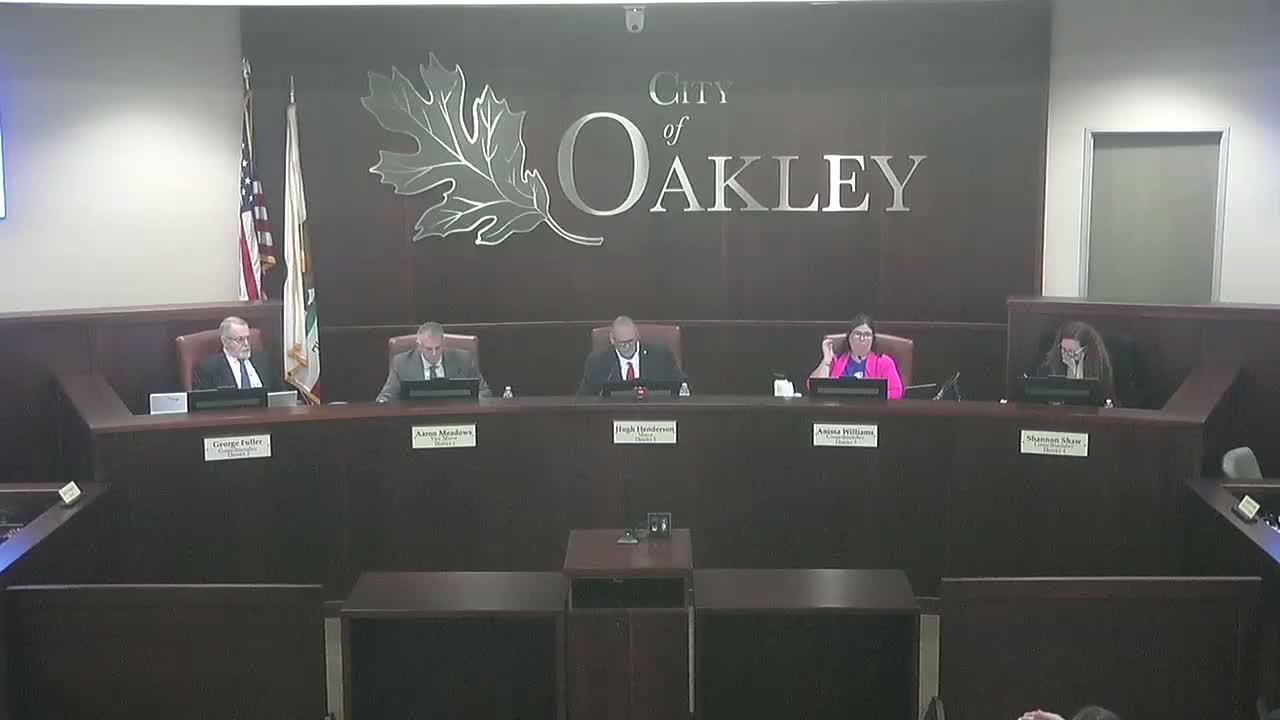
The Oakley City Council held a work session on Feb. 10 to consider whether to allow unhosted short‑term rentals in portions of the downtown specific plan and to update the local ordinance to implement state law SB 346.
Community Development Director Kentrilo said SB 346 requires facilitators such as Airbnb and VRBO to provide cities with quarterly listings and to display transient occupancy tax information and license numbers to improve enforcement. Kentrilo explained Oakley’s current code allows only hosted stays (where the owner is present) and prohibits vacation rentals and unhosted stays.
“SB346 essentially allows for cities to require facilitators such as Airbnb, VRBO to provide the city with information as to which listings are registered on their website,” Kentrilo told the council. Staff reported roughly 200 existing residential units within the downtown specific plan footprint and said permitting unhosted stays or vacation rentals could require additional enforcement and local standards.
Councilmembers discussed potential benefits — including attracting participants in local fishing and sports tournaments and generating transient occupancy tax revenue — and potential costs, such as extra code‑enforcement and police responses. Vice Mayor Meadows said she favored allowing vacation rentals in the downtown and noted potential local demand related to tournaments.
Council generally directed staff to prepare a packet and draft ordinance language for the Planning Commission that would include SB 346 reporting requirements, research on enforcement impacts, potential fee levels (existing permits are roughly $109 annually plus business-license costs) and comparisons with similar cities.
What’s next: Staff will prepare an ordinance draft with SB 346 language, collect law‑enforcement data and provide examples from comparable jurisdictions before the Planning Commission and subsequent council review.